Gutscheinbedingungen

**Gültig bis 25.06.2026 auf fremdsprachige Bücher online auf thalia.at und in der Thalia App. Einzelne Artikel können ausgeschlossen sein. Ausgenommen sind preisgebundene Artikel & eBooks. Pro Einkauf einmal einlösbar. Click & Collect nur bei Onlinevorabzahlung möglich. Keine Barauszahlung. Nicht kombinierbar mit anderen Aktionen und Gutscheinen. Gutschein wird auf max. 500€ Bestellwert angerechnet. Nicht gültig für Geschenkkarten, Versandkosten und Services.

Produktbild: Next-Generation High-Speed Electronics and Optoelectronics
- 12%

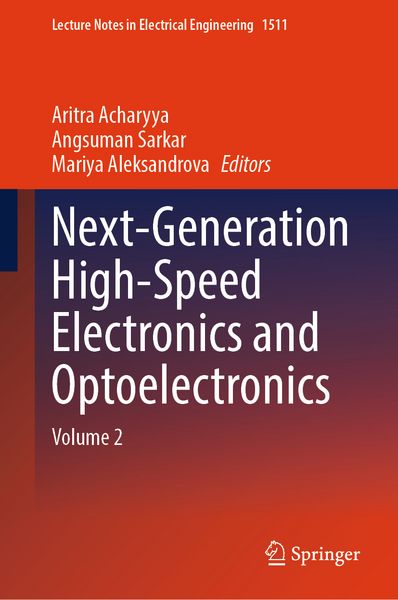
Next-Generation High-Speed Electronics and Optoelectronics Volume 2

12% sparen

192,99 € UVP 219,99 €

inkl. gesetzl. MwSt., Versandkostenfrei


Beschreibung

Produktdetails

Einband

Gebundene Ausgabe

Erscheinungsdatum

03.01.2026

Abbildungen

XIX, 202 illus., 178 illus. in color., schwarz-weiss Illustrationen, farbige Illustrationen

Herausgeber

Aritra Acharyya + weitere

Verlag

Springer Singapore

Seitenzahl

544

Maße (L/B/H)

24,1/16/3,4 cm

Gewicht

1049 g

Auflage

1. Auflage

Sprache

Englisch

ISBN

978-981-9544-14-1

Beschreibung

Portrait

Dr. Aritra Acharyya is Assistant Professor in the Department of Electronics and Communication Engineering at Kalyani Government Engineering College, West Bengal, since July 2024. He previously served as Assistant Professor in the Department of ECE, Cooch Behar Government Engineering College, from May 2016 to July 2024. Born in 1986, he received his B.E. from IIEST Shibpur in 2007, M.Tech. from the Institute of Radio Physics and Electronics, University of Calcutta, in 2010, and Ph.D. from the same institute in 2016. His research interests include high-frequency semiconductor devices, nanostructures, semiconductor physics, transport phenomena, quantum mechanics, and optoelectronics. He has published 102 papers in peer-reviewed journals, 72 papers in national and international conference proceedings, and several book chapters. He has also authored and edited 14 books. 

Dr. Angsuman Sarkar is Professor and Head of Electronics and Communication Engineering at Kalyani Government Engineering College, West Bengal. He previously served at Jalpaiguri GEC and KGEC as Lecturer, Assistant, and Associate Professor for over 23 years. He earned his M.Tech. in VLSI and microelectronics and Ph.D. from Jadavpur University. His research focuses on short-channel effects of sub-100 nm MOSFETs and nano device modeling. He is Senior Member of IEEE, Fellow of IE(I) and IETE, Life Member of ISTE, and Former Chairman of IEEE EDS Kolkata Chapter. He has authored 6 books, 23 book chapters, 110 international journal papers, and 68 conference papers. Featured in the “World Ranking of Top 2% Scientists” in Nanoscience and Nanotechnology by Stanford University and Elsevier, he also serves on editorial boards and reviews for leading journals. Currently, he supervises 8 Ph.D. scholars and has guided 9 to completion. 

Dr. Mariya Aleksandrova is Associate Professor of Fabrication Technology of Electronics at the Department of Microelectronics, Technical University of Sofia. She received her master’s in electronic engineering in 2007 and Ph.D. in 2010, focusing on interface optimization in organic light-emitting devices. After five years as Assistant Professor, she became Associate Professor in 2015. Her research has evolved from flexible polymeric light-emitting devices to flexible and wearable electronics, energy harvesting, and thin-film supercapacitors integrated with PCBs. Since 2018, her group has emphasized energy harvesting technologies. She leads the laboratories “Thin-film Electronics,” “Photolithography,” and “Quality and Reliability in Automotive Electronics.” Dr. Aleksandrova has designed seven core curricula at the Faculty of Electronic Engineering and Technology, including courses on micro- and nanosystems, thin-film electronics, and energy harvesting technologies. She has contributed to numerous national and international projects and authored 3 books, 5 book chapters, and over 120 peer-reviewed papers.

Produktdetails

Einband

Gebundene Ausgabe

Erscheinungsdatum

03.01.2026

Abbildungen

XIX, 202 illus., 178 illus. in color., schwarz-weiss Illustrationen, farbige Illustrationen

Herausgeber

Verlag

Springer Singapore

Seitenzahl

544

Maße (L/B/H)

24,1/16/3,4 cm

Gewicht

1049 g

Auflage

1. Auflage

Sprache

Englisch

ISBN

978-981-9544-14-1

Herstelleradresse

Springer-Verlag GmbH
Tiergartenstr. 17
69121 Heidelberg
DE

Email: ProductSafety@springernature.com

Kundinnen und Kunden meinen

0 Bewertungen

Informationen zu Bewertungen

Zur Abgabe einer Bewertung ist eine Anmeldung im Konto notwendig. Die Authentizität der Bewertungen wird von uns nicht überprüft. Wir behalten uns vor, Bewertungstexte, die unseren Richtlinien widersprechen, entsprechend zu kürzen oder zu löschen.

Die Bewertungen sind nach Format, Anzahl Sterne und Datum sortiert.

Verfassen Sie die erste Bewertung zu diesem Artikel

Helfen Sie anderen Kund*innen durch Ihre Meinung

Kundinnen und Kunden meinen

0 Bewertungen filtern

  • Produktbild: Next-Generation High-Speed Electronics and Optoelectronics
  • Introduction to Next-Generation High-Speed Electronics and Optoelectronics (Vol. 2).- Emerging Devices and Materials.- Nanotechnology in Electronic Devices.- Bending Light through Time and Space: A Translational Symmetry Perspective on Entangled Anti-nodal Dynamics.- Translational Symmetry of Intermediate Nodes in Entangled Particles: A New Perspective on Quantum Communication.- Silicon Carbide-Based Triple-Metal GAA MOSFETs: Analytical Insights into Electrical and Analog Performance.- Enhanced Reliability Architecture for VLSI Systems Using IRMC Algorithm for Error Detection and Correction.- Enhanced Non-Line-of-Sight Scattering Channel Modelling for MIMO-Based Underwater Wireless Optical Communication.- A Cryogenically Robust Bandgap Reference with Sub-2 ppm/°C Temperature Coefficient and High PSRR for Space-Grade and Low-Temperature Power Management ICs.- High-Linearity Al0.3Ga0.7N/GaN HEMTs for Spectrum-Efficient Millimetre-wave (m-Wave) IoE Networks.- Design and Analysis of a Photonic Crystal Gas Sensor using Machine Learning Approach.- Hardware-Efficient VLSI Implementation of Self-Attention Transformers for Natural Language Processing.- Brief Overview of Transition Metal Dichalcogenides (TMDs) as an Anode Material for Rechargeable Batteries.- Radiation Response of InAs Quantum Well n-MOSFETs: Role of Geometry and Bias.