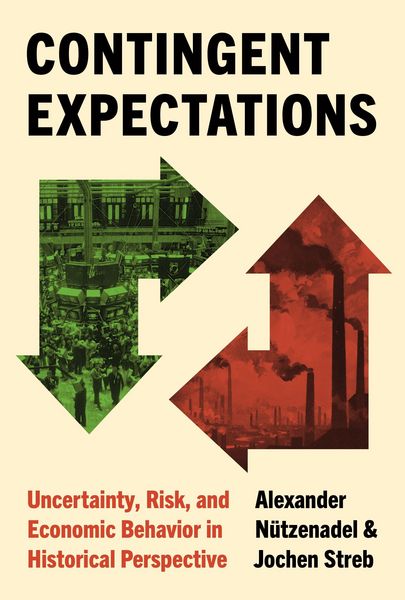
Contingent Expectations Uncertainty, Risk, and Economic Behavior in Historical Perspective
44,99 €
inkl. gesetzl. MwSt.,
Beschreibung
Produktdetails
Einband
Gebundene Ausgabe
Erscheinungsdatum
14.07.2026
Verlag
University PressesSeitenzahl
312
Maße (L/B)
23,5/15,6 cm
Sprache
Englisch
ISBN
978-0-691-24853-0
An empirical analysis and new theoretical framework for understanding economic expectations and decision-making in different historical settings.
Expectations play a crucial role in shaping economic behavior. But how are expectations actually formed, and how has this changed over time? The financial crisis of 2007–08 cast doubt on traditional theories of expectation formation, particularly the rational expectations framework. In Contingent Expectations, Alexander Nützenadel and Jochen Streb examine the ways that past experiences influence the economic expectations and decision-making of households, investors, and policymakers through history, and offer an alternative perspective. Combining a comprehensive empirical analysis of expectation formation from the eighteenth century to the present day with an assessment of the relevant economic theory, Nützenadel and Streb present a new theoretical framework, contingent expectations, for understanding economic expectation.
Nützenadel and Streb show how economic actors developed new forecasting methods in response to rising uncertainty brought on by the Industrial Revolution, the expansion of global trade, financial market integration, and environmental crises. Tracing the evolution of economic theories on expectations, they find that when growing market volatility made forecasting more complex, economic agents often adapted with remarkable flexibility to changing circumstances. Challenging prevailing concepts of expectations, including rational choice and adaptive expectations, Nützenadel and Streb emphasize the heterogeneity of economic agents’ cognitive practices—in particular, the need to consider variation in information costs and historical experience. Expectation formation, they argue, is contingent on each individual’s current decision-making situation. Their account of the history of economic expectations has significant implications for current debates in economics.
Kundinnen und Kunden meinen
Verfassen Sie die erste Bewertung zu diesem Artikel
Helfen Sie anderen Kund*innen durch Ihre Meinung
Kurze Frage zu unserer Seite
Vielen Dank für Ihr Feedback
Wir nutzen Ihr Feedback, um unsere Produktseiten zu verbessern. Bitte haben Sie Verständnis, dass wir Ihnen keine Rückmeldung geben können. Falls Sie Kontakt mit uns aufnehmen möchten, können Sie sich aber gerne an unseren Kund*innenservice wenden.
zum Kundenservice