Gutscheinbedingungen

**Gültig bis 25.06.2026 auf fremdsprachige Bücher online auf thalia.at und in der Thalia App. Einzelne Artikel können ausgeschlossen sein. Ausgenommen sind preisgebundene Artikel & eBooks. Pro Einkauf einmal einlösbar. Click & Collect nur bei Onlinevorabzahlung möglich. Keine Barauszahlung. Nicht kombinierbar mit anderen Aktionen und Gutscheinen. Gutschein wird auf max. 500€ Bestellwert angerechnet. Nicht gültig für Geschenkkarten, Versandkosten und Services.

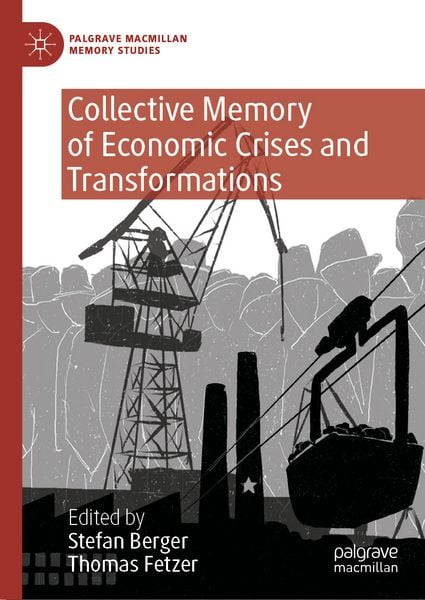
Produktbild: Collective Memory of Economic Crises and Transformations
- 11%

Collective Memory of Economic Crises and Transformations

11% sparen

135,99 € UVP 153,99 €

inkl. gesetzl. MwSt., Versandkostenfrei


Beschreibung

Produktdetails

Einband

Gebundene Ausgabe

Erscheinungsdatum

08.02.2026

Abbildungen

XIII, 8 illus., 7 illus. in color., farbige Illustrationen, schwarz-weiss Illustrationen

Herausgeber

Stefan Berger + weitere

Verlag

Springer

Seitenzahl

247

Maße (L/B/H)

21,6/15,3/1,9 cm

Gewicht

435 g

Sprache

Englisch

ISBN

978-3-032-09093-5

Beschreibung

Portrait

Stefan Berger is Professor of Social History and Director of the Institute for Social Movements at Ruhr-Universität Bochum. He is also executive chair of the Foundation History of the Ruhr and Honorary Professor at Cardiff University in the UK. He has published widely on nationalism, memory, deindustrialization, industrial heritage and the history of historiography. His latest monograph is History and Identity: How Historical Theory Shaped Historical Practice (2022).

Thomas Fetzer is Associate Professor at the Department of International Relations, Central European University. His research and publications focus on social and cultural dimensions of international economic integration. He is particularly interested in the relationship between nationalism and political economy. Publications include Paradoxes of Internationalization: British and German trade unions at Ford and General Motors, 1967–2000 (2012), and, as co-editor (with Stefan Berger), Nationalism and Economy: Explorations into a Neglected Relationship (2019).

Produktdetails

Einband

Gebundene Ausgabe

Erscheinungsdatum

08.02.2026

Abbildungen

XIII, 8 illus., 7 illus. in color., farbige Illustrationen, schwarz-weiss Illustrationen

Herausgeber

Verlag

Springer

Seitenzahl

247

Maße (L/B/H)

21,6/15,3/1,9 cm

Gewicht

435 g

Sprache

Englisch

ISBN

978-3-032-09093-5

Herstelleradresse

Springer-Verlag GmbH
Tiergartenstr. 17
69121 Heidelberg
DE

Email: ProductSafety@springernature.com

Kundinnen und Kunden meinen

0 Bewertungen

Informationen zu Bewertungen

Zur Abgabe einer Bewertung ist eine Anmeldung im Konto notwendig. Die Authentizität der Bewertungen wird von uns nicht überprüft. Wir behalten uns vor, Bewertungstexte, die unseren Richtlinien widersprechen, entsprechend zu kürzen oder zu löschen.

Die Bewertungen sind nach Format, Anzahl Sterne und Datum sortiert.

Verfassen Sie die erste Bewertung zu diesem Artikel

Helfen Sie anderen Kund*innen durch Ihre Meinung

Kundinnen und Kunden meinen

0 Bewertungen filtern

  • Produktbild: Collective Memory of Economic Crises and Transformations
  • .- Introduction: Collective Memory in the Context of Economic Crises and Transformations.- Part I Cyclical Economic Crises.- Battles of Narratives, Battles of Memory: Making Sense of the Ebbs and Flows of the Memory of the Great Depression.- Collective Famine Memories and the Economies of Catastrophe.- Part II Structural Change of Industrial Societies.- Industrial Heritage as a Consequence of Structural Economic Transformations: Rival Conceptualizations in Comparative Perspective.- Industrial Mnemoscapes of Post-Socialism: Heritage Legacies and Diverging Economic Memories.- Part III Systematic Political Transformations.- To Remember Impossible to Forget: The Memory of Entrepreneurship in the Late 19th – Early 21st Century in Ukraine.- Memories of Empire and Embedded Banking: Austrian Bankers Investing in Central Eastern Europe in the 1990s.- Part IV Economic Internationalization.- Impact of the Memory of Kaikoku (Opening the Country to the World) on the Course of Industrialization in Early Meiji Japan.- Harking Back to the ‘Golden Age’ of National Economies: German Memory Narratives in Times of Economic Internationalization.- Conclusions: Mapping the Economy/Memory Nexus – Themes and Future Agendas.