Gutscheinbedingungen

**Gültig bis 25.06.2026 auf fremdsprachige Bücher online auf thalia.at und in der Thalia App. Einzelne Artikel können ausgeschlossen sein. Ausgenommen sind preisgebundene Artikel & eBooks. Pro Einkauf einmal einlösbar. Click & Collect nur bei Onlinevorabzahlung möglich. Keine Barauszahlung. Nicht kombinierbar mit anderen Aktionen und Gutscheinen. Gutschein wird auf max. 500€ Bestellwert angerechnet. Nicht gültig für Geschenkkarten, Versandkosten und Services.

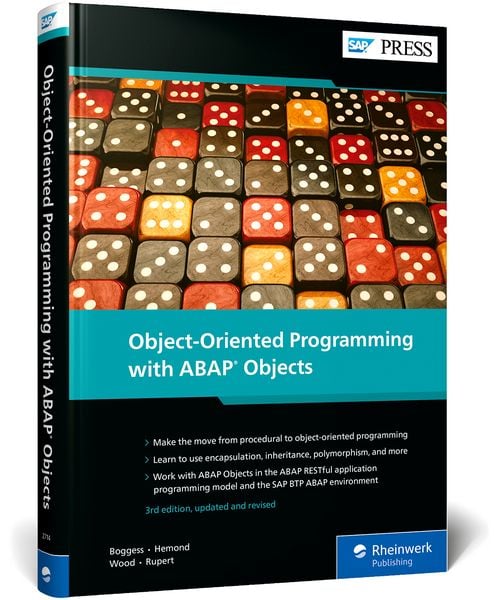
Produktbild: Object-Oriented Programming with ABAP Objects

Object-Oriented Programming with ABAP Objects

Aus der Reihe SAP Press Englisch

92,50 €

inkl. gesetzl. MwSt., Versandkostenfrei


Beschreibung

Produktdetails

Einband

Gebundene Ausgabe

Erscheinungsdatum

05.04.2026

Verlag

Rheinwerk Publishing

Seitenzahl

443

Maße (L/B/H)

26/18,3/2,7 cm

Gewicht

958 g

Auflage

3. Auflage

Sprache

Englisch

ISBN

978-1-4932-2714-3

Beschreibung

Produktdetails

Einband

Gebundene Ausgabe

Erscheinungsdatum

05.04.2026

Verlag

Rheinwerk Publishing

Seitenzahl

443

Maße (L/B/H)

26/18,3/2,7 cm

Gewicht

958 g

Auflage

3. Auflage

Sprache

Englisch

ISBN

978-1-4932-2714-3

Herstelleradresse

Rheinwerk Verlag GmbH
Rheinwerkallee 4
53227 Bonn
DE

Email: service@rheinwerk-verlag.de

Kundinnen und Kunden meinen

0 Bewertungen

Informationen zu Bewertungen

Zur Abgabe einer Bewertung ist eine Anmeldung im Konto notwendig. Die Authentizität der Bewertungen wird von uns nicht überprüft. Wir behalten uns vor, Bewertungstexte, die unseren Richtlinien widersprechen, entsprechend zu kürzen oder zu löschen.

Die Bewertungen sind nach Format, Anzahl Sterne und Datum sortiert.

Verfassen Sie die erste Bewertung zu diesem Artikel

Helfen Sie anderen Kund*innen durch Ihre Meinung

Kundinnen und Kunden meinen

0 Bewertungen filtern

  • Produktbild: Object-Oriented Programming with ABAP Objects
  • ... Preface ... 17

    ... Target Group and Prerequisites ... 17

    ... Structure of the Book ... 17

    ... Conventions ... 19

    ... Source Code and Examples ... 20

    ... Acknowledgments ... 20

    1 ... Introduction to Object-Oriented Programming ... 23

    1.1 ... The Need for a Better Abstraction ... 23

    1.2 ... Classes and Objects ... 25

    1.3 ... Establishing Boundaries ... 29

    1.4 ... Reuse ... 31

    1.5 ... Object Management ... 34

    1.6 ... UML Tutorial: Class Diagram Basics ... 35

    1.7 ... Summary ... 40

    2 ... Working with Objects ... 41

    2.1 ... Defining Classes ... 41

    2.2 ... Working with Objects ... 51

    2.3 ... Building Your First Object-Oriented Program ... 70

    2.4 ... Working with Global Classes ... 76

    2.5 ... Developing Classes Using ABAP Development Tools ... 88

    2.6 ... Working with Constructor Expressions ... 101

    2.7 ... UML Tutorial: Object Diagrams ... 104

    2.8 ... Summary ... 106

    3 ... Encapsulation and Implementation Hiding ... 107

    3.1 ... Lessons Learned from Procedural Programming ... 107

    3.2 ... Data Abstraction with Classes ... 116

    3.3 ... Defining Component Visibilities ... 117

    3.4 ... Hiding the Implementation ... 123

    3.5 ... Designing by Contract ... 124

    3.6 ... UML Tutorial: Sequence Diagrams ... 125

    3.7 ... Summary ... 126

    4 ... Object Initialization and Cleanup ... 129

    4.1 ... Understanding the Object Creation Process ... 129

    4.2 ... Working with Constructors ... 133

    4.3 ... Taking Control of the Instantiation Process ... 137

    4.4 ... Garbage Collection ... 143

    4.5 ... Tuning Performance ... 144

    4.6 ... UML Tutorial: State Machine Diagrams ... 146

    4.7 ... Summary ... 147

    5 ... Inheritance and Composition ... 149

    5.1 ... Generalization and Specialization ... 149

    5.2 ... Inheriting Components ... 159

    5.3 ... The Abstract and Final Keywords ... 166

    5.4 ... Inheritance Versus Composition ... 173

    5.5 ... Working with ABAP Refactoring Tools ... 176

    5.6 ... UML Tutorial: Advanced Class Diagrams, Part I ... 179

    5.7 ... Summary ... 182

    6 ... Polymorphism ... 183

    6.1 ... Object Reference Assignments Revisited ... 183

    6.2 ... Dynamic Method Call Binding ... 189

    6.3 ... Interfaces ... 191

    6.4 ... UML Tutorial: Advanced Class Diagrams, Part II ... 207

    6.5 ... Summary ... 209

    7 ... Component-Based Design Concepts ... 211

    7.1 ... Understanding SAP’s Component Model ... 211

    7.2 ... The Package Concept ... 214

    7.3 ... Package Design Concepts ... 233

    7.4 ... UML Tutorial: Package Diagrams ... 235

    7.5 ... Summary ... 237

    8 ... Error Handling with Exception Classes ... 239

    8.1 ... Lessons Learned from Prior Approaches ... 239

    8.2 ... The Class-Based Exception Handling Concept ... 241

    8.3 ... Creating Exception Classes ... 243

    8.4 ... Dealing with Exceptions ... 250

    8.5 ... Raising and Forwarding Exceptions ... 255

    8.6 ... UML Tutorial: Activity Diagrams ... 267

    8.7 ... Summary ... 269

    9 ... Unit Tests with ABAP Unit ... 271

    9.1 ... ABAP Unit Overview ... 271

    9.2 ... Creating Unit Test Classes ... 274

    9.3 ... Assertions in ABAP Unit ... 280

    9.4 ... Managing Dependencies ... 283

    9.5 ... Case Study: Creating a Unit Test in ABAP Unit ... 288

    9.6 ... Executing Unit Tests ... 291

    9.7 ... Evaluating Unit Test Results ... 294

    9.8 ... Measuring Code Coverage ... 294

    9.9 ... Moving Toward Test-Driven Development ... 296

    9.10 ... Behavior-Driven Development ... 296

    9.11 ... UML Tutorial: Use Case Diagrams ... 297

    9.12 ... Summary ... 301

    10 ... Business Object Development with BOPF ... 303

    10.1 ... What Is BOPF? ... 303

    10.2 ... Anatomy of a Business Object ... 305

    10.3 ... Working with the BOPF Client API ... 319

    10.4 ... Where to Go from Here ... 330

    10.5 ... UML Tutorial: Advanced Sequence Diagrams ... 331

    10.6 ... Summary ... 334

    11 ... ABAP RESTful Application Programming Model ... 335

    11.1 ... Introduction ... 335

    11.2 ... CDS and SAP Gateway Service Bindings ... 347

    11.3 ... Modeling Behavior Using Object-Oriented Techniques ... 350

    11.4 ... Summary ... 370

    12 ... ABAP Cloud ... 371

    12.1 ... Introduction to SAP Business Technology Platform ... 372

    12.2 ... ABAP Environment Overview ... 377

    12.3 ... Setting Up Your Cloud Development Environment ... 386

    12.4 ... Case Study: Implementing ABAP RESTful Application Programming Model Elements via ABAP Cloud ... 395

    12.5 ... Summary ... 397

    13 ... Best Practices and Design Patterns ... 399

    13.1 ... Object-Oriented Analysis and Design ... 399

    13.2 ... Creational Patterns ... 401

    13.3 ... Structural Patterns ... 408

    13.4 ... Behavioral Patterns ... 419

    13.5 ... Summary ... 425

    A ... Installing the Eclipse IDE ... 427

    A.1 ... Installing the Java SDK ... 427

    A.2 ... Installing Eclipse ... 428

    A.3 ... Installing the ABAP Development Tools ... 430

    A.4 ... Where to Go to Find Help ... 432

    B ... The Authors ... 433

    ... Index ... 435