Beschreibung
Produktdetails
Einband
Gebundene Ausgabe
Erscheinungsdatum
07.11.2025
Abbildungen
XV, 365 p. 42 illus., 41 illus. in color.
Herausgeber
Noushina Iqbal + weitereVerlag
Springer SingaporeSeitenzahl
365
Maße (L/B/H)
24,1/16/2,7 cm
Gewicht
738 g
Auflage
1. Auflage
Sprache
Englisch
ISBN
978-981-9533-76-3
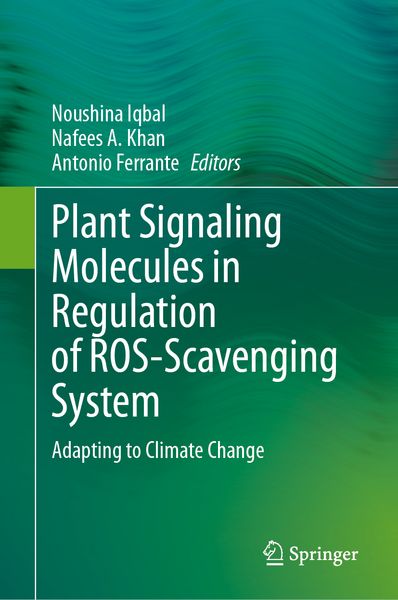
This contributed volume provides a comprehensive understanding of the complex interplay between signaling molecules and ROS-scavenging systems in the adaptation of plants to climate change. Plants produce reactive oxygen species (ROS) like superoxide radicals (O2.-) and hydrogen peroxide (H
2
O
2
), especially under stress, which can cause oxidative damage and cell death. ROS homeostasis is maintained by a ROS-scavenging system, consisting of enzymatic antioxidants and non-enzymatic antioxidants. This system is vital for physiological processes and stress tolerance in plants.
Signaling molecules are crucial in plant growth, development, and environmental responses. The abiotic stress perception triggers signaling events involving calcium ions (Ca²⁺), ROS, and phytohormones like abscisic acid (ABA). Mitogen-activated protein kinase (MAPK) cascades also play a key role, where a series of phosphorylation events activate genes involved in antioxidant defense. ROS scavenging is regulated by phytohormones and signaling molecules, including auxins, gibberellins, cytokinins, ABA, ethylene, salicylic acid, melatonin, H
2
S, H
2
O
2
, nitric oxide, and brassinosteroids. These molecules interact to enhance stress resilience through ROS scavenging. Additionally, plant growth-promoting rhizobacteria (PGPR) work with phytohormones to alleviate stress. Integrative approaches combining molecular biology, genomics, and systems biology are needed to understand the crosstalk between stress signaling and ROS regulation. CRISPR/Cas9 gene editing dissects gene functions in ROS regulation, while omics approaches (transcriptomics, proteomics, metabolomics) provide insights into plant stress responses. This book focusses on the mechanisms that drive plant responses to changing environmental conditions, and the potential to harness this knowledge to develop resilient crop varieties.
This book is an essential read for academicians, researchers, and scientists working in the field of plant biology, plant physiology, plant stress physiology, plant molecular biology and agronomy.
Noch keine Bewertungen vorhanden
Verfassen Sie die erste Bewertung zu diesem Artikel
Helfen Sie anderen Kundinnen und Kunden durch Ihre Meinung.
Kurze Frage zu unserer Seite
Vielen Dank für Ihr Feedback
Wir nutzen Ihr Feedback, um unsere Produktseiten zu verbessern. Bitte haben Sie Verständnis, dass wir Ihnen keine Rückmeldung geben können. Falls Sie Kontakt mit uns aufnehmen möchten, können Sie sich aber gerne an unseren Kund*innenservice wenden.
zum Kundenservice