KI-Beratung Beta

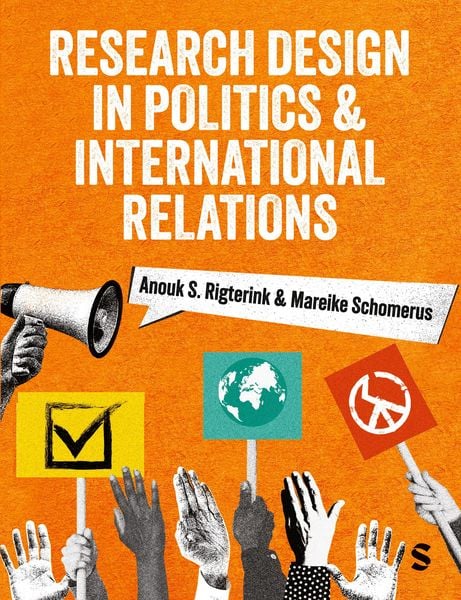
Produktbild: Research Design in Politics and International Relations
- 14%

Research Design in Politics and International Relations

14% sparen

43,99 € UVP 51,20 €

inkl. gesetzl. MwSt., Versandkostenfrei


Beschreibung

This textbook offers the definitive guide to starting your research project in Politics and IR. It shows how methods come alive when applied to real political dilemmas and offers an accessible framework to help make intentional and considered choices across all stages of research from formulating a question...

Beschreibung

This textbook offers the definitive guide to starting your research project in Politics and IR. It shows how methods come alive when applied to real political dilemmas and offers an accessible framework to help make intentional and considered choices across all stages of research from formulating a question to selecting a design, collecting data, and analysing results.
Rigterink and Schomerus introduce seven core research designs spanning discourse analysis and ethnography to quasi-experiments and process tracing through contemporary political topics such as violent conflict, the environment and political protests.
What sets this book apart is starting with topics rather than methods, so you ll learn how to research real-world issues like climate change, inequality, or war, and see how different research designs can help you understand them. It s also honest about the challenges of research, offering practical strategies to overcome distractions, doubts, and demotivation. 
Ideal for undergraduate and postgraduate students, this book is as much a practical manual as a conceptual map for navigating the terrain of political research that makes doing research manageable and enjoyable.
Anouk S. Rigterink is Associate Professor in Quantitative Comparative Politics, at Durham University, UK. 
Mareike Schomerus is VP at Busara, a research institute headquartered in Kenya, and a Visiting Lecturer at the University of Chicago Harris School of Public Policy, USA.
 

Rezension

The approach is original, the figure help clarify complex theorethical approaches and the boxes are useful and provide clear insights into up-to-date case studies. One of the most innovative that I have recently come across. Required reading.
Alexandra Dias 20260303

Produktdetails

Einband

Taschenbuch

Erscheinungsdatum

27.02.2026

Verlag SAGE Publications
Seitenzahl

482

Produktdetails

Einband

Taschenbuch

Erscheinungsdatum

27.02.2026

Verlag SAGE Publications
Seitenzahl

482

Maße (L/B/H)

24,6/18,9/2,6 cm

Gewicht

924 g

Auflage

1. Auflage

Sprache

Englisch

ISBN

978-1-5296-8530-5

EU-Ansprechpartner

Kolibri 360 GmbH
Ettore-Bugatti-Straße 6-14
51149 Köln
DE
produktsicherheit@kolibri360.de

Herstelleradresse

SAGE Publications
1 Oliver's Yard 55 City Road
EC1Y 1SP London
GB
orders@sagepub.co.uk

Noch keine Bewertungen vorhanden

Verfassen Sie die erste Bewertung zu diesem Artikel

Helfen Sie anderen Kundinnen und Kunden durch Ihre Meinung.

Kundinnen und Kunden meinen

Bewertungen (0)

Die Leseprobe wird geladen.
  • Produktbild: Research Design in Politics and International Relations
  • Chapter 1: Introduction: Let's find out what this is all about
    Chapter 2: The rewards of a research mindset
    Chapter 3: The research process
    Chapter 4: How do you know? Your epistemology
    Chapter 5: Formulating a research question and contributing to the literature
    Chapter 6: Theories and concepts
    Chapter 7: On the case: Cases, case selection and case studies
    Chapter 8: Knowledge hierarchies: Why you see things the way you do
    Chapter 9: The ethics of research
    Chapter 10: Testing causes: Quasi-experiments to study polarisation
    Chapter 11: Systematically together: Covariation to study voting
    Chapter 12: How does one thing lead to another? Process tracing to study social movements and protests
    Chapter 13: Compiling knowledge: Systematic reviews to study climate and the environment
    Chapter 14: Researching customs, practices and expressions: Using ethnography to study identity
    Chapter 15: Experiences, feelings and perceptions: Phenomenology to study inequality
    Chapter 16: Text as action: Discourse analysis to study war and violent conflict
    Chapter 17: Data collection with human participants: Who, how and why
    Chapter 18: Data collection without human participants
    Chapter 19: Qualitative data analysis
    Chapter 20: Quantitative data analysis
    Chapter 21: The final page - only to go back to the beginning