Gutscheinbedingungen

**Gültig bis 06.07.2026 auf fremdsprachige Bücher online auf thalia.at, in der Thalia App ab einem Mindestbestellwert von 30€ und in allen Thalia Buchhandlungen in Österreich. In den Buchhandlungen nur gültig auf lagernde Ware. Einzelne Artikel können ausgeschlossen sein. Ausgenommen sind preisgebundene Artikel & eBooks. Pro Einkauf einmal einlösbar. Nur gültig gegen Vorlage oder im Onlineshop hinterlegter Bonuscard. Infos zur Einlösung in der Buchhandlung sind auf der Bonuscard-Vorteilspreisseite zu finden. Click & Collect nur bei Onlinevorabzahlung möglich. Keine Einlösung bei Scan & Go-Bezahlung. Keine Barauszahlung. Nicht kombinierbar mit anderen Aktionen und Gutscheinen. Gutschein wird auf max. 500€ Bestellwert angerechnet. Nicht gültig für Versandkosten und Services.

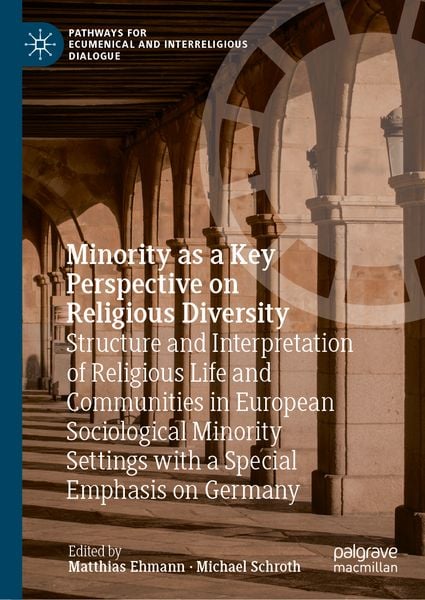
Produktbild: Minority as a Key Perspective on Religious Diversity
- 12%

Minority as a Key Perspective on Religious Diversity Structure and Interpretation of Religious Life and Communities in European Sociological Minority Settings with a Special Emphasis on Germany

12% sparen

144,99 € UVP 164,99 €

inkl. gesetzl. MwSt., Versandkostenfrei


Beschreibung

Produktdetails

Einband

Gebundene Ausgabe

Erscheinungsdatum

03.01.2026

Abbildungen

XIV, 1 illus., schwarz-weiss Illustrationen

Herausgeber

Matthias Ehmann + weitere

Verlag

Springer

Seitenzahl

272

Maße (L/B/H)

21,6/15,3/2,1 cm

Gewicht

486 g

Sprache

Englisch

ISBN

978-3-032-08255-8

Beschreibung

Portrait

Matthias Ehmann is Professor of Mission Studies and Intercultural Theology at Ewersbach Theological University, Germany. His research engages with theologies of migration in ecumenical perspective (Theologien der Migration 2023), revivalist Protestant movements (Perspectives on the Study of Revivalist Protestantism in Europe 2024), global Christianity, and digital theology. Integrating empirical and theological approaches (Integrating Theory and Praxis in Empirical Missiology 2021), he explores the intersections of theology and religious studies, contributing to current debates on the role of religion in contemporary societies (Donald Rumsfeld, Slavoj Žižek, and Spirituality in Research 2024).

Michael Schroth is Professor for Practical Theology at the Ewersbach Theological University, Germany. His research focuses on interdenominational church theory (Freie evangelische Gemeinden, 2022), pastoral theology with an emphasis on the different actors in churches and congregations and their interdependence (Irgendwie ganz anders, aber irgendwie dann auch doch nicht, 2024) and the intersection between pastoral care and leadership (Seelsorgerin oder Leiterin?, 2023) as well as late modern leadership concepts and their relevance for congregations and churches.

Produktdetails

Einband

Gebundene Ausgabe

Erscheinungsdatum

03.01.2026

Abbildungen

XIV, 1 illus., schwarz-weiss Illustrationen

Herausgeber

Verlag

Springer

Seitenzahl

272

Maße (L/B/H)

21,6/15,3/2,1 cm

Gewicht

486 g

Sprache

Englisch

ISBN

978-3-032-08255-8

Herstelleradresse

Springer-Verlag GmbH
Tiergartenstr. 17
69121 Heidelberg
DE

Email: ProductSafety@springernature.com

Noch keine Bewertungen vorhanden

Verfassen Sie die erste Bewertung zu diesem Artikel

Helfen Sie anderen Kundinnen und Kunden durch Ihre Meinung.

Kundinnen und Kunden meinen

Bewertungen (0)

  • Produktbild: Minority as a Key Perspective on Religious Diversity
  • Chapter 1. Minority as a Key Perspective for Religious Diversity in Late Modernity and Typical Dynamics of Religious Minorities – Summarizing Observations from the Case Studies (Ehmann and Schroth).- Part 1: Historical Insights on Religious Minorities.- Chapter 2. “Come over to Macedonia and help us!” (Acts 16:9) – Reflections on the Sociological Composition of the First Church in Europe (Steyn).- Chapter 3. My foe’s foe is my ally – The Stylization of Minorities in the Trial of Augustin Bader (Schäfer).- Chapter 4. The Free Evangelical Churches as Minority Churches – Constellations, Perceptions, Polemics in the Early Period (19th Century) (Heiser).- Chapter 5. Religion and Politics of Minority Protestants in Nineteenth-Century Italy – Rèveil and Risorgimento Nation, 1825–1870 (Popa).- Part 2: Aspects of Christian Minority-Settings in the German Context.- Chapter 6. Continuity and Religious Identity in Sociological Minority Settings – the Example of the Free Evangelical Churches in Germany (Iff).- Chapter 7. Reforming Theology – Transition from the First Order Theology of Churches with African Backgrounds to Second Order Theology of Post-Migration Churches of African Backgrounds (Ahialey-Mawusi).- Chapter 8. Evangelization or Diaspora? – Eastern Orthodox Minorities in the West. The Example of Germany (Vlantis).- Chapter 9. Free Churches and Regional Churches as Part of German Church Culture – Observations, Backgrounds, and Theological-Intercultural Perspectives on a Tension in German Protestantism from a Practical-Ecclesiastical Perspective (Burkhardt).- Part 3: International and Interreligious Perspectives on Religious Minorities in Europe.- Chapter 10. Unmuting the British Gujarati Christian Convert Experience through Contextual Cultural Celebration of Rakshabandan (Reifsnider).- Chapter 11. Integration in Question – Muslim Women’s Challenges and Perspectives in Germany (Bakhshizadeh).- Chapter 12. “I still wrap my hijab” – Muslim Women’s Self-Organizing in a Post-Digital World (Farizani).- Part 4: Theoretical Conceptualization of Religious Minorities in Late Modernity.- Chapter 13. Migration, a Sociological Particle Accelerator for Denominational Minorities in the West – Perspectives from Theologies of Migration on Minority Settings (Ehmann).- Chapter 14. A (small) Gap in the Religious Market? – Free Churches and Further Religious Minorities in Germany in the Perspective of Modernization Theory (Schroth).