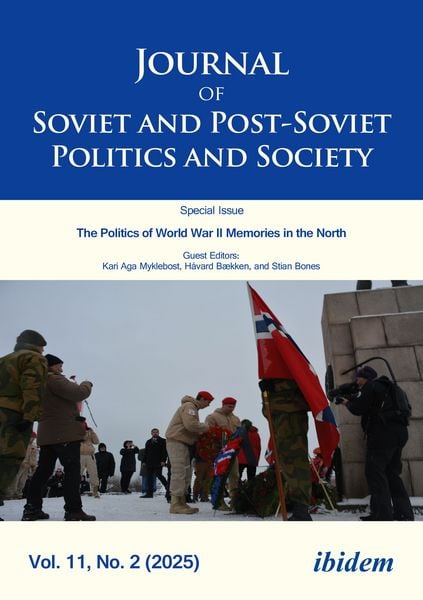
Journal of Soviet and Post-Soviet Politics and Society The Politics of World War II Memories in the North: Regional and Transborder Memory Politics in Russia and Norway. 2025/2
-
- Taschenbuch ausgewählt
- eBook
-
Sprache:Englisch
34,90 €
inkl. gesetzl. MwSt.,
Beschreibung
Produktdetails
Einband
Taschenbuch
Altersempfehlung
ab 12 Jahr(e)
Erscheinungsdatum
01.10.2025
Herausgeber
Kari Aga Myklebost + weitereVerlag
IbidemSeitenzahl
342
Maße (L/B/H)
21/14,8/1,9 cm
Gewicht
467 g
Auflage
1. Auflage
Sprache
Englisch
ISBN
978-3-8382-2055-0
Part I: Memory Politics in the Russian European North
Part II: Transborder Memory Politics: Russia and Norway
Featuring contributions by: Darya Aspøy; Håvard Bækken; Helge Blakkisrud; Stian Bones; Kristian Lundby Gjerde; Elena Kochetkova; Petia Mankova; Joakim Aalmen Markussen; Kari Aga Myklebost; Marianne Neerland Soleim; Artem Spirin
Over the past two decades, memory practices related to the Great Patriotic War have assumed an increasingly prominent position in Russian politics and identity-building, both in the domestic sphere and in the realm of foreign policy. Existing scholarship on Russian memory politics tends to concentrate overwhelmingly on the role of the Kremlin, while regional dynamics have received less attention. This special issue explores the Kremlin-driven politics of war memories as they unfold in the northernmost parts of Norway and European Russia, two regions that share not only a border but also a long history of interaction.
Across this border, we encounter two distinctly different social, cultural, and political contexts: on the one hand, Norway – a small, relatively homogenous, and stable welfare state; and on the other, Russia – a vast, complex, and increasingly authoritarian and neo-imperialist polity. By examining the construction and contestation of the past in a variety of regional and transborder settings, including museums, media, school curricula, libraries, and commemorative ceremonies, this issue explores the processes of negotiation, conflict, and adaptation among diverse mnemonic actors in the North.
The study of memory politics in this context sheds light on broader transformations within Russian politics, which has grown progressively more authoritarian while still remaining dependent on regional and local implementation. The cases discussed here further demonstrate how memory politics in Russia have become increasingly securitized over the past decades.
Noch keine Bewertungen vorhanden
Verfassen Sie die erste Bewertung zu diesem Artikel
Helfen Sie anderen Kundinnen und Kunden durch Ihre Meinung.
Kurze Frage zu unserer Seite
Vielen Dank für Ihr Feedback
Wir nutzen Ihr Feedback, um unsere Produktseiten zu verbessern. Bitte haben Sie Verständnis, dass wir Ihnen keine Rückmeldung geben können. Falls Sie Kontakt mit uns aufnehmen möchten, können Sie sich aber gerne an unseren Kund*innenservice wenden.
zum Kundenservice