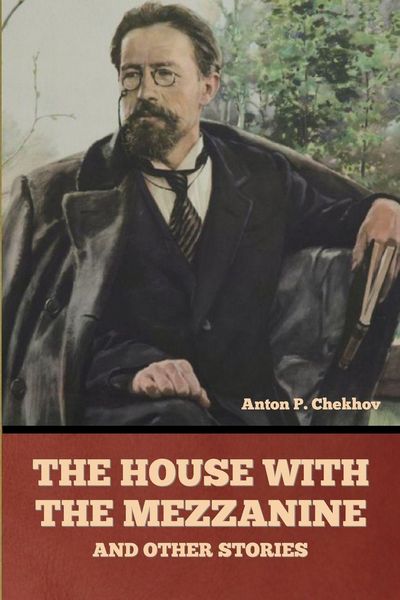
The House with the Mezzanine and Other Stories
-
- Hardcover
- Taschenbuch ausgewählt
- eBook
-
Sprache:Englisch
-
Verlag:Bibliotech Pr
16,99 €
inkl. gesetzl. MwSt.,
- Kostenlose Lieferung ab 30 € Einkaufswert
- Versandkostenfrei für Bonuscard-Kund*innen
Beschreibung
Produktdetails
Einband
Taschenbuch
Erscheinungsdatum
28.08.2025
Verlag
Bibliotech PrSeitenzahl
138
Maße (L/B/H)
22,9/15,2/0,8 cm
Gewicht
236 g
Sprache
Englisch
EAN
9798897732289
"The House with the Mezzanine and Other Stories" is a collection of short stories by Anton Pavlovich Chekhov, one of the most influential Russian writers of the late 19th and early 20th centuries. Chekhov is renowned for his mastery of the short story form, his subtle characterizations, and his ability to portray the complexities of human life with emotional depth and minimalism. "The House with the Mezzanine" (also sometimes translated as "The House with the Upper Floor") is the title story of this collection, and it captures many of Chekhov's recurring themes: The conflict between art and practicality The divide between social classes The nature of love and missed opportunities A sense of quiet melancholy and nostalgia This story, like many in the collection, is introspective and rich with atmosphere. It explores a short but meaningful relationship between a painter (the narrator) and a young woman named Lida, as well as her sister Zhenya, who live in a house with a mezzanine in a provincial Russian town. Other stories in the collection are: Typhus Gooseberries In Exile The Lady with the Toy Dog Goussiev My Life About the Author Anton Pavlovich Chekhov (29 January 1860 - 15 July 1904) was a Russian playwright and short-story writer, widely considered to be one of the greatest writers of all time. His career as a playwright produced four classics, and his best short stories are held in high esteem by writers and critics. Along with Henrik Ibsen and August Strindberg, Chekhov is often referred to as one of the three seminal figures in the birth of early modernism in the theatre. Chekhov was a physician by profession. "Medicine is my lawful wife," he once said, "and literature is my mistress." Chekhov renounced the theatre after the reception of The Seagull in 1896, but the play was revived to acclaim in 1898 by Konstantin Stanislavski's Moscow Art Theatre, which subsequently also produced Chekhov's Uncle Vanya and premiered his last two plays, Three Sisters and The Cherry Orchard. These four works present a challenge to the acting ensemble as well as to audiences, because in place of conventional action Chekhov offers a "theatre of mood" and a "submerged life in the text." The plays that Chekhov wrote were not complex, and created a somewhat haunting atmosphere for the audience. Chekhov began writing stories to earn money, but as his artistic ambition grew, he made formal innovations that influenced the evolution of the modern short story. He made no apologies for the difficulties this posed to readers, insisting that the role of an artist was to ask questions, not to answer them. (wikipedia.org)
Noch keine Bewertungen vorhanden
Verfassen Sie die erste Bewertung zu diesem Artikel
Helfen Sie anderen Kundinnen und Kunden durch Ihre Meinung.
Kurze Frage zu unserer Seite
Vielen Dank für Ihr Feedback
Wir nutzen Ihr Feedback, um unsere Produktseiten zu verbessern. Bitte haben Sie Verständnis, dass wir Ihnen keine Rückmeldung geben können. Falls Sie Kontakt mit uns aufnehmen möchten, können Sie sich aber gerne an unseren Kund*innenservice wenden.
zum Kundenservice