KI-Beratung Beta

Gutscheinbedingungen

**Gültig bis 11.11.2026 auf Spielzeug, Schreibwaren, Filme, Geschenke & Trends, Musik, tolino eReader & Zubehör, Hörbücher und Hörbuch-Downloads, nicht preisgebundene Bücher und Kalender online auf thalia.at und in der Thalia App. Einzelne Artikel können ausgeschlossen sein. Aufgrund der Buchpreisbindung sind deutschsprachige Bücher und eBooks ausgenommen. Zusätzlich ausgenommen sind Abos & Flatrates, Games, Geschenkkarten/-boxen, Shelfies, Software, Zeitschriften sowie einzelne Artikel von tonies®. Pro Einkauf einmal einlösbar. Click & Collect nur bei Onlinevorabzahlung möglich. Keine Barauszahlung. Nicht kombinierbar mit anderen Aktionen und Gutscheinen. Gutschein wird auf max. 500€ Bestellwert angerechnet. Nicht gültig für Versandkosten und Services.

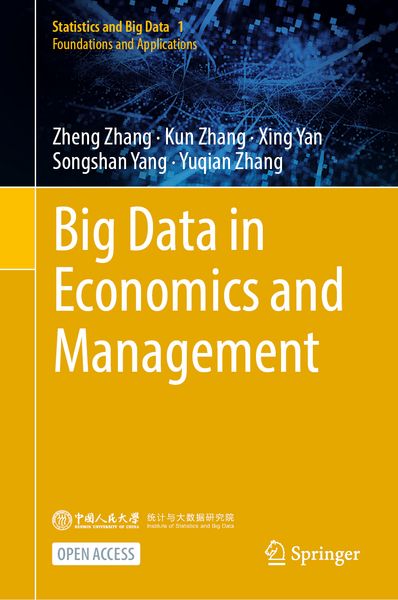
Produktbild: Big Data in Economics and Management
Band 1

Big Data in Economics and Management

Aus der Reihe Statistics and Big Data

49,99 €

inkl. gesetzl. MwSt., Versandkostenfrei


Beschreibung

With the rapid development of big data, three major challenges arise in the field of economics and management. The first challenge is that the traditional correlation-based methods cannot essentially reveal the true philosophy under the economic activities, modelling and inferring the causal relationship...

Beschreibung

With the rapid development of big data, three major challenges arise in the field of economics and management. The first challenge is that the traditional correlation-based methods cannot essentially reveal the true philosophy under the economic activities, modelling and inferring the causal relationship is paramount for discovering the essential effect of certain economic and management policies. The second one is that the computational burden becomes extremely high and the estimation accuracy is lost when the data scale is large. The third one is that financial institutions typically hold tens of thousands of assets, making portfolio risk assessment very computationally intensive.


This book discusses three advanced topics in modern economics and management: causal inference, financial model computing and decisions, and financial risk management. The first part of the book introduces the counterfactual framework for causal inference in observational studies and defines important causal parameters under both discrete and continuous treatments. The second part focuses on the computations associated with the financial model and its consequent decision making. The third part studies the nested simulation method for portfolio risk measurement and introduces the neural network methodology for market risk forecasting. 


The goal of this book is to provide cutting-edge methodologies and rigorous theory to solve advanced problems in economics and management, such as program/policy evaluation, efficient computation of econometric models, and financial risk management. This book will be appealing to academic researchers and graduate students. Practitioners may also find this book helpful.


This is an open access book.

Produktdetails

Einband

Gebundene Ausgabe

Erscheinungsdatum

29.03.2026

Abbildungen

IX, 218 p. 15 illus., 9 illus. in color.

Verlag Springer Singapore

Produktdetails

Einband

Gebundene Ausgabe

Erscheinungsdatum

29.03.2026

Abbildungen

IX, 218 p. 15 illus., 9 illus. in color.

Verlag Springer Singapore
Seitenzahl

218

Maße (L/B/H)

24,1/16/1,8 cm

Gewicht

501 g

Auflage

1. Auflage

Sprache

Englisch

ISBN

978-981-9531-24-0

Herstelleradresse

Springer-Verlag GmbH
Europaplatz 3
69115 Heidelberg
DE

Email: ProductSafety@springernature.com

Noch keine Bewertungen vorhanden

Verfassen Sie die erste Bewertung zu diesem Artikel

Helfen Sie anderen Kundinnen und Kunden durch Ihre Meinung.

Kundinnen und Kunden meinen

Bewertungen (0)

  • Produktbild: Big Data in Economics and Management

  • Part I Causal Inference in Economics.- 1 Causal Inference for A Discrete Treatment.-
    1.1 Basic Framework.- 1.2 Causal Inference based on Covariate Balancing Calibration.- 1.3 Causal Inference based on Semi-supervised Data.- 1.4 Causal Inference based on Neural Networks
    .- 2 Causal Inference for A Continuous Treatment.-
    2.1 Basic Framework.- 2.2 Semiparametric Efficiency Bound.- 2.3 Maximum Entropy Weighting.- 2.4 Efficient Estimation Results.- 2.5 Model Specification Tests.- 2.6 Nonparametric Estimation of ATE
    .-
    2.7 Nonparametric Estimation of Distributional and Quantile

    Treatment Effects.- 2.8 Testing Distributional Effects.- 2.9 Empirical Study: Presidential Campaign Data.-
    3 Causal Inference with Measurement Errors.-
    3.1 Basic Framework.- 3.2 Estimation Method.- 3.3 Large Sample Properties.- 3.4 Select the Smoothing Parameters.- 3.5 Real Data Example.-
    Part II Financial Model Computing and Decisions.- 4 Efficient Computing for High-Dimensional Econometric Models.-
    4.1 Introduction.- 4.2 Asset-splitting algorithm for portfolio selection.- 4.3 Feature-splitting algorithm for PQR.- 4.4 Numerical study.- 4.5 Conclusion and discussion
    .-
    4.6 Appendix.-
    Part III Financial Risk Management.- 5 Bootstrap-based Budget Allocation for Nested Simulation.-
    5.1 Introduction.- 5.2 Backgrounds.- 5.3 A Sample-Driven Budget Allocation Method
    .-
    5.4 Appendix
    .- 6 Constructing Confidence Intervals for Nested Simulation.-
    6.1 Introduction.- 6.2 Formulations
    .-
    6.3 Confidence Intervals
    .- 7 Deep Probabilistic Forecasting for Market Risks.-
    7.1 Background of Market Risk Forecasting
    .-
    7.2 Background of Uncertainty Quantification in Machine Learning
    .-
    7.3 Deep Sequential Learning of Conditional Heavy-Tailed Distributions
    .-
    7.4 Ensemble Multi-Quantile Regression with Deep Learning
    .-
    Appendix
    .-
    References
    .