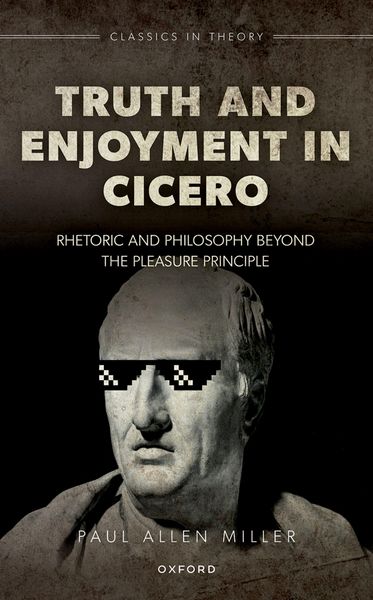
Truth and Enjoyment in Cicero Rhetoric and Philosophy Beyond the Pleasure Principle
-
- Englisch ausgewählt
161,99 €
inkl. gesetzl. MwSt.,
Beschreibung
Produktdetails
Einband
Gebundene Ausgabe
Erscheinungsdatum
16.07.2026
Verlag
Oxford AcademicSeitenzahl
320
Maße (L/B/H)
21,8/14,8/2,5 cm
Gewicht
531 g
Sprache
Englisch
ISBN
978-0-19-893132-4
Truth and Enjoyment in Cicero offers a fundamental re-examination of the relation between truth and enjoyment as understood in the traditional confrontation between rhetoric and philosophy in Cicero. His simultaneous advocacy of classical rationality and continued emphasis on the importance of performativity and enjoyment in language-on ratio as a desire (cupiditas) and force (vis) in the real-situates him at the crossroads of reason and the unconscious. Where the modern concept of truth abstracts truth from the subjective experience of speaker and hearer, for Cicero truth is inseparable from our experience of it, and it is precisely the possibility of their separation that he criticizes in works like De Oratore and De Re Publica where he seeks an ideal reconciliation between rhetoric and philosophy, truth and enjoyment. This book looks at the problem of enjoyment (jouissance) as central to understanding the differend between rhetoric and philosophy. Paul Allen Miller distinguishes "pleasure" from "enjoyment," with pleasure always being balanced by the constraints of the reality principle and hence always open to substitution and deferral. Jouissance, however, is a drive that leads beyond any utilitarian calculus, seeking a form of radical experience that can be both sublime and destructive.
There has never been a psychoanalytic treatment of Cicero's philosophical works, and while we must beware of crude attempts to psychoanalyze a long-dead author, Freud's hermeneutic model can provide new insights into Cicero's investment in concepts of desire, the sublime, and the abject, as well as how these concepts undergird his understanding of rational appeals to his audience. The conflict between rhetoric and philosophy dates to at least the fifth century. It has often understood itself as a conflict between a discourse that speaks to desire and one that speaks to truth. In the Gorgias, the rhetor is compared to the pastry chef, while the philosopher is the doctor whose bitter gall leads to health. Cicero is situated at this nexus between these figures, and, as he has Crassus argue in De Oratore Book 3, we live a more destitute and impoverished existence since these functions of discourse, truth and desire, have been split apart.
Miller offers the first psychoanalytic account of Cicero as a philosopher and rhetorician, bringing a fresh reading of five Cicero's major works during a crucial period of the Roman republic.
Noch keine Bewertungen vorhanden
Verfassen Sie die erste Bewertung zu diesem Artikel
Helfen Sie anderen Kundinnen und Kunden durch Ihre Meinung.
Kurze Frage zu unserer Seite
Vielen Dank für Ihr Feedback
Wir nutzen Ihr Feedback, um unsere Produktseiten zu verbessern. Bitte haben Sie Verständnis, dass wir Ihnen keine Rückmeldung geben können. Falls Sie Kontakt mit uns aufnehmen möchten, können Sie sich aber gerne an unseren Kund*innenservice wenden.
zum Kundenservice