Beschreibung
Produktdetails
Einband
Gebundene Ausgabe
Erscheinungsdatum
15.05.2025
Verlag
American Institute of Aeronautics & AstronauticsSeitenzahl
268
Maße (L/B/H)
23,4/15,9/2,1 cm
Gewicht
566 g
Sprache
Englisch
ISBN
978-1-62410-734-4
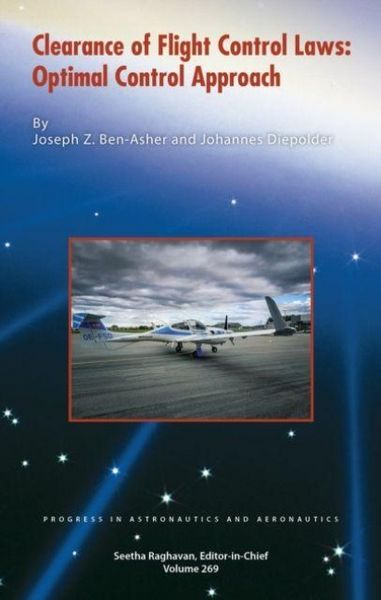
Clearance of Flight Control Laws: Optimal Control Approach is intended to provide domain experts with the required background for an appropriate application of clearance methods and interpretation of numerical results. The content is divided into three main parts: fundamentals, methods, and tools. These parts build on each other in the sense that the clearance methods depend on the underlying theoretical fundamentals, and clearance tools provide implementations of the clearance methods at a suitable level of abstraction. Part I introduces the building blocks of the direct discretization approach for optimal control problems: optimization (Chapter 1) and simulation (Chapter 2). Furthermore, Chapter 3 discusses optimal control problems in continuous time. Part II, which focuses on clearance analysis methods, contains the core topics of this book. The following types of analysis are covered for linear and linear-parametric systems (Chapter 4 and Chapter 5) as well as nonlinear-parametric systems (Chapter 6):真真真Nominal Analysis: Are there worst-case inputs violating a clearance criterion? 真真真Sensitivity Analysis: What is the influence of parameters on (optimal) worst-case solutions? 真真真Combined Analysis: Is there a worst-case combination of parameters and inputs violating a clearance criterion? Additionally, Chapter 7 covers set-based approaches regarding the joint consideration of multiple criteria for linear and nonlinear systems. Part III illustrates the use of software for the application of clearance methods in practice. The COLIBRY framework, which can be used to implement the presented methods for linear and nonlinear systems, is covered in Chapter 8; the FALCON.m toolbox described in Chapter 9 is useful for modeling general nonlinear-parametric optimal control-based clearance problems using direct methods. Designed for practitioners, particularly flight dynamics and control engineers without a strong theoretical background in the fields of optimization and optimal control, this book facilitates the adoption of these methods by domain experts facing practical clearance tasks.
Noch keine Bewertungen vorhanden
Verfassen Sie die erste Bewertung zu diesem Artikel
Helfen Sie anderen Kundinnen und Kunden durch Ihre Meinung.
Kurze Frage zu unserer Seite
Vielen Dank für Ihr Feedback
Wir nutzen Ihr Feedback, um unsere Produktseiten zu verbessern. Bitte haben Sie Verständnis, dass wir Ihnen keine Rückmeldung geben können. Falls Sie Kontakt mit uns aufnehmen möchten, können Sie sich aber gerne an unseren Kund*innenservice wenden.
zum Kundenservice