KI-Beratung Beta

Gutscheinbedingungen

**Gültig am 27.11.2026 auf Spielzeug, Schreibwaren, Filme, Geschenke & Trends, Musik, tolino eReader & Zubehör, Hörbücher und Hörbuch-Downloads, nicht preisgebundene Bücher und Kalender online auf thalia.at und in der Thalia App. Einzelne Artikel können ausgeschlossen sein. Aufgrund der Buchpreisbindung sind deutschsprachige Bücher und eBooks ausgenommen. Zusätzlich ausgenommen sind Abos & Flatrates, Games, Geschenkkarten/-boxen, Shelfies, Software, Zeitschriften sowie einzelne Artikel von tonies®. Pro Einkauf einmal einlösbar. Click & Collect nur bei Onlinevorabzahlung möglich. Keine Barauszahlung. Nicht kombinierbar mit anderen Aktionen und Gutscheinen. Gutschein wird auf max. 500€ Bestellwert angerechnet. Nicht gültig für Versandkosten und Services.

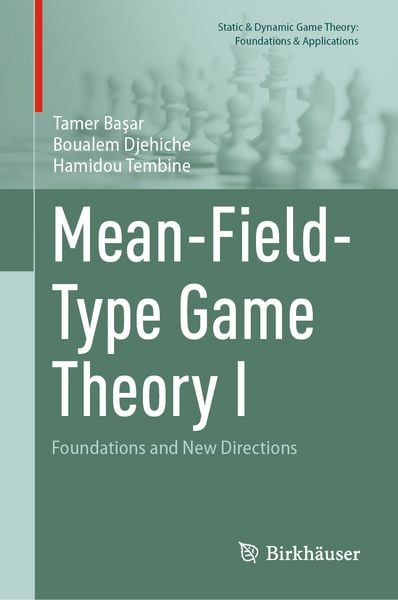
Produktbild: Mean-Field-Type Game Theory I
- 11%

Mean-Field-Type Game Theory I Foundations and New Directions

11% sparen

106,99 € UVP 120,99 €

inkl. gesetzl. MwSt., Versandkostenfrei


Beschreibung

Mean-Field-Type Game Theory I is the first of two volumes that together form a comprehensive treatment of mean-field-type game theory and applications, focused on finding state-of-the-art solutions to issues surrounding the next generation of cloud social networking, smart energy systems, transportation...

Beschreibung

Mean-Field-Type Game Theory I
is the first of two volumes that together form a comprehensive treatment of mean-field-type game theory and applications, focused on finding state-of-the-art solutions to issues surrounding the next generation of cloud social networking, smart energy systems, transportation and wireless networks. The text shows how mean-field-type game theory provides the ideal framework for designing robust, accurate and efficient algorithms for the autonomous and distributed architectures on which future cities and networks will rely to improve the efficiency and flexibility, security and quality of life. 


This first volume enables readers to develop a solid understanding of mean-field-type game theory. It covers key theoretical results such as the stochastic maximum principle and dynamic programming in both discrete and continuous time. The book also covers a wide range of techniques for modeling, designing and analyzing risk and uncertainties using game theory, as well as state-of-the-art distributed mean-field learning algorithm techniques.


Mean-Field-Type Game Theory I
:
Foundations and New Directions
is an ideal resource for academic researchers, and advanced undergraduate and graduate students, surveying basic ideas and advanced topics.

Produktdetails

Einband

Gebundene Ausgabe

Erscheinungsdatum

07.02.2026

Abbildungen

XXIX, 887 p. 1 illus.

Verlag Springer

Produktdetails

Einband

Gebundene Ausgabe

Erscheinungsdatum

07.02.2026

Abbildungen

XXIX, 887 p. 1 illus.

Verlag Springer
Seitenzahl

887

Maße (L/B/H)

24,1/16/5,5 cm

Gewicht

1474 g

Sprache

Englisch

ISBN

978-3-032-07026-5

Herstelleradresse

Springer-Verlag GmbH
Europaplatz 3
69115 Heidelberg
DE

Email: ProductSafety@springernature.com

Noch keine Bewertungen vorhanden

Verfassen Sie die erste Bewertung zu diesem Artikel

Helfen Sie anderen Kundinnen und Kunden durch Ihre Meinung.

Kundinnen und Kunden meinen

Bewertungen (0)

  • Produktbild: Mean-Field-Type Game Theory I

  • Part 1. Discrete State Markov Games of Mean-Field Type.- Chapter 1. One-Shot Mean-Field-Type Games.- Chapter 2. Markov Games.- Chapter 3. Mean-Field-Type Games with Discrete State Spaces.- Part 2. Equilibrium Principles.- Chapter 4. Stochastic Maximum Principle.- Chapter 5. Dynamic Programming Principle.- Part 3. Classes of Mean-Field-Type Games .- Chapter 6. Non Asymptotic Mean-Field-Type Games.- Chapter 7. Linear-Quadratic Mean-Field and Mean-Field-Type Differential Games.- Chapter 8. Mean-Field-Type Games with Jump and Regime Switching.- Chapter 9. MASS: Master Adjoint Systems.- Chapter 10. Semi-Explicit Solutions in Non-Quadratic Mean-Field-Type Games.- Chapter 11. Stackelberg Mean-Field-Type Games.- Chapter 12. Mean-Field-Type Games Driven by Rosenblatt Noises.- Chapter 13. Mean-Field-Type Games with Asymmetric Information.- Chapter 14. Difference Games of Mean-Field Type.- Part 4. Wrap-up.- Chapter 15. Conclusions and New Directions.