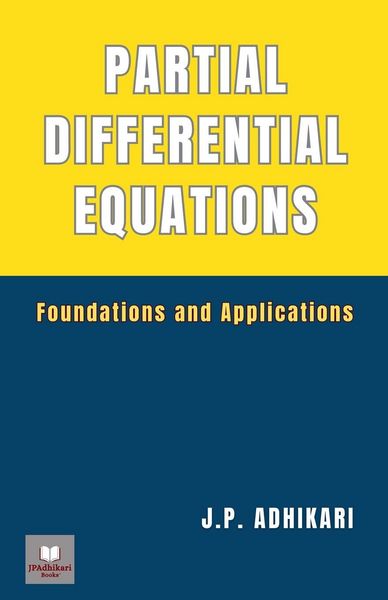
Partial Differential Equations Foundations and Applications
-
- Englisch ausgewählt
275,99 €
inkl. gesetzl. MwSt.,
Beschreibung
Produktdetails
Einband
Taschenbuch
Erscheinungsdatum
15.08.2025
Verlag
JPAdhikari BooksSeitenzahl
242
Maße (L/B/H)
21,6/14/1,4 cm
Gewicht
310 g
Sprache
Englisch
ISBN
978-93-343-7532-9
Partial Differential Equations: Foundations and Applications offers a clear, precise, and conceptually rich introduction to one of the most fundamental areas of mathematics. Far beyond abstract formalism, partial differential equations form the language through which the laws of nature are expressed, governing phenomena in physics, engineering, and the life sciences - from heat diffusion and wave propagation to fluid motion, electromagnetism, and quantum systems. This volume is designed for undergraduate and postgraduate students in mathematics, physics, and engineering, as well as for motivated self-learners and researchers seeking a unified and reliable reference. It balances mathematical depth with conceptual clarity, integrating theory and application so that abstract methods emerge from physical motivations. This book includes:Fundamental definitions, classification, and formation of partial differential equations First-order partial differential equations: method of characteristics, Lagrange's method, Charpit's method, and applications such as transport equations and Burgers' equation Second-order partial differential equations: classification into hyperbolic, parabolic, and elliptic types, canonical forms, and associated physical models Separation of variables and Sturm-Liouville theory, with orthogonal functions and eigenfunction expansions Fourier series and Fourier transforms, convergence theorems, Parseval's identity, and applications to the heat and wave equations The heat, wave, and Laplace equations in one or more dimensions, steady-state and time-dependent solutions, and coordinate-based techniques Laplace transform methods for problems on semi-infinite domains, impulsive sources, and delta function initial conditions Each chapter is structured to develop both analytical techniques and physical insight, supported by solved examples and graded exercises with answers. Special attention is given to connecting mathematical derivations with their physical interpretations, ensuring the reader gains not only procedural skill but also a comprehensive insight of the underlying principles of the subject.
Noch keine Bewertungen vorhanden
Verfassen Sie die erste Bewertung zu diesem Artikel
Helfen Sie anderen Kundinnen und Kunden durch Ihre Meinung.
Kurze Frage zu unserer Seite
Vielen Dank für Ihr Feedback
Wir nutzen Ihr Feedback, um unsere Produktseiten zu verbessern. Bitte haben Sie Verständnis, dass wir Ihnen keine Rückmeldung geben können. Falls Sie Kontakt mit uns aufnehmen möchten, können Sie sich aber gerne an unseren Kund*innenservice wenden.
zum Kundenservice