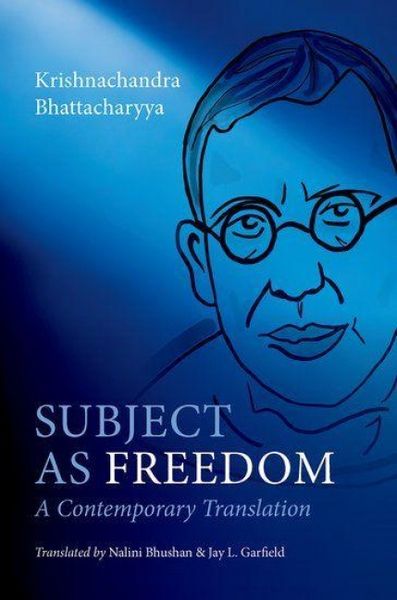
Subject as Freedom
-
- Hardcover ausgewählt
- Taschenbuch
- eBook
-
Sprache:Englisch
168,99 €
inkl. gesetzl. MwSt.,
Beschreibung
Produktdetails
Einband
Gebundene Ausgabe
Erscheinungsdatum
24.10.2025
Verlag
Oxford AcademicSeitenzahl
352
Maße (L/B/H)
23,4/15,6/2,4 cm
Gewicht
667 g
Übersetzt von
Bhushan Nalini + weitere
Sprache
Englisch
ISBN
978-0-19-780992-1
Krishnachandra Bhattacharyya (1875-1947) was one of the most prominent philosophers in India in the first half of the 20th century. He was King George Professor of Philosophy at Presidency College in Calcutta. KC Bhattacharyya was a noted Kant scholar, as well as an expert on classical Indian philosophy. His work is inflected by Advaita Vedanta, Nyaya, Samkhya, and Yoga philosophy, as well as by the thought of Kant and Husserl. But above all, it is highly original, responding to ideas raised in these traditions through a profound reflection on the nature of subjectivity. Subject as Freedom was published in 1930. It is almost universally regarded by those who study modern Indian philosophy as the most important philosophical treatise composed in India during the period of British occupation. It is a meticulous analysis of the structure of human subjectivity. KC Bhattacharyya achieves a remarkable synthesis of neo-Vedantin, Kantian, and Husserlian insights, exploring the role of embodiment, of language, and of introspective consciousness in the achievement of self-knowledge. KC Bhattacharyya argues that subjectivity itself comprises a hierarchy of grades or levels of self-consciousness, and that each of these constitutes a mode of freedom from objects of knowledge. His analysis anticipates many important ideas that emerged in Europe and the United States through the work of Merleau-Ponty, Wittgenstein, Sellars, and Davidson, and provides insight into the interconnection of these ideas and their role in our understanding of human consciousness. Despite its importance and reputation, however, this book has been little read and has been under-studied. This is because of KC Bhattacharyya's unusual prose style and vocabulary. The present edition includes both his original text and a translation of that text into more familiar contemporary philosophical English with some explanatory notes and a new introduction. This translation both makes the contents of the text more accessible and provides a guide to reading the original text.
Noch keine Bewertungen vorhanden
Verfassen Sie die erste Bewertung zu diesem Artikel
Helfen Sie anderen Kundinnen und Kunden durch Ihre Meinung.
Kurze Frage zu unserer Seite
Vielen Dank für Ihr Feedback
Wir nutzen Ihr Feedback, um unsere Produktseiten zu verbessern. Bitte haben Sie Verständnis, dass wir Ihnen keine Rückmeldung geben können. Falls Sie Kontakt mit uns aufnehmen möchten, können Sie sich aber gerne an unseren Kund*innenservice wenden.
zum Kundenservice