KI-Beratung Beta

Gutscheinbedingungen

**Gültig am 15.10.2026 auf Spielzeug, Schreibwaren, Filme, Geschenke & Trends, Musik, tolino eReader & Zubehör, Hörbücher und Hörbuch-Downloads, nicht preisgebundene Bücher und Kalender in der Thalia App. Einzelne Artikel können ausgeschlossen sein. Aufgrund der Buchpreisbindung sind deutschsprachige Bücher und eBooks ausgenommen. Zusätzlich ausgenommen sind Abos & Flatrates, Games, Geschenkkarten/-boxen, Shelfies, Software, Zeitschriften sowie einzelne Artikel von tonies®. Pro Einkauf einmal einlösbar. Click & Collect nur bei Onlinevorabzahlung möglich. Keine Barauszahlung. Nicht kombinierbar mit anderen Aktionen und Gutscheinen. Gutschein wird auf max. 500€ Bestellwert angerechnet. Nicht gültig für Versandkosten und Services.

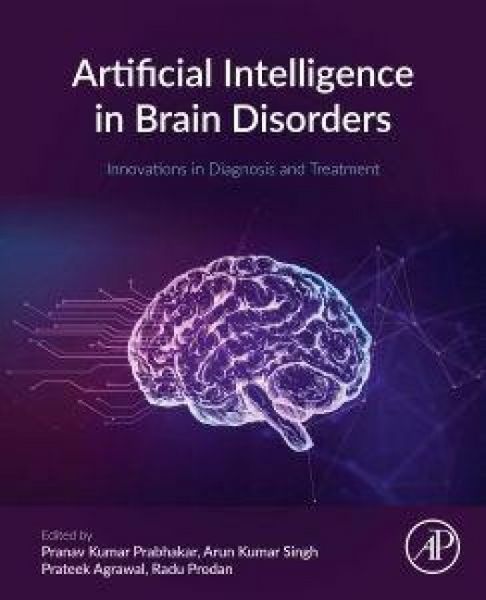
Produktbild: Artificial Intelligence in Brain Disorders
Neu

Artificial Intelligence in Brain Disorders Innovations in Diagnosis and Treatment

192,99 €

inkl. gesetzl. MwSt., Versandkostenfrei


Beschreibung

Produktdetails

Einband

Taschenbuch

Erscheinungsdatum

01.10.2026

Herausgeber

Pranav Kumar Prabhakar + weitere

Verlag

Elsevier

Seitenzahl

516

Maße (L/B)

23,5/19,1 cm

Gewicht

450 g

Sprache

Englisch

ISBN

978-0-443-27722-1

Beschreibung

Portrait

Pranav Kumar Prabhakar is Professor and Head of the Department of Biotechnology, School of Engineering and Technology, Nagaland University, Kohima, India. His research focuses on understanding molecular mechanisms involved in metabolic disorders, particularly diabetes, and on developing strategies for oral insulin delivery using natural products and biotechnology-based approaches. He is actively involved in research, academic mentoring, peer review, and editorial activities within the biomedical and biotechnology fields. His professional interests include translational research, signaling pathways associated with metabolic diseases, and the application of biotechnology to improve therapeutic outcomes. He contributes to scientific and academic initiatives that support advancements in biotechnology and healthcare research.

Arun Kumar Singh is Assistant Professor in the Department of Pharmacy at Vivekanand Global University, India. His teaching and research activities span pharmaceutical sciences and a range of interdisciplinary fields, including nanoformulation, cancer biology, artificial intelligence, machine learning, blockchain technology, the Internet of Things, big data analytics, and neuroscience. He has contributed to scholarly publishing through authorship and editorial work and has participated in research and academic initiatives that integrate emerging technologies with healthcare and pharmaceutical applications. His interests focus on advancing innovative approaches to drug delivery, biomedical research, and technology-enabled solutions for healthcare challenges.

Prateek Agrawal is professor and deputy dean at the School of Computer Science & Engineering, Lovely Professional University, Phagwara, Punjab, India. His research areas include natural language processing, computer vision, video processing, expert systems, deep learning applications, and other related topics. He is a senior member of IEEE and core member of IEEE India Council for Sustainable Development Activity, and is also a member of different reputed organizations like IET, MIR lab, and IAENG among others. Dr. Agarwal has published over 70 research papers in Scopus/SCIE indexed journals and conferences, 60 national patents, five edited books, and 10 book chapters. He is book series editor of the IOP series on next generation computing, and is a reviewer for many SCIE journals like Multimedia tools and Applications, Plos One, PeerJ, Oxford computer science, IEEE Access, and Ambient Intelligent & Humanized Computing.

Radu Prodan is professor of distributed systems at the Institute of Information Technology (ITEC), University of Klagenfurt, Austria. He was an associate professor at the University of Innsbruck until 2018. His research interests include performance, optimization, and resource management tools for parallel and distributed systems, as well as middleware system tools for cloud, fog, and edge computing. He has participated in numerous projects, including coordinating the Horizon 2020 project ARTICONF. He has coauthored over 200 publications and received three IEEE best paper awards. He is a member of ACM.

Produktdetails

Einband

Taschenbuch

Erscheinungsdatum

01.10.2026

Herausgeber

Verlag

Elsevier

Seitenzahl

516

Maße (L/B)

23,5/19,1 cm

Gewicht

450 g

Sprache

Englisch

ISBN

978-0-443-27722-1

Herstelleradresse

Libri GmbH
Europaallee 1
36244 Bad Hersfeld
DE

Email: gpsr@libri.de

Noch keine Bewertungen vorhanden

Verfassen Sie die erste Bewertung zu diesem Artikel

Helfen Sie anderen Kundinnen und Kunden durch Ihre Meinung.

Kundinnen und Kunden meinen

Bewertungen (0)

Weitere Artikel finden Sie in

Die Leseprobe wird geladen.
  • Produktbild: Artificial Intelligence in Brain Disorders
  • 1. An Overview of Artificial Intelligence-Based Imaging Techniques
    2. Identification and evaluation of low-grade gliomas in the brain using machine learning
    3. Cognitive therapy for brain diseases using deep learning models
    4. Machine Intelligence in Clinical Neuroscience
    5. Brain Informatics, by NL Swathy, Department Of Pharmacy Practice
    6. Alzheimer's Disease Diagnosis using Artificial Intelligence
    7. AI-enabled assistance support to Alzheimer Patients
    8. Adolescents with serious depressive disorder: AI for detecting mental disorders
    9. Modelling cognitive impairment in Parkinson s patients using deep learning
    10. Parkinson’s disease diagnosis using AI
    11. Artificial Intelligence shaping the future of neurology practice
    12. Convergence of Artificial Intelligence and Neuroscience for Neurological Disorder Diagnosis
    13. Early detection and prediction of brain tumurs in human patients using deep learning
    14. Using deep learning to identify Brain tumors
    15. Combining artificial intelligence and neuroscience to diagnose and predict neurological diseases
    16. The role of AI in neuroethics and patients’ privacy