KI-Beratung Beta

Gutscheinbedingungen

**Gültig bis 11.11.2026 auf Spielzeug, Schreibwaren, Filme, Geschenke & Trends, Musik, tolino eReader & Zubehör, Hörbücher und Hörbuch-Downloads, nicht preisgebundene Bücher und Kalender online auf thalia.at und in der Thalia App. Einzelne Artikel können ausgeschlossen sein. Aufgrund der Buchpreisbindung sind deutschsprachige Bücher und eBooks ausgenommen. Zusätzlich ausgenommen sind Abos & Flatrates, Games, Geschenkkarten/-boxen, Shelfies, Software, Zeitschriften sowie einzelne Artikel von tonies®. Pro Einkauf einmal einlösbar. Click & Collect nur bei Onlinevorabzahlung möglich. Keine Barauszahlung. Nicht kombinierbar mit anderen Aktionen und Gutscheinen. Gutschein wird auf max. 500€ Bestellwert angerechnet. Nicht gültig für Versandkosten und Services.

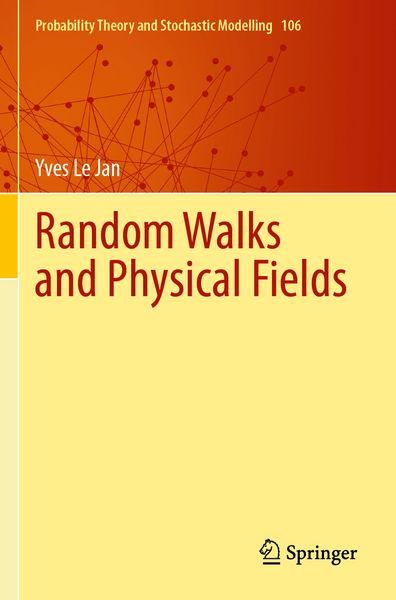
Produktbild: Random Walks and Physical Fields
Band 106

Random Walks and Physical Fields

138,99 €

inkl. gesetzl. MwSt., Versandkostenfrei


Beschreibung

This book presents fundamental relations between random walks on graphs and field theories of mathematical physics. Such relations have been explored for several decades and remain a rapidly developing research area in probability theory.

The main objects of study include Markov loops, spanning forests,...

Beschreibung

This book presents fundamental relations between random walks on graphs and field theories of mathematical physics. Such relations have been explored for several decades and remain a rapidly developing research area in probability theory.

The main objects of study include Markov loops, spanning forests, random holonomies, and covers, and the purpose of the book is to investigate their relations to Bose fields, Fermi fields, and gauge fields. The book starts with a review of some basic notions of Markovian potential theory in the simple context of a finite or countable graph, followed by several chapters dedicated to the study of loop ensembles and related statistical physical models. Then, spanning trees and Fermi fields are introduced and related to loop ensembles. Next, the focus turns to topological properties of loops and graphs, with the introduction of connections on a graph, loop holonomies, and Yang–Mills measure. Among the main results presented is an intertwining relation between merge-and-split generators on loop ensembles and Casimir operators on connections, and the key reflection positivity property for the fields under consideration.

Aimed at researchers and graduate students in probability and mathematical physics, this concise monograph is essentially self-contained. Familiarity with basic notions of probability, Poisson point processes, and discrete Markov chains are assumed of the reader.

Rezension

“I enjoyed reading this very well-written and interesting book. It introduces objects such as Markov loops, spanning forests, random homologies and covers, which are related to random walks on graphs. Relations between these objects and random fields used in mathematical physics are explored.” (John Masson Noble, Mathematical Reviews, May, 2025)

Produktdetails

Einband

Taschenbuch

Erscheinungsdatum

03.07.2025

Abbildungen

XIII, 184 p. 7 illus.

Verlag Springer

Produktdetails

Einband

Taschenbuch

Erscheinungsdatum

03.07.2025

Abbildungen

XIII, 184 p. 7 illus.

Verlag Springer
Seitenzahl

184

Maße (L/B/H)

23,5/15,5/1,2 cm

Gewicht

312 g

Sprache

Englisch

ISBN

978-3-031-57925-7

Herstelleradresse

Springer-Verlag KG
Sachsenplatz 4-6
1201 Wien
AT

Email: ProductSafety@springernature.com

Noch keine Bewertungen vorhanden

Verfassen Sie die erste Bewertung zu diesem Artikel

Helfen Sie anderen Kundinnen und Kunden durch Ihre Meinung.

Kundinnen und Kunden meinen

Bewertungen (0)

  • Produktbild: Random Walks and Physical Fields
  • 1 Markov Chains and Potential Theory on Graphs.- 2 Loop Measures.- 3 Decompositions, Traces and Excursions.- 4 Occupation Fields.- 5 Primitive Loops, Loop Clusters, and Loop Percolation.- 6 The Gaussian Free Field.- 7 Networks, Ising Model, Flows, and Configurations.- 8 Loop Erasure, Spanning Trees and Combinatorial Maps.- 9 Fock Spaces, Fermi Fields, and Applications.- 10 Groups and Covers.- 11 Holonomies and Gauge Fields.- 12 Reflection Positivity and Physical Space.