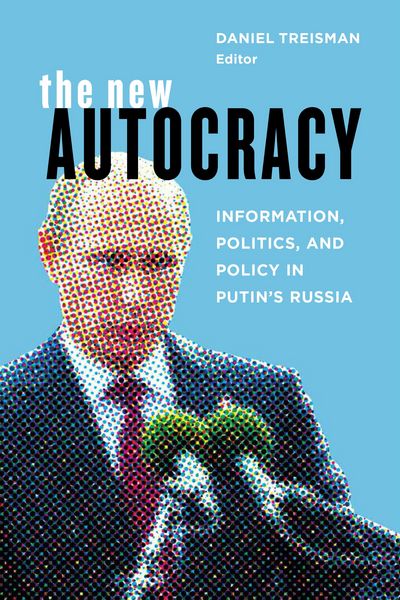
The New Autocracy Information, Politics, and Policy in Putin's Russia
-
- Taschenbuch
- eBook ausgewählt
-
Form:Einzelkauf Download
-
Sprache:Englisch
-
eBook Format:PDF
- PDF 34,50 € ausgewählt
- ePUB 34,00 €
34,50 €
inkl. gesetzl. MwSt.Beschreibung
Produktdetails
Format
Kopierschutz
Ja
Family Sharing
Nein
Text-to-Speech
Nein
Erscheinungsdatum
06.02.2018
Herausgeber
Daniel TreismanVerlag
Bloomsbury eBooks USSeitenzahl
(Printausgabe)
Auflage
1. Auflage
Sprache
Englisch
EAN
9780815743286
Corruption, fake news, and the "informational autocracy" sustaining Putin in power
After fading into the background for many years following the collapse of the Soviet Union, Russia suddenly has emerged as a new threat-at least in the minds of many Westerners. But Western assumptions about Russia, and in particular about political decision-making in Russia, tend to be out of date or just plain wrong.
Under the leadership of Vladimir Putin since 2000, Russia is neither a somewhat reduced version of the Soviet Union nor a classic police state. Corruption is prevalent at all levels of government and business, but Russia's leaders pursue broader and more complex goals than one would expect in a typical kleptocracy, such as those in many developing countries. Nor does Russia fit the standard political science model of a "competitive authoritarian" regime; its parliament, political parties, and other political bodies are neither fakes to fool the West nor forums for bargaining among the elites.
The result of a two-year collaboration between top Russian experts and Western political scholars, Autocracy explores the complex roles of Russia's presidency, security services, parliament, media and other actors. The authors argue that Putin has created an "informational autocracy," which relies more on media manipulation than on the comprehensive repression of traditional dictatorships. The fake news, hackers, and trolls that featured in Russia's foreign policy during the 2016 U.S. presidential election are also favored tools of Putin's domestic regime-along with internet restrictions, state television, and copious in-house surveys. While these tactics have been successful in the short run, the regime that depends on them already shows signs of age: over-centralization, a narrowing of information flows, and a reliance on informal fixers to bypass the bureaucracy. The regime's challenge will be to continue to block social modernization without undermining the leadership's own capabilities.
Kundinnen und Kunden meinen
Verfassen Sie die erste Bewertung zu diesem Artikel
Helfen Sie anderen Kund*innen durch Ihre Meinung
Kurze Frage zu unserer Seite
Vielen Dank für Ihr Feedback
Wir nutzen Ihr Feedback, um unsere Produktseiten zu verbessern. Bitte haben Sie Verständnis, dass wir Ihnen keine Rückmeldung geben können. Falls Sie Kontakt mit uns aufnehmen möchten, können Sie sich aber gerne an unseren Kund*innenservice wenden.
zum Kundenservice