KI-Beratung Beta

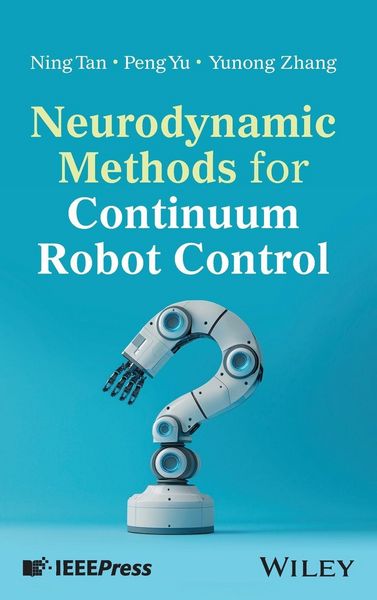
Produktbild: Neurodynamic Methods for Continuum Robot Control

Neurodynamic Methods for Continuum Robot Control

185,99 €

inkl. gesetzl. MwSt., Versandkostenfrei


Beschreibung

Exploration on how neurodynamic methods can be effectively applied to control complex, flexible robotic systems in research, and real-world settings

Neurodynamic Methods for Continuum Robot Control presents a comprehensive exploration of neurodynamic control methods for continuum robots-a new generation...

Beschreibung

Exploration on how neurodynamic methods can be effectively applied to control complex, flexible robotic systems in research, and real-world settings

Neurodynamic Methods for Continuum Robot Control presents a comprehensive exploration of neurodynamic control methods for continuum robots-a new generation of soft, flexible robotic systems inspired by nature. The book is organized into seven thematic parts and eleven chapters, progressing from fundamental analytical techniques to advanced hybrid and adaptive control systems. After the introduction chapter, each chapter includes detailed theoretical derivations, algorithm design, and extensive validation through simulations and physical experiments.

This book explores how continuum robots are controlled effectively and robustly in real time, without requiring complex modeling or extensive data training. The solution explored throughout this book is a suite of neurodynamic control algorithms, which offer a powerful alternative to traditional model-based and learning-based approaches. These neurodynamic methods-particularly gradient neurodynamics (GND) and zeroing neurodynamics (ZND)-allow for fast, adaptive, and model-free solutions to inverse kinematics and trajectory tracking problems.

Written by a team of highly qualified authors with extensive experience in the field, this book includes information on:

  • Inherent challenges in modeling and controlling continuum robots, including model uncertainty, high dimensionality, and elastic deformation
  • Mathematical foundations of GND and ZND and the derivation and application of Jacobian-based and model-free kinematic control methods
  • Advanced neurodynamic models including predefined-time convergent, time-synchronized, and varying-parameter schemes
  • Hybrid intelligent methods such as fuzzy logic-enhanced neurodynamics and cerebellum-inspired architectures
  • Benefits of neurodynamic control, including real-time performance, robustness, adaptability, and simplicity in deployment

Discussing theory, design, and applications to deliver state-of-the-art research, Neurodynamic Methods for Continuum Robot Control is an essential resource on the subject for researchers, graduate students, and advanced practitioners-not only a technical reference, but also a visionary guide to the future of intelligent robotics.

Produktdetails

Einband

Gebundene Ausgabe

Erscheinungsdatum

02.06.2026

Verlag Wiley
Seitenzahl

240

Produktdetails

Einband

Gebundene Ausgabe

Erscheinungsdatum

02.06.2026

Verlag Wiley
Seitenzahl

240

Maße (L/B/H)

22,9/15,2/1,4 cm

Gewicht

494 g

Sprache

Englisch

ISBN

978-1-394-40273-1

Herstelleradresse

Libri GmbH
Europaallee 1
36244 Bad Hersfeld
DE

Email: gpsr@libri.de

Noch keine Bewertungen vorhanden

Verfassen Sie die erste Bewertung zu diesem Artikel

Helfen Sie anderen Kundinnen und Kunden durch Ihre Meinung.

Kundinnen und Kunden meinen

Bewertungen (0)

Die Leseprobe wird geladen.
  • Produktbild: Neurodynamic Methods for Continuum Robot Control
  • Foreword xi
    About the Authors xiii
    Preface xv
    Acknowledgments xxi
    Acronyms xxii

    Part I Introduction 1

    1 Introduction to Continuum Robots and Theoretical Foundations 3
    1.1 Introduction 3
    1.2 Modeling Continuum Robots Using PCC 4
    1.3 Neurodynamic Models 6
    1.4 Chapter Summary 7

    Part II Model-based Neurodynamic Methods 9

    2 Analytical-Jacobian-based Neurodynamic Control Methods 11
    2.1 Introduction 11
    2.2 Model-based Kinematic Control 12
    2.3 Simulative Verification 21
    2.4 Chapter Summary 26

    Part III Model-free Neurodynamic Methods 27

    3 Continuous-time Hybrid Neurodynamic Control Methods 29
    3.1 Introduction 29
    3.2 Model-free Kinematic Control 31
    3.3 Simulative Verification 34
    3.4 Chapter Summary 41

    4 Discrete-time Neurodynamic Control Methods 43
    4.1 Introduction 43
    4.2 Method 44
    4.3 Verification 48
    4.4 Chapter Summary 54

    Part IV Model- and Inverse-free Zeroing Neurodynamics Methods 57

    5 Quad Neurodynamic Control Methods 59
    5.1 Introduction 59
    5.2 Preliminary 62
    5.3 Velocity-level Quad Neurodynamics 63
    5.4 Acceleration-level Quad Neurodynamics 67
    5.5 Verification of DQND4 73
    5.6 Verification of ADQN 75
    5.7 Chapter Summary 80

    Part V Variants of Zeroing Neurodynamics Methods 81

    6 Nonlinearly Activated Zeroing Neurodynamic Control Methods 83
    6.1 Introduction 83
    6.2 Variants of ZND Models 84
    6.3 Method 89
    6.4 Verification 91
    6.5 Chapter Summary 99

    7 Varying-parameter Zeroing Neurodynamic Control Methods 101
    7.1 Introduction 101
    7.2 Preliminary 103
    7.3 Varying-parameter ZND Methods 104
    7.4 Recursive Least Square-aided Varying-parameter ZND Method 107
    7.5 Verification of VP-ZND-1 and VP-ZND-2 111
    7.6 Verification of ADVPEZND 114
    7.7 Chapter Summary 117

    8 Prescribed-performance Convergent Zeroing Neurodynamic Control Methods 119
    8.1 Introduction 119
    8.2 Predefined-time Convergent Method 121
    8.3 PTS Method 126
    8.4 Prescribed-performance Control Method 134
    8.5 Verification of PTC-ZND 143
    8.6 Verification of PTS-ZND 148
    8.7 Verification of BPAC 149
    8.8 Chapter Summary 161

    Part VI Enhancing Zeroing Neurodynamics Methods with Intelligent Algorithms 163

    9 Fuzzy-enhanced Zeroing Neurodynamic Control Method 165
    9.1 Introduction 165
    9.2 Method 167
    9.3 Verification 170
    9.4 Chapter Summary 174

    10 Spiking Neural Network-enhanced Zeroing Neurodynamic Control Method 175
    10.1 Introduction 175
    10.2 Preliminary 176
    10.3 LSM-based Control Scheme 179
    10.4 Verification 185
    10.5 Chapter Summary 186

    Part VII Neurodynamics-based Model-free Teleoperation Method 187

    11 Neurodynamics-based Teleoperation 189
    11.1 Introduction 189
    11.2 Preliminary 190
    11.3 Method 191
    11.4 Verification 196
    11.5 Chapter Summary 198

    References 199
    Index 215