Gutscheinbedingungen

**Gültig bis 06.07.2026 auf fremdsprachige Bücher online auf thalia.at, in der Thalia App ab einem Mindestbestellwert von 30€ und in allen Thalia Buchhandlungen in Österreich. In den Buchhandlungen nur gültig auf lagernde Ware. Einzelne Artikel können ausgeschlossen sein. Ausgenommen sind preisgebundene Artikel & eBooks. Pro Einkauf einmal einlösbar. Nur gültig gegen Vorlage oder im Onlineshop hinterlegter Bonuscard. Infos zur Einlösung in der Buchhandlung sind auf der Bonuscard-Vorteilspreisseite zu finden. Click & Collect nur bei Onlinevorabzahlung möglich. Keine Einlösung bei Scan & Go-Bezahlung. Keine Barauszahlung. Nicht kombinierbar mit anderen Aktionen und Gutscheinen. Gutschein wird auf max. 500€ Bestellwert angerechnet. Nicht gültig für Versandkosten und Services.

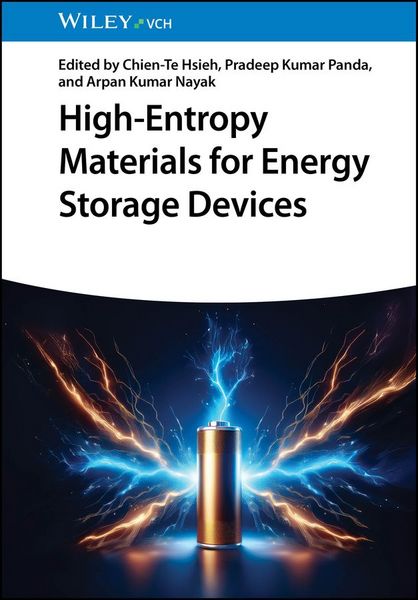
Produktbild: High-Entropy Materials for Energy Storage Devices
- 11%

High-Entropy Materials for Energy Storage Devices

11% sparen

152,99 € UVP 173,80 €

inkl. gesetzl. MwSt., Versandkostenfrei


Beschreibung

Produktdetails

Einband

Gebundene Ausgabe

Erscheinungsdatum

22.04.2026

Abbildungen

Tabellen, schwarz-weiss, farbige Illustrationen

Herausgeber

Chien-Te Hsieh + weitere

Verlag

Wiley-VCH

Seitenzahl

480

Maße (L/B/H)

24,7/17,6/3 cm

Gewicht

666 g

Auflage

1. Auflage

Sprache

Englisch

ISBN

978-3-527-35558-7

Beschreibung

Portrait

Dr. Chien-Te Hsieh is currently a professor in Department of Chemical Engineering and Materials Science at Yuan Ze University, Taiwan. His research focuses on two main areas, (i) nanomaterial synthesis using atomic layer deposition (ALD), microwave deposition, and infrared-assisted methods, and (ii) energy storage applications, including Li-ion batteries, Na-ion batteries, solid-state batteries, electrochemical capacitors, and fuel cells. His research group published over 270 SCI papers and secured more than 40 patents.


Dr. Pradeep Kumar Panda is a post-doctoral researcher at Department of Chemical Engineering and Materials Science, Yuan Ze University, Taiwan. His field of research encompasses sustainable nanomaterials, electrochemical catalyst, energy device, polymer science, and biomaterials.


Dr. Arpan Kumar Nayak is working as an Assistant Professor at Regional Institute of Education (NCERT) Mysuru, India. His current research mainly focuses on the synthesis of various nanostructured materials and carbon-based materials towards environment and energy applications. He has published more than 110 articles in various international journals.

Produktdetails

Einband

Gebundene Ausgabe

Erscheinungsdatum

22.04.2026

Abbildungen

Tabellen, schwarz-weiss, farbige Illustrationen

Herausgeber

Verlag

Wiley-VCH

Seitenzahl

480

Maße (L/B/H)

24,7/17,6/3 cm

Gewicht

666 g

Auflage

1. Auflage

Sprache

Englisch

ISBN

978-3-527-35558-7

Herstelleradresse

Wiley-VCH GmbH
Boschstraße 12
69469 Weinheim
DE

Email: GPSR Kontakt

Noch keine Bewertungen vorhanden

Verfassen Sie die erste Bewertung zu diesem Artikel

Helfen Sie anderen Kundinnen und Kunden durch Ihre Meinung.

Kundinnen und Kunden meinen

Bewertungen (0)

  • Produktbild: High-Entropy Materials for Energy Storage Devices
  • Preface xvii

    List of Abbreviations xix

    1 Overview of High-Entropy Materials for Energy Storage: Surface Chemistry and Its Functionality 1
    Mukarram Ali, Mohsin Saleem, Tahir Sattar, Muhammad Zubair Khan, Yoon-Cheol Ha, and Jung Hyuk Koh

    1.1 Introduction 1

    1.2 Fundamental Principles in HEMs 3

    1.3 Design and Synthesis of High-Entropy Materials for Energy Storage 5

    1.4 High-Entropy Phase Stabilization and Structural Integrity 8

    1.5 Compositional Engineering in High-Entropy Materials 12

    1.6 High-Entropy Electrodes for Energy Storage 15

    1.7 High-Entropy Electrolytes and Interface Engineering 18

    1.8 Advanced Characterization Techniques for HEMs 20

    1.9 Challenges, Prospects, and Commercialization Pathways 22

    1.10 Summary and Outlook 24

    1.11 Outlook 24

    Acknowledgment 26

    References 26

    2 Perovskite-Based High-Entropy Materials for Energy Storage Applications 33
    Asfaq Ali, Sanjeev Verma, Pradeep Kumar Panda, and Tapas Das

    2.1 Introduction 33

    2.2 Design Strategies and Entropy Engineering in HEPOs 34

    2.3 Synthesis Techniques 39

    2.4 Energy Storage Applications 42

    2.5 Challenges and Future Prospects 55

    2.6 Conclusions 56

    References 56

    3 Functional 2D-Based High-Entropy Materials for Energy Storage Applications 63
    Asfaq Ali, Sanjeev Verma, Pradeep Kumar Panda, and Tapas Das

    3.1 Introduction 63

    3.2 Structural Characteristics and Stabilization of 2D-Based HEMs 66

    3.3 Structural Flexibility and Charge Transport in 2D HEMs 67

    3.4 Classification and Synthesis of HEMs 68

    3.5 Mechanisms of High-Entropy Structures 77

    3.6 Applications of High-Entropy 2D Materials in Energy Storage 81

    3.7 Conclusions 90

    3.8 Future Scope 91

    References 91

    4 Recent Advancements for High-Entropy Materials for the Dielectric Capacitor 101
    Sushree Sangita Swain, Subash Chandra Sahu, Arpan Kumar Nayak, and Rakesh K. Sahoo

    4.1 Introduction 101

    4.2 Processing Methods and Structural Characteristics of High-Entropy Materials (HEMs) 103

    4.3 Synthesis Techniques for High-Entropy Materials (HEMs) 104

    4.4 Defining High-Entropy Materials: Composition and Entropy Perspectives 107

    4.5 Recently Reported High-Entropy Material 107

    4.6 Potential of High-Entropy Materials (HEMs) in Dielectric Energy Storage Devices 109

    4.7 Application of High-Entropy Materials in Dielectric Energy Storage 110

    4.8 Unique Effects in HEAs and Their Influence on Properties 113

    4.9 Challenges in HEM Design for Dielectric Energy Storage 115

    4.10 Device-Level Challenges in Incorporating High-Entropy Materials (HEMs) 116

    4.11 Temperature-Dependent Conductivity Degradation in HEMs 117

    4.12 Dielectric Polarization Response to Temperature Fluctuations in HEMs 118

    4.13 Conclusion and Future Perspectives 120

    References 121

    5 Electrokinetics of High-Entropy Materials for Energy Storage Devices 129
    Yukti Setia, Nikita Bhatt, Sankeerthana Bellamkonda, and Malaya K. Sahoo

    5.1 Introduction 129

    5.2 Fundamentals of Electrokinetics in Energy Storage Devices 130

    5.3 Mechanistic Insights: Electrokinetics of HEMs in Energy Storage 136

    5.4 Conclusions and Perspectives 151

    References 152

    6 Importance of High-Entropy Materials for Energy Storage Applications 159
    Jala Bib Khan, Pradeep Kumar Panda, Pranjyan Dash, and Chien-Te Hsieh

    6.1 Introduction 159

    6.2 Fundamentals of High-Entropy Materials 160

    6.3 Synthesis 162

    6.4 Applications 166

    6.5 Challenges and Limitations 175

    6.6 Future Prospective 178

    6.7 Conclusions 179

    References 179

    7 Noble-Metal-Based High-Entropy Oxides for Energy Storage Applications 185
    Dibyananda Majhi, Shreeganesh Subraya Hegde, and Subrahmanyam Challapalli

    7.1 Introduction 185

    7.2 High-Entropy Oxides and Noble-Metal-Based High-Entropy Oxides 186

    7.3 Synthesis Methods for High-Entropy Oxides and Noble-Metal-Based High-Entropy Oxides 189

    7.4 Noble-Metal-Based High-Entropy Oxides for Energy Applications 192

    7.5 Current Challenges and Future Perspectives 200

    7.6 Conclusions 201

    Funding Statement 201

    Author Contributions 201

    Conflict of Interest 202

    References 202

    8 Noble-Metal-Free High-Entropy Oxides for Energy Storage Applications 209
    Biraj K. Satpathy

    8.1 Introduction 209

    References 231

    9 Noble Metal-Based High-Entropy Alloys for Energy Storage Applications 239
    Parul Devi

    9.1 Introduction 239

    9.2 Synthesis Methods 243

    9.3 Entropy Enhancement of HEAs 249

    9.4 Application of HEAs 250

    9.5 Summary and Outlook 254

    References 256

    10 Noble-Metal-Free High-Entropy Alloys for Energy Storage Applications 263
    Yukti Setia, Nikita Bhatt, Maneesh Kumar, and Malaya K. Sahoo

    10.1 Introduction 263

    10.2 Fundamentals of HEAs 265

    10.3 Applications of NMF-HEAs in Energy Storage Devices 268

    10.4 Conclusions and Perspectives 281

    Author Contributions 282

    References 282

    11 Metal-Free High-Entropy Materials for Energy Storage Applications 289
    Jnanranjan Panda, Dipanwita Das, Subhashree Mohanty, and Sumit Majumder

    11.1 Introduction 289

    11.2 Classification of HEMs 292

    11.3 Advanced Synthesis Methods of HEMs 294

    11.4 Characterization Techniques 299

    11.5 Application of HEMs in Energy Storage Systems 300

    11.6 Advantages and Challenges 308

    11.7 Conclusions 309

    11.8 Future Perspectives 310

    References 310

    12 Metal-Doped High-Entropy Materials for Energy Storage Applications 315
    Barkha Rani, Sourav Ghosh, A. Deepak, and M. Suresh Kumar

    12.1 Introduction 315

    12.2 Role of Doping in HEMs for Energy Storage 318

    12.3 Synthesis Methods of M-HEMs 319

    12.4 Advantages of M-HEMs in Energy Storage Applications 325

    12.5 Computational Modeling for M-HEM Development 334

    12.6 Conclusions and Future Perspectives 337

    References 338

    13 Noble Metal-Doped High-Entropy Materials for Energy Storage Applications 347
    Rajashree Sahoo, Saswat Mohapatra, Swagat Kumar Purohit, and Arpan Kumar Nayak

    13.1 Introduction 347

    13.2 Outline of the Applications of HEAs in Battery Fabrication 350

    13.3 Synthesis 352

    13.4 Summary and Future Scope 369

    References 369

    14 Morphology-Dependent High-Entropy Materials for Energy Storage Applications 377
    Pranshula Panigrahi, Manoj Kumar Mallick, and Akshaya Kumar Palai

    14.1 Introduction 377

    14.2 Advanced Synthesis Techniques for Morphology Control 380

    14.3 Characterization of Morphology and Properties 383

    14.4 Mechanisms Governing Morphology-Dependent Performance 389

    14.5 Potential Energy Storage Applications 391

    14.6 Challenges and Future Perspectives 393

    14.7 Conclusion 396

    References 396

    15 Industrial Aspects of High-Entropy Materials for Energy Storage Applications 401
    Chandan Kumar Panda, Subhashree Behera, Hyun-Suk Kim, and Jungseek Hwang

    15.1 Introduction 401

    15.2 Fundamentals of HEMs 404

    15.3 Characterization of HEMs 407

    15.4 Industrial Energy Storage Technologies Utilizing HEMs 410

    15.5 Manufacturing and Industrial Challenges in Energy Storage Applications 415

    15.6 Summary and Conclusions 420

    Acknowledgement 421

    References 421

    16 Current Status, Challenges, and Prospects of High-Entropy Materials 427
    Swagat Kumar Purohit, Abhaya Kumar Mishra, Deepak Kumar Pradhan, and Arpan Kumar Nayak

    16.1 Introduction 427

    16.2 Background 428

    16.3 Synthesis Method for HEMs 429

    16.4 Current Status of HEMs as the Electrode in Supercapacitors 432

    16.5 Current Status of HEMs as the Electrode in Lithium-Ion Batteries 433

    16.6 Current Status of HEMs as the Electrode in Dielectric Materials 433

    16.7 Challenges in Using HEMs as the Electrode in Supercapacitors 435

    16.8 Challenges in Using HEMs as the Electrode in Lithium-Ion Batteries 435

    16.9 Challenges in Using HEMs as the Raw Material for the Synthesis of Dielectric Materials 436

    16.10 Prospects of HEMs as the Electrode in Supercapacitors 436

    16.11 Prospects of HEMs as the Electrode in Lithium-Ion Batteries 437

    16.12 Prospects of HEMs in the Synthesis of Dielectric Materials 437

    References 438

    Index 445