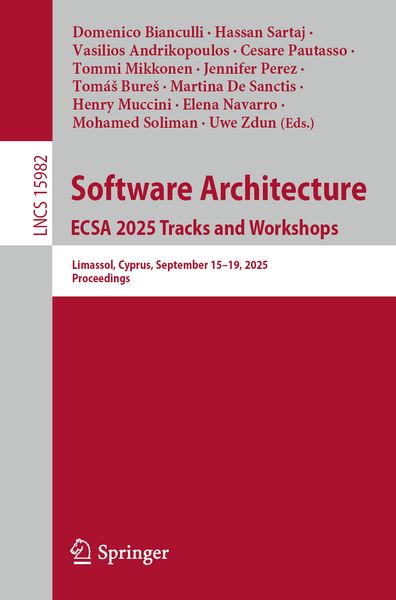
Produktbild: Software Architecture. ECSA 2025 Tracks and Workshops
Band 15982

Software Architecture. ECSA 2025 Tracks and Workshops Limassol, Cyprus, September 15–19, 2025, Proceedings

58,99 €

inkl. gesetzl. MwSt., Versandkostenfrei


Beschreibung

Produktdetails

Einband

Taschenbuch

Erscheinungsdatum

08.09.2025

Abbildungen

XXVI, 390 p. 89 illus., 71 illus. in color.

Herausgeber

Hassan Sartaj + weitere

Verlag

Springer

Seitenzahl

390

Maße (L/B/H)

23,5/15,5/2,3 cm

Gewicht

628 g

Sprache

Englisch

ISBN

978-3-032-04402-0

Beschreibung

Produktdetails

Einband

Taschenbuch

Erscheinungsdatum

08.09.2025

Abbildungen

XXVI, 390 p. 89 illus., 71 illus. in color.

Herausgeber

Verlag

Springer

Seitenzahl

390

Maße (L/B/H)

23,5/15,5/2,3 cm

Gewicht

628 g

Sprache

Englisch

ISBN

978-3-032-04402-0

Herstelleradresse

Springer-Verlag KG
Sachsenplatz 4-6
1201 Wien
AT

Email: ProductSafety@springernature.com

Noch keine Bewertungen vorhanden

Verfassen Sie die erste Bewertung zu diesem Artikel

Helfen Sie anderen Kundinnen und Kunden durch Ihre Meinung.

Kundinnen und Kunden meinen

Bewertungen (0)

  • Produktbild: Software Architecture. ECSA 2025 Tracks and Workshops

  • .- Tools and Demos.


    .- SAVAT: A Tool for Visualizing the Impact of Changes in Microservices.


    .- Infragenie: Living Software Architecture Diagrams From Docker Compose Files.


    .- ServLessSense: Serverless Smell Detection Tool.


    .- CUBEX: A CubeSat Exemplar for Teaching Software Architecture Principles.


    .- Tutorial.


    .- Software Architecture in the Age of Agentic AI.


    .- Doctoral Symposium.


    .- Requirements-compliant IT system deployment architectures for IoT


    systems.


    .- GreenDevLoop: Power-Aware Software Development with CI/CD, AI


    and Feedback.


    .- Architecting Carbon-aware Software-as-a-Service.


    .- Temporal Network Analysis of Microservice Architectural Degradation.


    .- AISA workshop.


    .- The Impact of AI-Generated Solutions on Software Architecture and


    Productivity: Results from a Survey Study.


    .- Autonomic Microservice Management via Agentic AI and MAPE-K


    Integration.


    .- Application of AI in Software Architecture Development at Volvo


    Construction Equipment.


    .- Towards Benchmarking Design Pattern Detection Under Obfuscation:


    Reproducing and Evaluating Attention-Based Detection Method.


    .- LLM-Based Explainability at Design Time: Detecting Elasticity


    Antipatterns in Software Architectures.


    .- AI-Powered Architecting for Industry 4.0 Cyber-Physical Production


    Systems: A Novel Approach, Research Problems and Challenges.


    .- AMP workshop.


    .- Assessing the Impact of Asynchronous Communication on Resilience


    and Robustness: A Comparative Study of Microservice and Monolithic


    Architectures.


    .- Exploring Micro Frontends: A Case Study Application in E-Commerce.


    .- Industrial views on DevOps adoption before and after implementation:


    A qualitative comparison.


    .- The (C)omprehensive (A)rchitecture (P)attern (I)ntegration method:


    Navigating the sea of technology.


    .- ArchDTO workshop.


    .- Requirements for a Digital Twin of Organizations for Advancing


    Cybersecurity Risk Management.


    .- AROSA Workshop.


    .- Comprehensive Exploration of Resilience and Adaptability in IoT-based


    System-of-Systems: Bibliometric and Full-Text Literature Analysis.


    .- Recent Literature Review on Modeling Explainable Medical


    Cyber-Physical Systems: A Bibliometric Analysis.


    .- Silver Box Testing for Scaling Software Development Fidelity:


    Enhancing Quality and Efficiency.


    .- CASA Workshop.


    .- The Lifecycle Workbench - A Configurable Framework for Digitized


    Product Maintenance Services.


    .- Exploring Static Analysis for Understanding Self-Adaptive Systems.


    .- SADIS Workshop.


    .- AutoML: A Tertiary Study of Phases, Methods, Tools, and Frameworks.


    .- FAIR-ER Data: Proposing a data model for Data Cooperatives.


    .- GLOVES 2.0: Global Counterfactual-based Visual Explanations.


    .- Temporal Harmonization of Heterogeneous Software Logs: A Unified


    Model for Time-Series Analysis.


    .- Making a Pipeline Production-Ready: Challenges and Lessons Learned


    in the Healthcare Domain.


    .- DQGen: Scalable Metadata-Driven Automation for Data Quality


    Validation in Data-Intensive Applications.


    .- A Visionary Architecture for Adaptive Data Contracts in


    Behavior-Driven IoT Systems.