Gutscheinbedingungen

**Gültig bis 06.07.2026 auf fremdsprachige Bücher online auf thalia.at, in der Thalia App ab einem Mindestbestellwert von 30€ und in allen Thalia Buchhandlungen in Österreich. In den Buchhandlungen nur gültig auf lagernde Ware. Einzelne Artikel können ausgeschlossen sein. Ausgenommen sind preisgebundene Artikel & eBooks. Pro Einkauf einmal einlösbar. Nur gültig gegen Vorlage oder im Onlineshop hinterlegter Bonuscard. Infos zur Einlösung in der Buchhandlung sind auf der Bonuscard-Vorteilspreisseite zu finden. Click & Collect nur bei Onlinevorabzahlung möglich. Keine Einlösung bei Scan & Go-Bezahlung. Keine Barauszahlung. Nicht kombinierbar mit anderen Aktionen und Gutscheinen. Gutschein wird auf max. 500€ Bestellwert angerechnet. Nicht gültig für Versandkosten und Services.

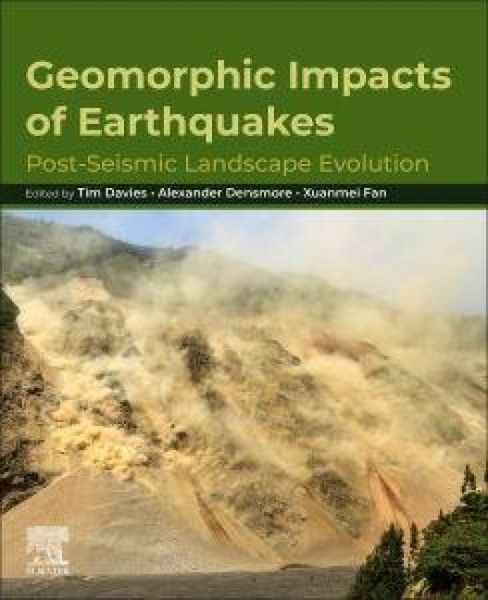
Produktbild: Geomorphic Impacts of Earthquakes
Vorbesteller Neu

Geomorphic Impacts of Earthquakes Post-Seismic Landscape Evolution

148,99 €

inkl. gesetzl. MwSt., Versandkostenfrei


Beschreibung

Produktdetails

Einband

Taschenbuch

Erscheinungsdatum

01.09.2026

Herausgeber

Tim Davies + weitere

Verlag

Elsevier

Seitenzahl

410

Maße (L/B)

23,5/19,1 cm

Gewicht

450 g

Sprache

Englisch

ISBN

978-0-443-40375-0

Beschreibung

Portrait

Tim Davies is a Professor in the School of Earth and Environment at the University of Canterbury (NZ). His research focusses on the application of geomorphology in prediction of landform response to disturbance, in particular in the context of natural hazard assessment and disaster impact reduction.

Prof. Xuanmei Fan, an esteemed expert in geological hazards and risk assessment, is currently affiliated with Chengdu University of Technology. With a background at the United Nations Institute for Training and Research (UNITAR) and as a Full Professor at the State Key Laboratory of Geohazard Prevention and Geoenvironment Protection in China, her research focuses on earthquake-induced geological hazards, particularly in the Tibetan Plateau. Notably, Prof. Fan's studies on the causes and effects of earthquake-induced landslides following the 2008 Wenchuan earthquake have been extensive. She has made significant contributions to the development of early warning systems for post-earthquake debris flows, resulting in numerous lives saved. Her exceptional achievements have garnered recognition, including the 2016 Richard Wolters Prize from the International Association for Engineering Geology and the Environment (IAEG). Prof. Xuanmei Fan's remarkable contributions to science and technology have earned her acclaim as one of China's top female geologists, receiving national and provincial prizes in honor of her accomplishments.

Prof Alexander Densmore, Deputy Head of the Department of Geography at Durham University, UK, is a leading expert in the dynamic processes shaping Earth's surface. Raised on the tectonically active west coast of North America, his fascination with mountain-building and erosion has driven his academic pursuits. After earning a PhD from the University of California, Santa Cruz, he held prestigious positions at Trinity College Dublin and ETH Zurich before joining Durham University in 2006. Currently, his research delves into the aftermath of earthquakes on mass wasting and sediment transfer in Nepal and China. He also focuses on utilizing scientific data to mitigate earthquake and monsoon-induced hazards, particularly in Nepal. Furthermore, his work extends to comprehending sediment routing systems, employing both field studies in northern India and advanced numerical modeling techniques. Professor Densmore's multidisciplinary approach enriches our understanding of geological phenomena and their societal impacts.

Produktdetails

Einband

Taschenbuch

Erscheinungsdatum

01.09.2026

Herausgeber

Verlag

Elsevier

Seitenzahl

410

Maße (L/B)

23,5/19,1 cm

Gewicht

450 g

Sprache

Englisch

ISBN

978-0-443-40375-0

Herstelleradresse

Libri GmbH
Europaallee 1
36244 Bad Hersfeld
DE

Email: gpsr@libri.de

Noch keine Bewertungen vorhanden

Verfassen Sie die erste Bewertung zu diesem Artikel

Helfen Sie anderen Kundinnen und Kunden durch Ihre Meinung.

Kundinnen und Kunden meinen

Bewertungen (0)

  • Produktbild: Geomorphic Impacts of Earthquakes
  • Section A - Fundamentals
    1. Introduction: Tectonics, Earthquakes, and Landforms: The Big Picture
    2. Large Earthquakes - Spatio-Temporal Distribution and Aftershocks
    3. Coseismic Ground Motion
    4. Rock Fracture and Ground Failure
    5. Earth Surface Processes
    6. Seismotectonic-Geomorphic Event Cascades

    Section B - Tectonic Processes and Morphologies
    7. Fault Trace Processes
    8. Slope Failure Processes
    9. Coseismic Landslides and Rockfalls, Paraseismic Landslides, Source and Deposit Morphologies
    10. Liquefaction and lateral spreading
    11. Fluvial Responses to Fault Offset and Uplift, and to Sediment Inputs
    12. Glacial Processes and Impacts
    13. Coastal Processes and Impacts
    14. Marine Processes
    15. Post-Earthquake Sediment and Fluxes
    16. Geomorphic Indicators of Past Earthquakes
    17. Climate Change Influences on Earthquake Geomorphology
    18. Anthropic Influences on Earthquake Geomorphology

    Section C - Case Studies
    19. 1999 Chichi earthquake, Taiwan (remote sensing and analysis, and fluvial impacts)
    20. 2008 Wenchuan earthquake, China (remote sensing and analysis, post-seismic debris flows, and river aggradation)
    21. 2011 Tohoku earthquake (unexpected magnitude, geomorphic evidence of prior events, and tsunami)
    22. 2015 Gorka earthquake, Nepal (mass movements and societal impacts)
    23. 2016 Kaikoura earthquake (multiple fault ruptures, landslides and fluvial impacts)

    Section D - Conclusion
    24. Implications for Natural Hazard Risk Analysis, Risk Assessment, Impacts And Mitigation - Examples
    25. Summary and Future Perspectives