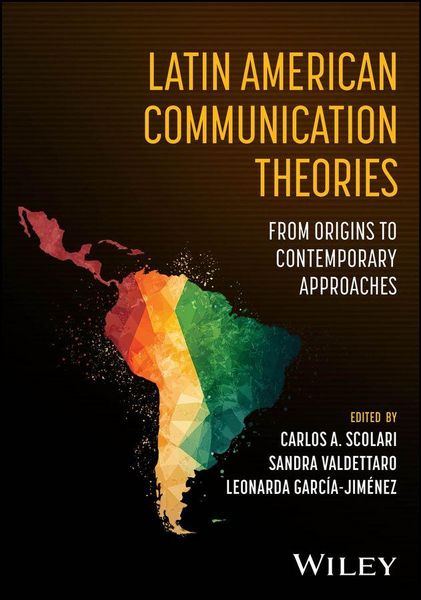
Latin American Communication Theories From Origins to Contemporary Approaches
-
- Englisch ausgewählt
99,99 €
inkl. gesetzl. MwSt.,
Beschreibung
Produktdetails
Einband
Taschenbuch
Erscheinungsdatum
02.09.2026
Herausgeber
Carlos A. Scolari + weitereVerlag
WileySeitenzahl
288
Maße (L/B/H)
25,2/17,8/1,5 cm
Gewicht
590 g
Auflage
1. Auflage
Sprache
Englisch
ISBN
978-1-394-30782-1
The first English-language anthology of Latin American communication theory
Latin American communication scholarship has shaped global debates on mediation, dependency, and mediatization, yet most foundational texts remain unavailable in English. Latin American Communication Theories: From the Origins to Contemporary Approaches, assembled by a team of communication scholars based at leading universities in Spain and Argentina, translates and contextualizes key writings from six decades of regional research for an international readership.
The volume maps intellectual trajectories from development and dependency theories through mediation, cultural industries, popular cultures, and mediatization. Introductory and section-level editorial texts guide readers through the historical, institutional, and theoretical evolution of the field. Classic contributions appear alongside emerging voices, creating a structured overview that connects Latin American debates with contemporary global discussions in media and communication studies.
Readers will also find:
- A curated selection of foundational Latin American texts published in English for the first time, spanning six decades of scholarship
- Editorial framing that contextualizes each section within the broader historical and institutional development of the communication field
- Critical engagement with hegemonic paradigms from the Global North, highlighting the originality of Latin American theoretical perspectives
- Coverage of key concepts including dependency theory, mediation, mediatization, cultural industries, and popular cultures across the region
- A structured intellectual map suitable for graduate coursework in global communication theory, media studies, and Latin American studies
Designed for graduate students, doctoral researchers, and faculty in communication theory, media studies, cultural studies, and Latin American studies, this anthology provides direct access to a scholarly tradition that has remained largely outside the English-language canon while offering structured pathways through its core debates and concepts.
Noch keine Bewertungen vorhanden
Verfassen Sie die erste Bewertung zu diesem Artikel
Helfen Sie anderen Kundinnen und Kunden durch Ihre Meinung.
Kurze Frage zu unserer Seite
Vielen Dank für Ihr Feedback
Wir nutzen Ihr Feedback, um unsere Produktseiten zu verbessern. Bitte haben Sie Verständnis, dass wir Ihnen keine Rückmeldung geben können. Falls Sie Kontakt mit uns aufnehmen möchten, können Sie sich aber gerne an unseren Kund*innenservice wenden.
zum Kundenservice