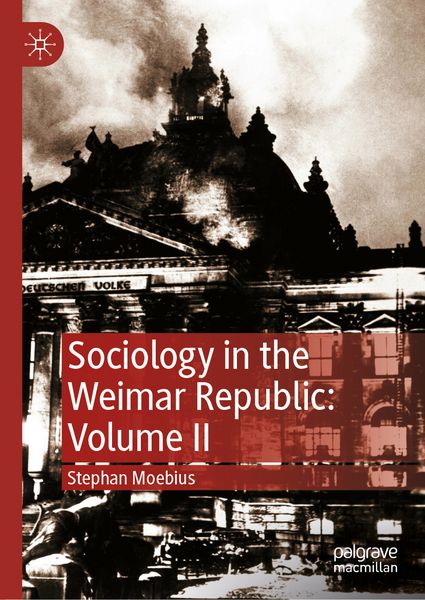
Sociology in the Weimar Republic: Volume II
135,99 €
UVP
153,99 €
inkl. gesetzl. MwSt.,
Beschreibung
Produktdetails
Einband
Gebundene Ausgabe
Erscheinungsdatum
11.11.2025
Abbildungen
XIII, 1 illus., schwarz-weiss Illustrationen
Verlag
SpringerSeitenzahl
171
Maße (L/B/H)
21,6/15,3/1,5 cm
Gewicht
361 g
Sprache
Englisch
ISBN
978-3-032-03779-4
This book — a two-volume work —reexamines the development of sociology during the Weimar Republic, characterising it as a period of remarkable theoretical, institutional, and disciplinary vitality. Contrary to conventional assumptions, sociology experienced a dynamic phase of professionalisation and differentiation during this period, establishing itself both as an academic discipline and as a practice of societal self-reflection in a time of economic, political, social, and cultural upheaval. By engaging with the crises of democracy, capitalism, new media, modernity, relativism, intellectual life, and identity, sociology came to play a crucial orienting role within Weimar society.
The professional self-examination of modern society that this initiated continues to yield valuable insights into how social and historical processes unfold in modern societies. As such, studying sociology during the Weimar period is not just of interest to historians of science; it remains highly relevant to anyone seeking to understand the dynamics and structures of contemporary modern societies.
Volume 2 examines how sociology in the Weimar Republic positioned itself in response to the economic, political, social, and intellectual crises of modernity. Set against a backdrop of fragmentation, relativism, and a perceived absence of normative foundations, the book traces key debates over how sociology might provide coherence and direction. One section considers the theoretical approaches developed to challenge historicism and epistemic uncertainty. Another investigates the emergence of a sociology of intellectuals, reflecting on the role of thought leaders in a society marked by polarisation and ideological upheaval. A third section explores sociological analyses of the era’s central crises—democracy under strain, capitalism in turmoil, the ambivalence of individualisation, and the longing for community and cultural meaning. Across these responses, the volume reveals sociology’s self-understanding as a science of orientation and societal reflection — an ambition that remains as urgent today as it was in the Weimar era.
Noch keine Bewertungen vorhanden
Verfassen Sie die erste Bewertung zu diesem Artikel
Helfen Sie anderen Kundinnen und Kunden durch Ihre Meinung.
Kurze Frage zu unserer Seite
Vielen Dank für Ihr Feedback
Wir nutzen Ihr Feedback, um unsere Produktseiten zu verbessern. Bitte haben Sie Verständnis, dass wir Ihnen keine Rückmeldung geben können. Falls Sie Kontakt mit uns aufnehmen möchten, können Sie sich aber gerne an unseren Kund*innenservice wenden.
zum Kundenservice