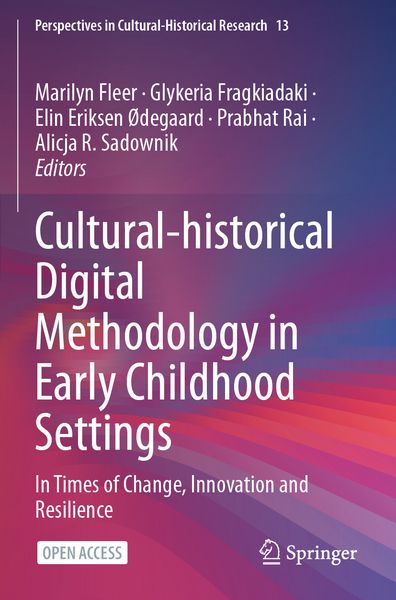
Produktbild: Cultural-historical Digital Methodology in Early Childhood Settings

Cultural-historical Digital Methodology in Early Childhood Settings In Times of Change, Innovation and Resilience

39,99 €

inkl. gesetzl. MwSt., Versandkostenfrei


Beschreibung

Produktdetails

Einband

Taschenbuch

Erscheinungsdatum

12.07.2025

Herausgeber

Marilyn Fleer + weitere

Verlag

Springer

Seitenzahl

305

Maße (L/B/H)

23,5/15,5/1,8 cm

Gewicht

487 g

Sprache

Englisch

ISBN

978-3-031-59787-9

Beschreibung

Produktdetails

Einband

Taschenbuch

Erscheinungsdatum

12.07.2025

Herausgeber

Verlag

Springer

Seitenzahl

305

Maße (L/B/H)

23,5/15,5/1,8 cm

Gewicht

487 g

Sprache

Englisch

ISBN

978-3-031-59787-9

Herstelleradresse

Springer-Verlag KG
Sachsenplatz 4-6
1201 Wien
AT

Email: GPSR Kontakt

Noch keine Bewertungen vorhanden

Verfassen Sie die erste Bewertung zu diesem Artikel

Helfen Sie anderen Kundinnen und Kunden durch Ihre Meinung.

Kundinnen und Kunden meinen

Bewertungen (0)

Weitere Artikel finden Sie in

  • Produktbild: Cultural-historical Digital Methodology in Early Childhood Settings
  • 1.Cultural-historical digital methodology: In times of change, innovation and resilience in the early years.- 2. Theoretical framing of a digital education experiment.- 3. Beyond physical space: Using digital technology as a relational tool to support collaborative educational experiment implementation.- 4. The individual and collective minds behind the role of the educator-researcher: An integrated educational experiment.- 5. Methodological opportunities in using Digital tools: An Educational experiment aimed at studying young children's theoretical modelling in science.- 6. The role of social media used in a digital experiment with kindergarten teachers in China.- 7. Digital analysis: challenges, possibilities, and opportunities.- 8. Mapping the Pathway of Science Concept Formation Across Infancy and Toddlerhood: A Digital Methodology.- 9. Becoming conscious of gendered interactions: Teacher development through an app as a digital tool.- 10. Cultural Historical digital methodologies and analysis: Lessons learned from a hybrid to a fully digitalised approach.- 11. Beyond the everyday: Digital tools for analysing how children create their own developmental conditions for inclusion.- 12. Historical and Psychological Materialism: Conceptual tools for digital educational experiments in the family settings.- 13. Creating Conditions for the Doubleness of Parents’ Role in Research: Building Research Intersubjectivity between the Researcher and Parents in a Digital Cultural-Historical Educational Experiment.- 14. Narrative-based digital apps to help families create motivating conditions for young children’s spatial reasoning skills development.- 15. Conceptual PlayWorlds for families: A social media educational experiment with families to support young children’s STEM concept formation in home settings.- 16. Conceptualising the role of parents in digital educational experiments: Conceptual PlayWorlds in family settings.- 17. defysicalisation or innovation of institutional practice: question of motives encouraged by digital artifacts.- 18. Transformation of Academic Teachers’ Motives and Dilemmas When Digitalising Kindergarten Teacher Education in Norway.- 19. Researching intergenerational engagements and programmes during the COVID-19 pandemic: a methodological reflexivity.- 20. (Data) Sharing is caring: corona-changes of research design in a PhD project.- 21. Multiple Perspectives in Digital Visual Observation: A New Methodological Approach to Study Children.- 22. Digital data and communication in context of the profession.- 23. Resilience in partnership research – using digital platforms in the co-creation of knowledge in pandemic times.- 24. PLUM – SKUM - The making of a Video of washing hands with and for the youngest children after the outbreak of Covid-19.- 25. VR technology in preschool teacher education -Methodological reflections.- 26. Digitaliation – professional development/teacher education – internationalization.- 27. Afterwords/Conclusions.