Gutscheinbedingungen

**Gültig von 22.06.2026 ab 19 Uhr bis 23.06.2026 24 Uhr auf Spielzeug, Schreibwaren, Filme, Geschenke & Trends, Musik, tolino eReader & Zubehör, Hörbücher und Hörbuch-Downloads (außer Abo), nicht preisgebundene Bücher und Kalender online auf thalia.at und in der Thalia App. Einzelne Artikel können ausgeschlossen sein. Aufgrund der Buchpreisbindung sind deutschsprachige Bücher und eBooks ausgenommen. Zusätzlich ausgenommen sind preisgebundene Artikel, Abos & Flatrates, eBooks, Games, Geschenkkarten/-boxen, Shelfies, Software, Zeitschriften sowie einzelne Artikel von tonies®. Pro Einkauf einmal einlösbar. Click & Collect nur bei Onlinevorabzahlung möglich. Keine Barauszahlung. Nicht kombinierbar mit anderen Aktionen und Gutscheinen. Gutschein wird auf max. 500€ Bestellwert angerechnet. Nicht gültig für Versandkosten und Services.

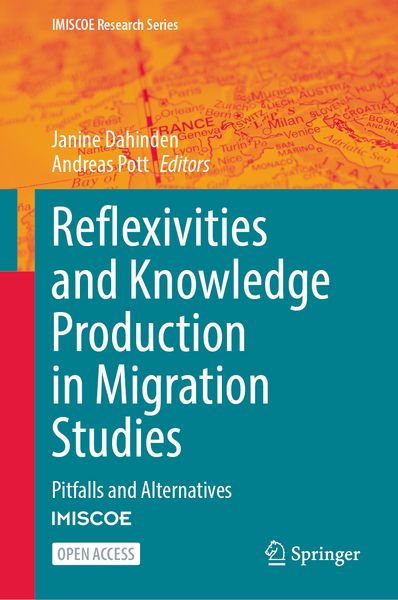
Produktbild: Reflexivities and Knowledge Production in Migration Studies

Reflexivities and Knowledge Production in Migration Studies Pitfalls and Alternatives

Aus der Reihe IMISCOE Research Series

49,99 €

inkl. gesetzl. MwSt., Versandkostenfrei


Beschreibung

Produktdetails

Einband

Gebundene Ausgabe

Erscheinungsdatum

31.10.2025

Abbildungen

XVI, 6 illus., schwarz-weiss Illustrationen

Herausgeber

Janine Dahinden + weitere

Verlag

Springer

Seitenzahl

352

Maße (L/B/H)

24,1/16/2,5 cm

Gewicht

637 g

Sprache

Englisch

ISBN

978-3-032-03336-9

Beschreibung

Portrait

Janine Dahinden is Professor of transnational Studies at the University of Neuchâtel and research director of the NCCR on the move, Switzerland. She is also the co-director of the IMISCOE Standing Committee on Reflexivities in Migration Studies. Her research contributes mainly to three domains: Reflexivities and knowledge production in migration studies, the social organization of 'difference' and mobility studies.  In particular, her research is anchored in what has been called reflexive migration studies: she aims at developing theoretical and methodological approaches which can overcome the nation-state- and ethnicity-centred epistemology that still largely informs migration studies and that not only creates particular forms of exclusions but also runs the risk to reproduce hegemonic structures. She proposed a few years ago to 'de-migranticize' research on migration and integration as one possible way to tackle such problems. Meanwhile she became more generally interested in the pattern how knowledge is produced within migration studies and the ethical, political and epistemological consequences that go with it.

Andreas Pott is Professor of Social Geography at Osnabrück University, Germany. He is chair of the Collaborative Research Centre Production of Migration (SFB 1604), funded by the German Research Foundation (DFG) since 2024. He serves as deputy director of the interdisciplinary Institute for Migration Research and Intercultural Studies (IMIS) and co-director of the IMISCOE Standing Committee on Reflexivities in Migration Studies. His academic work is dedicated to the study of geographies of migration and to the development of a reflexive theory of the societal production of migration.

Produktdetails

Einband

Gebundene Ausgabe

Erscheinungsdatum

31.10.2025

Abbildungen

XVI, 6 illus., schwarz-weiss Illustrationen

Herausgeber

Verlag

Springer

Seitenzahl

352

Maße (L/B/H)

24,1/16/2,5 cm

Gewicht

637 g

Sprache

Englisch

ISBN

978-3-032-03336-9

Herstelleradresse

Springer-Verlag GmbH
Tiergartenstr. 17
69121 Heidelberg
DE

Email: ProductSafety@springernature.com

Kundinnen und Kunden meinen

0 Bewertungen

Informationen zu Bewertungen

Zur Abgabe einer Bewertung ist eine Anmeldung im Konto notwendig. Die Authentizität der Bewertungen wird von uns nicht überprüft. Wir behalten uns vor, Bewertungstexte, die unseren Richtlinien widersprechen, entsprechend zu kürzen oder zu löschen.

Die Bewertungen sind nach Format, Anzahl Sterne und Datum sortiert.

Verfassen Sie die erste Bewertung zu diesem Artikel

Helfen Sie anderen Kund*innen durch Ihre Meinung

Kundinnen und Kunden meinen

0 Bewertungen filtern

  • Produktbild: Reflexivities and Knowledge Production in Migration Studies
  • Chapter 1. Why We (Still) Need to Think and Write About Reflexivities in Migration Studies.- Part I: Epistemology and Producing Knowledge.- Chapter 2. Writing Migrants. Or What I Learnt About the Racialised Production of ‘Scientificity’ While Crossing the Boundary Between Researched Migrant and Migration Researcher.- Chapter 3. Unsettling Normalisation Through Strong Reflexivity: Engaged Scholarship’s Co-Creating Practices Toward Refugees’ Inclusion in the Netherlands.- Chapter 4. Practicing Double Reflexivity. Producing Knowledge on the Production of Knowledge on Migration.- Chapter 5. The Crisis of Representation and the Reflexive Turn in Migration Studies.- Part II: Knowledge Production and Power.- Chapter 6. Decolonising This, Decolonising That: Beyond Rhetorical Decolonisation in Migration Studies.- Chapter 7. Unequal Knowledge Production and Circulation in Migration Studies: Feminist Perspectives.- Chapter 8. Linguistic Hegemony, Marginalization, and Migration Scholarship. A View from the Francophone World.- Chapter 9. Racism in/through Migration Studies.- Part III: Concepts and Categorisations.- Chapter 10. What Comes After ‘Post-Migration’? On the Biographies of Terms.- Chapter 11. A Reflexive Turn in Integration and Assimilation Studies. The Importance of the Power of White People Without a Migration Background.- Chapter 12. Experimenting with Analytical Categories as Reflexive Method: Mobility Trajectories to Study Young People with and without Migration Background.- Chapter 13. The Violence in and the Violence of Gendered Representations of Migrant Others.- Chapter 14. Mixed Migration-Mobility Couples: Disrupting the Age-Old Marriage Between Migration and Culture.- Chapter 15. Kinship Theory and Migration Studies: Challenging Ethnocentrism, Normativity, and State-Centered Epistemologies.- Part IV: Reflecting Reflexivities.- Chapter 16. Rethinking Reflexivities in Migration Studies. A Conversation.- Chapter 17. Shake It, Stretch It, Share It! Moving Reflexivities Beyond Migration.