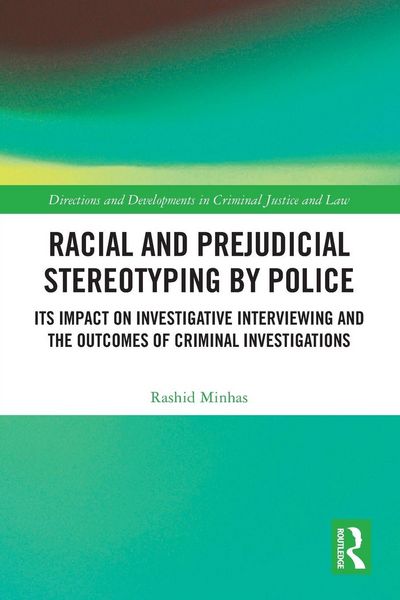
Racial and Prejudicial Stereotyping by Police Its Impact on Investigative Interviewing and the Outcomes of Criminal Investigations
-
- Hardcover
- Taschenbuch ausgewählt
- eBook
-
Sprache:Englisch
63,99 €
inkl. gesetzl. MwSt.,
Beschreibung
Produktdetails
Einband
Taschenbuch
Erscheinungsdatum
29.08.2025
Abbildungen
schwarz-weiss Illustrationen, Raster, schwarz-weiss, Tabellen, schwarz-weiss
Verlag
Taylor and FrancisSeitenzahl
232
Maße (L/B/H)
22,9/15,2/1,3 cm
Gewicht
360 g
Sprache
Englisch
ISBN
978-1-03-243338-7
This book uncovers the influence of racial and prejudicial stereotyping during police investigation of suspects from stigmatised communities. It examines the under-researched aspect of whether and how negative stereotypes appear to influence the police interviews, investigative decision-making, and outcomes of criminal investigations when officers investigate individuals from stigmatised communities as suspects of crime.
In the United Kingdom, the United States, and Europe, the war on terror has been argued to impact adversely on existing race relations policies in the aftermath of terrorist activity in both the United States and Europe. Recent research has suggested that changes in legislation and counterterrorism measures have contributed to the construction and reinforcement of the Muslim community as a suspect, which, in turn, may result in police bias and prejudice towards members of Muslim communities. Based on novel and groundbreaking research studies, the author examines whether such police bias could influence the police investigation and interviewing processes concerning individuals from the suspect community as well as the outcome of a criminal investigation.
The author introduces the Minhas Investigative Interviewing Prejudicial Stereotyping Scale (MIIPSS), an instrument developed and used to assess the level of police interviewers' racial and prejudicial stereotyping towards suspects from stigmatised groups, and maintains that its use would serve to minimise the influence of racial and prejudicial stereotypes on investigation. It is further suggested that the training of police officers on the implications of such prejudicial (racial/ religious) stereotyping is essential to improving interviewing performance, case outcomes, and community cohesion.
This book will benefit academics, researchers, police officers, lawyers, social policy officers, and probation officers across the globe.
Noch keine Bewertungen vorhanden
Verfassen Sie die erste Bewertung zu diesem Artikel
Helfen Sie anderen Kundinnen und Kunden durch Ihre Meinung.
Kurze Frage zu unserer Seite
Vielen Dank für Ihr Feedback
Wir nutzen Ihr Feedback, um unsere Produktseiten zu verbessern. Bitte haben Sie Verständnis, dass wir Ihnen keine Rückmeldung geben können. Falls Sie Kontakt mit uns aufnehmen möchten, können Sie sich aber gerne an unseren Kund*innenservice wenden.
zum Kundenservice