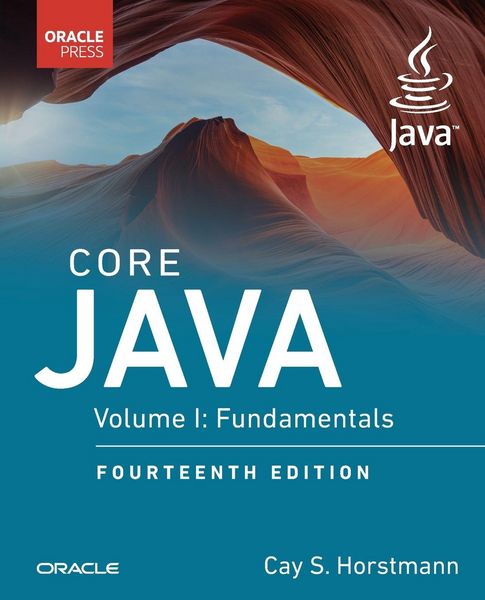
Core Java, Volume I Fundamentals
-
- Taschenbuch ausgewählt
- eBook
-
Sprache:Englisch
96,99 €
inkl. gesetzl. MwSt.,
Beschreibung
Produktdetails
Einband
Taschenbuch
Erscheinungsdatum
20.10.2025
Verlag
Pearson AcademicSeitenzahl
816
Maße (L/B/H)
23/18/4,9 cm
Gewicht
1083 g
Auflage
14th edition
Sprache
Englisch
ISBN
978-0-13-555857-7
The Classic Guide to the Java Programming Language--Fully Updated through Java 25
Whatever version of Java you are using, Core Java, Volume I: Fundamentals, Fourteenth Edition, will help you achieve a deep and practical understanding of the language and APIs. With hundreds of realistic examples, Java Champion Cay S. Horstmann demonstrates the most powerful and effective ways to get the job done.
Written for experienced programmers looking for in-depth coverage of the Java language and platform, this revised and updated edition continues to be the first choice for serious programmers. The carefully crafted sample programs demonstrate almost every language and library feature, as well as the newest capabilities introduced in Java 25. The examples are purposefully simple to focus on the major points, but for the most part, they aren't fake and they don't cut corners. They should make good starting points for your own code.
This first of two volumes offers a detailed treatment of fundamental Java programming topics, including object-oriented programming, reflection and proxies, interfaces and inner classes, exception handling, generics, collections, lambda expressions, concurrency, annotations, and the Java platform module system.
- Master foundational techniques, idioms, and best practices for
writing superior Java code - Leverage the power of interfaces, lambda expressions, and inner classes
- Take advantage of sealed class hierarchies and pattern matching for processing structured data
- Harden programs through effective exception handling and debugging
- Write safer, more reusable code with generic programming
- Improve performance and efficiency with Java's standard collections
- Explore simple programs with compact compilation units, instance main methods, and module imports
- Assemble complex programs with archives and modules
- Effectively utilize Java's powerful concurrency model, using platform and virtual thread
This is the definitive reference and instructional work for Java and the Java ecosystem."
--Andrew Binstock, Java Magazine
See Core Java, Volume II: Advanced Features, Fourteenth Edition, for coverage of Java 25 enterprise features, including detailed discussions of networking, security, internationalization, and advanced UI programming.
Register your book for convenient access to downloads, updates, and/or corrections as they become available. See inside book for details.
Noch keine Bewertungen vorhanden
Verfassen Sie die erste Bewertung zu diesem Artikel
Helfen Sie anderen Kundinnen und Kunden durch Ihre Meinung.
Kurze Frage zu unserer Seite
Vielen Dank für Ihr Feedback
Wir nutzen Ihr Feedback, um unsere Produktseiten zu verbessern. Bitte haben Sie Verständnis, dass wir Ihnen keine Rückmeldung geben können. Falls Sie Kontakt mit uns aufnehmen möchten, können Sie sich aber gerne an unseren Kund*innenservice wenden.
zum Kundenservice