Gutscheinbedingungen

**Gültig bis 06.07.2026 auf fremdsprachige Bücher online auf thalia.at, in der Thalia App ab einem Mindestbestellwert von 30€ und in allen Thalia Buchhandlungen in Österreich. In den Buchhandlungen nur gültig auf lagernde Ware. Einzelne Artikel können ausgeschlossen sein. Ausgenommen sind preisgebundene Artikel & eBooks. Pro Einkauf einmal einlösbar. Nur gültig gegen Vorlage oder im Onlineshop hinterlegter Bonuscard. Infos zur Einlösung in der Buchhandlung sind auf der Bonuscard-Vorteilspreisseite zu finden. Click & Collect nur bei Onlinevorabzahlung möglich. Keine Einlösung bei Scan & Go-Bezahlung. Keine Barauszahlung. Nicht kombinierbar mit anderen Aktionen und Gutscheinen. Gutschein wird auf max. 500€ Bestellwert angerechnet. Nicht gültig für Versandkosten und Services.

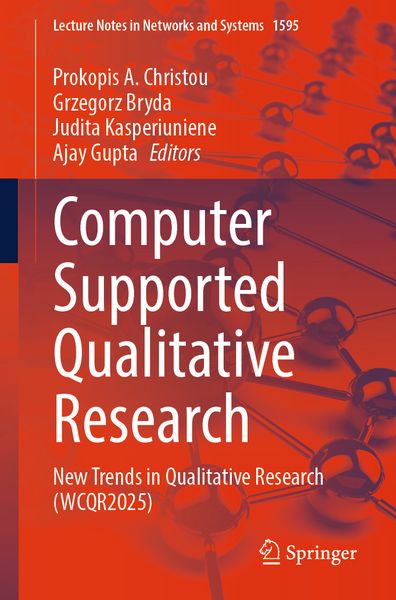
Produktbild: Computer Supported Qualitative Research
Band 1595 - 13%

Computer Supported Qualitative Research New Trends in Qualitative Research (WCQR2025)

13% sparen

189,99 € UVP 219,99 €

inkl. gesetzl. MwSt., Versandkostenfrei


Beschreibung

Produktdetails

Einband

Taschenbuch

Erscheinungsdatum

03.01.2026

Abbildungen

XI, 86 illus., 75 illus. in color., farbige Illustrationen, schwarz-weiss Illustrationen

Herausgeber

Prokopis A. Christou + weitere

Verlag

Springer

Seitenzahl

436

Maße (L/B/H)

23,5/15,5/2,5 cm

Gewicht

680 g

Sprache

Englisch

ISBN

978-3-032-02998-0

Beschreibung

Portrait

Prokopis A. Christou is an assistant professor at the Cyprus University of Technology. His research interests center on qualitative inquiry and how this is influenced by technological innovation, particularly Artificial Intelligence (AI). He is also concerned with the broader impact of AI on research and societal fields, such as education, psychology, and tourism. He is the author of three books, the editor of the book Artificial Intelligence in Social Research, and has published academic papers on the intersection of AI and qualitative research.

Grzegorz Bryda is an assistant professor at Jagiellonian University and head of CAQDAS TM Lab, as well as director of CAQDAS TM Summer School, specializes in Cognitive Sociology, Qualitative Digital Sociology, Digital Humanities, and AI with focus on NLP and LLMs. He has a strong foundation in both quantitative and qualitative research, leading over 450 Focus Groups and conducting 300+ in-depth interviews, completing 80+ projects in market and social research. Now he incorporates AI technologies (NLP/LLMs), and Text Mining into Qualitative Data Analysis and Modeling. He worked as a senior consultant for IBM Predictive Solutions (former SPSS Polska) and held various roles at Jagiellonian University, including Rector’s Proxy for Quality Assurance. He designed evaluation methodologies and data analysis quality assurance system at Jagiellonian University. Currently, he provides methodological consulting, developing AI-enhanced analytical frameworks for institutions and organizations.

Judita Kasperiuniene is an associate professor and head of the System Analysis Department at the Faculty of Informatics, Vytautas Magnus University, Lithuania. She is also a senior researcher at the Educational Research Institute, Education Academy, Vytautas Magnus University, Lithuania, where she leads the research group “Educational Innovation and Change.” Currently, Judita Kasperiuniene conducts interdisciplinary research on the application of generative AI in social research, with a particular emphasis on qualitative and mixed methods approaches. Her recent publications highlight how ChatGPT can function as a co analyst, consultant, and trainer in qualitative coding workflows, demonstrating its value in accelerating data immersion, generating initial coding structures, and distinguishing between human and non human elements in complex data environments.

Dr. Ajay Gupta, a professor at VES Business School, India, is an Erasmus Mundus fellow from the University of Milan, Italy, and a senior ATLAS.ti trainer. With a Ph.D. in organizational psychology from TISS and a master’s from the Asian Institute of Management, Manila, he brings 30 years of experience from the Indian Air Force, banking, and management education. He has taught at TAPMI, Manipal, and IIM Mumbai, earning 9.72/10 faculty feedback. Dr. Gupta has led 40+ workshops globally and authored three books, including “Qualitative Methods and Data Analysis using ATLAS.ti: A Comprehensive Researchers’ Manual,” published by Springer.

Produktdetails

Einband

Taschenbuch

Erscheinungsdatum

03.01.2026

Abbildungen

XI, 86 illus., 75 illus. in color., farbige Illustrationen, schwarz-weiss Illustrationen

Herausgeber

Verlag

Springer

Seitenzahl

436

Maße (L/B/H)

23,5/15,5/2,5 cm

Gewicht

680 g

Sprache

Englisch

ISBN

978-3-032-02998-0

Herstelleradresse

Springer-Verlag KG
Sachsenplatz 4-6
1201 Wien
AT

Email: GPSR Kontakt

Noch keine Bewertungen vorhanden

Verfassen Sie die erste Bewertung zu diesem Artikel

Helfen Sie anderen Kundinnen und Kunden durch Ihre Meinung.

Kundinnen und Kunden meinen

Bewertungen (0)

  • Produktbild: Computer Supported Qualitative Research
  • Part 1: Shaping the future: AI across health, industries and communities.- Stakeholders' visions of AI's future. Analyzing sociotechnological narratives.- A qualitative study on the integration of artificial intelligence in the FinTech industry.- Artificial intelligence in healthcare: A rapid review using Rayyan and webQDA tools.- Responsible technology: Analysing public perception about ethical challenges in digital innovation.- Exploring emotional resilience in youth through AI-driven qualitative research in smart cities.- Part 2: AI in education: Rethinking learning, skills, and academic growth.- The integration of generative artificial intelligence and critical and creative thinking in a learning model.- Artificial intelligence as a mediating tool for training in a phenomenological experience of higher education for engineering.- The role of artificial intelligence in enhancing postgraduate research: A case of chatgpt usage at University of Limpopo.- Identifying key competencies for education PhD students with generative AI integration: A scoping review.- Using artificial intelligence for qualitative analysis of adolescents’ interviews about moral growth.- Part 3: Innovations for learners: Towards inclusive and engaging education.- A qualitative study of effective teaching-learning pedagogy for management education.- An investigation of non-competitive gamification additions to an online course.- Exploring the role of work-life balance among HEI academicians in enhancing higher education quality: A qualitative study using ATLAS.ti 25.- Development of a transmedia awareness campaign for digital inclusion: A study on assistive technologies for children with special educational needs.- Play with music: Developing an inclusive digital musical game for children with Cerebral Palsy.- AI vs Human. Sentiment analysis of children's stories on living with a cochlear implant. Methodological considerations on the analysis of qualitative coding by Humans and AI.- Inclusive spaces: Characterization, audiences and disseminating practices.- Part 4: Reimagining methods: New paths in qualitative research.- The evolution of ethnography in social sciences: The role of the researcher between traditional and new approaches.- Employing mixed intra-paradigm qualitative methodology to examine the extracurricular activities impact on underprivileged pupils and university students.- A step to bridge the gap between qualitative and quantitative research by IAR score: A mathematical equation.