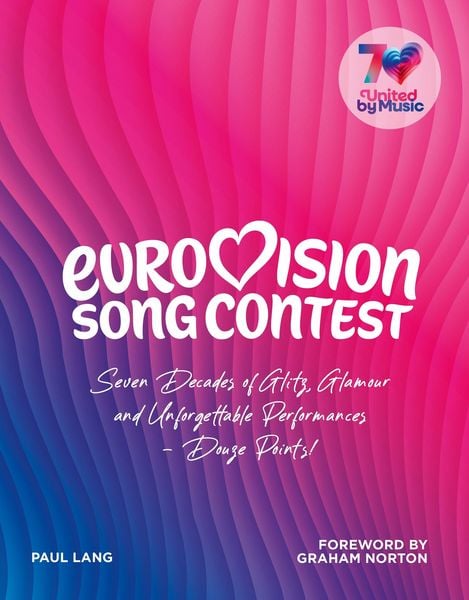
Produktbild: Eurovision
- 24%

Eurovision Seven Decades of Glitz, Glamour and Unforgettable Performances - Douze Points!

Aus der Reihe BBC Books
1
24% sparen

24,99 € UVP 33,30 €

inkl. gesetzl. MwSt., zzgl. Versandkosten


  • Kostenlose Lieferung ab 30 € Einkaufswert
  • Versandkostenfrei für Bonuscard-Kund*innen

Beschreibung

Produktdetails

Verkaufsrang

10537

Einband

Gebundene Ausgabe

Erscheinungsdatum

23.04.2026

Verlag

Vermilion

Seitenzahl

256

Maße (L/B/H)

25,3/19,5/2,4 cm

Gewicht

1010 g

Farbe

Magenta

Sprache

Englisch

ISBN

978-1-78594-993-7

Beschreibung

Produktdetails

Verkaufsrang

10537

Einband

Gebundene Ausgabe

Erscheinungsdatum

23.04.2026

Verlag

Vermilion

Seitenzahl

256

Maße (L/B/H)

25,3/19,5/2,4 cm

Gewicht

1010 g

Farbe

Magenta

Sprache

Englisch

ISBN

978-1-78594-993-7

EU-Ansprechpartner

Penguin Random House Ireland
Morrison Chambers, 32 Nassau Street
D02 YH68 Dublin
IE
E-Mail-Adresse 2:https://eu-contact.penguin.ie

Herstelleradresse

Penguin Random House LLC
One Embassy Gardens, 8 Viaduct Gardens
SW11 7BW London
UK
penguinpublicity@penguinrandomhouse.com

Kundinnen und Kunden meinen

1 Bewertungen

Informationen zu Bewertungen

Zur Abgabe einer Bewertung ist eine Anmeldung im Konto notwendig. Die Authentizität der Bewertungen wird von uns nicht überprüft. Wir behalten uns vor, Bewertungstexte, die unseren Richtlinien widersprechen, entsprechend zu kürzen oder zu löschen.

Die Bewertungen sind nach Format, Anzahl Sterne und Datum sortiert.

5 Sterne

(1)

4 Sterne

(0)

3 Sterne

(0)

2 Sterne

(0)

1 Sterne

(0)

Good tribute to 70 Years of the Eurovison Song Contest

Bewertung am 31.05.2026

Bewertungsnummer: 3154060

Bewertet: Buch (Gebundene Ausgabe)

Producing a book that does justice to the 70-year history of the Eurovision Song Contest was always going to be a formidable challenge, but Paul Lang has succeeded admirably in doing so. Organised by decade, the book's well-written narrative progresses chronologically through the contest's history, a structure that generally works very effectively. One minor exception is the transition from 1972 to 1973, where there is little indication that the narrative has moved into a new year. In a work of this scope, a handful of factual inaccuracies are perhaps inevitable, but they are relatively few. For example, songwriters Phil Coulter and Bill Martin are credited in a photo caption with securing two Eurovision victories for the United Kingdom, despite their hugely successful "Congratulations" finishing as runner-up in 1968. Coulter is also incorrectly identified as the writer of the 1970 winning entry, "All Kinds of Everything". While his orchestral arrangement undoubtedly enhanced the song, its writers were Derry Lindsay and Jackie Smith, a fact Coulter himself has never disputed. The assertion that Vicky Leandros' 1972 winning song was rejected in the German national selection is similarly questionable. While it is widely believed that Leo Leandros initially offered the song to Germany on the condition that it bypass the national final process, he appears to have withdrawn it once Luxembourg agreed to those terms. Elsewhere, Germany's 1988 representatives are described as "returning artists", despite having competed only once. The Swedish group One More Time, who represented Sweden in 1996, are reduced from a trio to a duo, while Denmark's mixed-gender duo from 1999 are promoted to the status of a boy band. Attentive readers may also notice that the book incorrectly identifies Lys Assia in 1957 as the last artist to defend a Eurovision title before Lena in 2011. In fact, that distinction belongs to Corry Brokken, who returned in 1958. The most puzzling error appears near the end of the book, where Tommy Cash's 2025 entry "Espresso Macchiato" is mistakenly listed as "Living for Love". Rather than filling its pages with exhaustive lists of entries and results, the book wisely limits statistical content to a table of winners from 1956 to 2025. Instead, it focuses on a superb collection of photographs that capture many of the most memorable moments from the contest's seven-decade history. This visual approach is where the book truly excels and what makes it an essential addition to the collection of both dedicated Eurovision enthusiasts and more casual fans alike. Graham Norton's foreword sets the tone perfectly, providing an engaging introduction to a highly enjoyable retrospective of one of television's most enduring cultural institutions.

Good tribute to 70 Years of the Eurovison Song Contest

Bewertung am 31.05.2026
Bewertungsnummer: 3154060
Bewertet: Buch (Gebundene Ausgabe)

Producing a book that does justice to the 70-year history of the Eurovision Song Contest was always going to be a formidable challenge, but Paul Lang has succeeded admirably in doing so. Organised by decade, the book's well-written narrative progresses chronologically through the contest's history, a structure that generally works very effectively. One minor exception is the transition from 1972 to 1973, where there is little indication that the narrative has moved into a new year. In a work of this scope, a handful of factual inaccuracies are perhaps inevitable, but they are relatively few. For example, songwriters Phil Coulter and Bill Martin are credited in a photo caption with securing two Eurovision victories for the United Kingdom, despite their hugely successful "Congratulations" finishing as runner-up in 1968. Coulter is also incorrectly identified as the writer of the 1970 winning entry, "All Kinds of Everything". While his orchestral arrangement undoubtedly enhanced the song, its writers were Derry Lindsay and Jackie Smith, a fact Coulter himself has never disputed. The assertion that Vicky Leandros' 1972 winning song was rejected in the German national selection is similarly questionable. While it is widely believed that Leo Leandros initially offered the song to Germany on the condition that it bypass the national final process, he appears to have withdrawn it once Luxembourg agreed to those terms. Elsewhere, Germany's 1988 representatives are described as "returning artists", despite having competed only once. The Swedish group One More Time, who represented Sweden in 1996, are reduced from a trio to a duo, while Denmark's mixed-gender duo from 1999 are promoted to the status of a boy band. Attentive readers may also notice that the book incorrectly identifies Lys Assia in 1957 as the last artist to defend a Eurovision title before Lena in 2011. In fact, that distinction belongs to Corry Brokken, who returned in 1958. The most puzzling error appears near the end of the book, where Tommy Cash's 2025 entry "Espresso Macchiato" is mistakenly listed as "Living for Love". Rather than filling its pages with exhaustive lists of entries and results, the book wisely limits statistical content to a table of winners from 1956 to 2025. Instead, it focuses on a superb collection of photographs that capture many of the most memorable moments from the contest's seven-decade history. This visual approach is where the book truly excels and what makes it an essential addition to the collection of both dedicated Eurovision enthusiasts and more casual fans alike. Graham Norton's foreword sets the tone perfectly, providing an engaging introduction to a highly enjoyable retrospective of one of television's most enduring cultural institutions.

Kundinnen und Kunden meinen

Eurovision

von Paul Lang

0 Bewertungen filtern

Weitere Artikel finden Sie in

  • Produktbild: Eurovision