KI-Beratung Beta

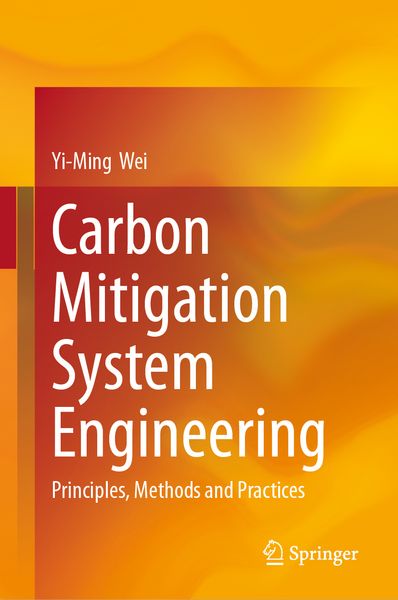
Produktbild: Carbon Mitigation System Engineering
- 11%

Carbon Mitigation System Engineering Principles, Methods and Practices

11% sparen

96,99 € UVP 109,99 €

inkl. gesetzl. MwSt., Versandkostenfrei


Beschreibung

This book provides a comprehensive introduction to the theoretical, technological, and practical systems of carbon mitigation system engineering developed by the author’s team through long-term research and engineering practice. The book is structured into three sections: Theory, Technology, and Practice....

Beschreibung

This book provides a comprehensive introduction to the theoretical, technological, and practical systems of carbon mitigation system engineering developed by the author’s team through long-term research and engineering practice. The book is structured into three sections: Theory, Technology, and Practice. Section I establishes the carbon mitigation system engineering theory, referred to as the “Time-Space-Efficiency-Benefit” (TSEB) coordination theory. Guided by this theory, section II establishes a comprehensive assessment technology system for carbon mitigation pathway design, officially named the China’s Climate Change Integrated Assessment Model (C³IAM). Section III addresses key engineering challenges in Carbon Capture, Utilization and Storage (CCUS) projects by employing the TSEB theory and C³IAM model. These challenges encompass project feasibility assessment, site selection, infrastructure planning, schedule management, operational optimization, and risk management. This book is tailored for professionals in carbon neutrality and emission reduction fields, including engineers, government officials, corporate managers, university students, researchers, and other stakeholders interested in climate change and energy system low-carbon transitions, as well as carbon reduction.

The translation was done with the help of artificial intelligence. A subsequent human revision was done primarily in terms of content.

Produktdetails

Einband

Gebundene Ausgabe

Erscheinungsdatum

10.11.2025

Abbildungen

XXX, 546 p. 138 illus., 120 illus. in color.

Verlag Springer Singapore

Produktdetails

Einband

Gebundene Ausgabe

Erscheinungsdatum

10.11.2025

Abbildungen

XXX, 546 p. 138 illus., 120 illus. in color.

Verlag Springer Singapore
Seitenzahl

546

Maße (L/B/H)

24,1/16/3,7 cm

Gewicht

970 g

Auflage

1. Auflage

Sprache

Englisch

ISBN

978-981-9503-70-4

Herstelleradresse

Springer-Verlag GmbH
Europaplatz 3
69115 Heidelberg
DE

Email: ProductSafety@springernature.com

Noch keine Bewertungen vorhanden

Verfassen Sie die erste Bewertung zu diesem Artikel

Helfen Sie anderen Kundinnen und Kunden durch Ihre Meinung.

Kundinnen und Kunden meinen

Bewertungen (0)

  • Produktbild: Carbon Mitigation System Engineering
  • .- Part Ⅰ  Theory Framework of Carbon Mitigation: ‘Time-Space-Efficiency-Benefit’(TSEB) Overall Planning.

    .- Chapter 1 Introduction.    

    .- Chapter 2 Carbon Mitigation System Engineering and Its ‘Time-Space-Efficiency-Benefit’ Overall Planning Principles.

    .- Chapter 3 Time Coordination: Short-term and Long-term Synergy.

    .- Chapter 4 Spatial Coordination: Local and Overall Synergy.

    .- Chapter 5 Efficiency Coordination: Government Regulation and Market Mechanism Synergy.

    .- Chapter 6: Benefit Coordination: Development and Carbon Reduction Synergy.

    .- Part Ⅱ  Carbon Reduction Pathways Design and System Optimization Technology Via TSEB.

    .- Chapter 7 Carbon Reduction Pathways Design Technology.

    .- Chapter 8 Integrated Assessment Platform (C3IAM) and Overall Design of Coupling Technology.

    .- Chapter 9 Carbon Reduction Technology System in Industries.

    .- Chapter 10 Economic System.

    .- Chapter 11 Climate System.

    .- Chapter 12 Land Use System.

    .- Chapter 13 Design and Assessment of Global Emission Reduction Pathways.

    .- Part III  Management Practices for Carbon Capture Utilization and Storage (CCUS) Projects Via TSEB.

    .- Chapter 14: Carbon Reduction Pathways and CCUS Projects.

    .- Chapter 15 Feasibility Analysis of CCUS Projects Deployment.

    .- Chapter 16 Investment Decision and Operational Optimization of CCUS Projects.

    .- Chapter 17 Risk Management for CCUS Projects.

    .- Chapter 18 Source-Sink Assessment for CCUS Engineering.

    .- Chapter 19 Source-Sink Matching and Spatial Planning for CCUS Engineering.

    .- Chapter 20: Optimization Design of CO2 Pipeline Network for CCUS.

    .- Chapter 21 Pathways to Achieving Carbon Peaking and Carbon Neutrality in China.