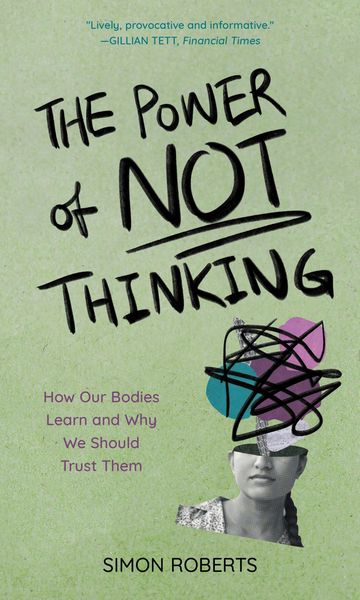
The Power of Not Thinking How Our Bodies Learn and Why We Should Trust Them
-
- Hardcover
- Taschenbuch
- eBook ausgewählt
-
Form:Einzelkauf Download
-
Sprache:Englisch
-
eBook Format:PDF
- PDF 29,80 € ausgewählt
- ePUB 7,70 €
29,80 €
inkl. gesetzl. MwSt.Beschreibung
Produktdetails
Format
Kopierschutz
Ja
Family Sharing
Nein
Text-to-Speech
Nein
Erscheinungsdatum
12.09.2022
Verlag
Bloomsbury eBooks USSeitenzahl
336 (Printausgabe)
Auflage
1. Auflage
Sprache
Englisch
EAN
9798765177242
Details the role our body plays in how we learn and how we can tap into our body's knowledge to excel in all facets of life.
Ask someone to point to the part of their body responsible for their intelligence and it is highly likely that they will point at their head. This assumption is understandable, given that, for centuries, from Descartes' "cogito ergo sum" to the computer age, this is what we have been told to think.
And yet we all share common experiences that have revealed the incomparable power of "not thinking". Have you ever struggled to remember your pin number only to hold your fingers out and type it correctly with your hands, played the piano without focusing on remembering the correct notes or listened to your gut feeling when under the pressure of a big decision? All these instances prove that it is time to stop neglecting the role the body plays in our acquisition of knowledge and to explore how it is that brain and body combine to deliver what we view as uniquely human intelligence. You never forgot how to ride a bike did you?
In this unique new book, social and business anthropologist Simon Roberts looks at the pivotal role that our body plays in how we learn and reminds us of why we should learn to listen to it more often. Drawing upon an incredible range of cutting-edge science, real-life examples and personal experience, Roberts explores the complexity of even the simplest of tasks that humans perform every day and goes on to explain how, with a greater awareness of the processes at work, we can tap into our full potential and excel in any area of our lives.
His proposition isn't the antidote to big data, cold rationalism, and reductionism. But, as embodied knowledge emerges from our engagement and interaction with the world, the author underlines why intelligence does not solely reside in our brains. If there's a single, practical message to be taken from it, it is that we should give more credit to the role of the body as a resource for learning about and understanding the world. That means a more 'sleeves rolled up', engaged and practical way of 'learning by doing' not by rational detachment.
Ask someone to point to the part of their body responsible for their intelligence and it is highly likely that they will point at their head. This assumption is understandable, given that, for centuries, from Descartes' "cogito ergo sum" to the computer age, this is what we have been told to think.
And yet we all share common experiences that have revealed the incomparable power of "not thinking". Have you ever struggled to remember your pin number only to hold your fingers out and type it correctly with your hands, played the piano without focusing on remembering the correct notes or listened to your gut feeling when under the pressure of a big decision? All these instances prove that it is time to stop neglecting the role the body plays in our acquisition of knowledge and to explore how it is that brain and body combine to deliver what we view as uniquely human intelligence. You never forgot how to ride a bike did you?
In this unique new book, social and business anthropologist Simon Roberts looks at the pivotal role that our body plays in how we learn and reminds us of why we should learn to listen to it more often. Drawing upon an incredible range of cutting-edge science, real-life examples and personal experience, Roberts explores the complexity of even the simplest of tasks that humans perform every day and goes on to explain how, with a greater awareness of the processes at work, we can tap into our full potential and excel in any area of our lives.
His proposition isn't the antidote to big data, cold rationalism, and reductionism. But, as embodied knowledge emerges from our engagement and interaction with the world, the author underlines why intelligence does not solely reside in our brains. If there's a single, practical message to be taken from it, it is that we should give more credit to the role of the body as a resource for learning about and understanding the world. That means a more 'sleeves rolled up', engaged and practical way of 'learning by doing' not by rational detachment.
Noch keine Bewertungen vorhanden
Verfassen Sie die erste Bewertung zu diesem Artikel
Helfen Sie anderen Kundinnen und Kunden durch Ihre Meinung.
Kurze Frage zu unserer Seite
Vielen Dank für Ihr Feedback
Wir nutzen Ihr Feedback, um unsere Produktseiten zu verbessern. Bitte haben Sie Verständnis, dass wir Ihnen keine Rückmeldung geben können. Falls Sie Kontakt mit uns aufnehmen möchten, können Sie sich aber gerne an unseren Kund*innenservice wenden.
zum Kundenservice