KI-Beratung Beta

Gutscheinbedingungen

**Gültig am 20.11.2026 ab einem Mindestbestellwert von 30€ auf Spielzeug, Schreibwaren, Filme, Geschenke & Trends, Musik, tolino eReader & Zubehör, Hörbücher und Hörbuch-Downloads, nicht preisgebundene Bücher und Kalender online auf thalia.at und in der Thalia App. Einzelne Artikel können ausgeschlossen sein. Aufgrund der Buchpreisbindung sind deutschsprachige Bücher und eBooks ausgenommen. Zusätzlich ausgenommen sind Abos & Flatrates, Games, Geschenkkarten/-boxen, Shelfies, Software, Zeitschriften sowie einzelne Artikel von tonies®. Pro Einkauf einmal einlösbar. Click & Collect nur bei Onlinevorabzahlung möglich. Keine Barauszahlung. Nicht kombinierbar mit anderen Aktionen und Gutscheinen. Gutschein wird auf max. 500€ Bestellwert angerechnet. Nicht gültig für Versandkosten und Services. Preisgebundene Artikel sind vom Mindestbestellwert ausgeschlossen.

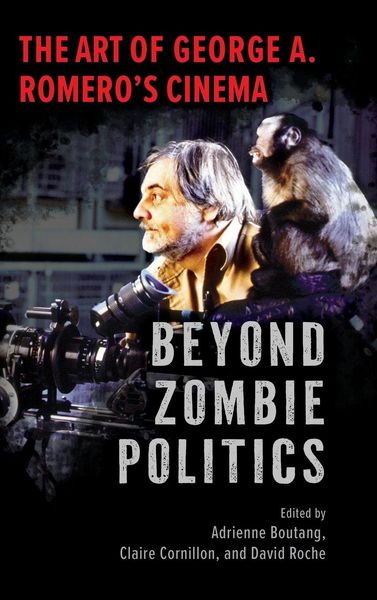
Produktbild: Beyond Zombie Politics

Beyond Zombie Politics The Art of George A. Romero's Cinema

107,99 €

inkl. gesetzl. MwSt., Versandkostenfrei


Beschreibung

Contributions by Julien Achemchame, Julie Assouly, David Church, Suzanne Desrocher-Romero, Hélène Frazik, Pierre Jailloux, Nicolas Labarre, Sophie Lécole-Solnychkine, Janice Loreck, Stella Louis, Kingsley Marshall, Krista Mitchell, Karen D. Thornton, and Arnaud Widendaële Best known for Night of the...

Beschreibung

Contributions by Julien Achemchame, Julie Assouly, David Church, Suzanne Desrocher-Romero, Hélène Frazik, Pierre Jailloux, Nicolas Labarre, Sophie Lécole-Solnychkine, Janice Loreck, Stella Louis, Kingsley Marshall, Krista Mitchell, Karen D. Thornton, and Arnaud Widendaële
Best known for Night of the Living Dead (1968) and its sequels, George A. Romero (1940-2017) was a writer, editor, director, producer, and influential pioneer of the horror film genre. Beyond Zombie Politics: The Art of George A. Romero's Cinema gathers a group of contributors to explore Romero's work beyond the Living Dead films with two parallel but complementary tendencies within twenty-first-century film studies: the renewed interest in horror aesthetics and the emphasis on filmmaking as a collaborative practice.
Opening with an original interview with Suzanne Desrocher-Romero, who shares her views on the late director's craft and influence, the anthology is divided into three sections that deal with genre, visual and musical motifs, and the (re)creative process. Each chapter adopts fresh methodologies to focus on an area that has received little academic study. Contributors investigate the films' relation to subgenres like the counterculture movie or the witchcraft film; their debt to slapstick comedy or the recurrence of specific visual motifs like hands; the editing and the handling of space; the use of make-up and music; the films' relation to comics; and their adaptation into other media. Authored by established and up-and-coming experts of horror and the Fantastic, the chapters in Beyond Zombie Politics aim to offer fresh insights into an important body of work, to contribute to current studies of the evolution of horror aesthetics, and to map the borders between exploitation, independent, and mainstream film.

Rezension

"With Beyond Zombie Politics Roche, Boutang, and Cornillon have assembled a collection that completely revolutionizes how we can, and should, think about Romero as an artist, about film theory as a translator, and about cinema as a medium. This is an innovative, forward-thinking, and necessary intervention into writing about Romero and his work and marks the start of a new chapter in the further exploration of this unique artist and those he worked with." - Wickham Clayton, author of SEE! HEAR! CUT! KILL! Experiencing "Friday the 13th"

"This book stages new and necessary interventions in the study of popular cinema. Its primary strengths lie in the close attention it pays to often overlooked facets of Romero's filmography, its novel use of theory, and its careful engagement with existing scholarship in both English and French. A well-organized and comprehensive study, Beyond Zombie Politics will have a significant impact on how scholars and fans think about Romero, his work, his contexts, and his intertexts." - Miranda Corcoran, author of Witchcraft and Adolescence in American Popular Culture: Teen Witches

Produktdetails

Einband

Gebundene Ausgabe

Erscheinungsdatum

06.10.2025

Abbildungen

48 b&w illustrations

Herausgeber David Roche + weitere

Produktdetails

Einband

Gebundene Ausgabe

Erscheinungsdatum

06.10.2025

Abbildungen

48 b&w illustrations

Herausgeber
Verlag University Press Of Mississippi
Seitenzahl

288

Maße (L/B/H)

23,5/15,7/2,2 cm

Gewicht

622 g

Sprache

Englisch

ISBN

978-1-4968-6026-2

Herstelleradresse

Libri GmbH
Europaallee 1
36244 Bad Hersfeld
DE

Email: gpsr@libri.de

Noch keine Bewertungen vorhanden

Verfassen Sie die erste Bewertung zu diesem Artikel

Helfen Sie anderen Kundinnen und Kunden durch Ihre Meinung.

Kundinnen und Kunden meinen

Bewertungen (0)

Die Leseprobe wird geladen.
  • Produktbild: Beyond Zombie Politics
  • Contents
    Acknowledgments
    Introduction —David Roche, Adrienne Boutang and Claire Cornillon
    Interview with Suzanne Desrocher-Romero —Julien Achemchame
    Part I. Genre, Culture, and Identity
    Chapter 1 The Specter of Failure: Personal and Professional Disillusionment in George A. Romero’s Counterculture Trilogy —David Church
    Chapter 2 From Pittsburgh to Pennsyltucky: Romero’s Pennsylvania Through the Lens of Critical Regionalism —Julie Assouly
    Chapter 3 Feminist Investments: Women, Empowerment, and Witchcraft in Jack’s Wife —Janice Loreck
    Chapter 4 Slapstick in George A. Romero’s Horror Comedies: The "Crazy Body" and Relentless Repetition —Arnaud Widendaële
    Part II. Visual and Aural Motifs
    Chapter 5 Seeing with Your Hands, Touching with Your Eyes: Visuality and Hapticity in the Films of George A. Romero —Sophie Lécole-Solnychkine
    Chapter 6 Nightmares of Confinement: An Analysis of a Key Motif of Romero’s Films —Hélène Frazik
    Chapter 7 "I Am Dead": Unnatural Editing in the Films of George A. Romero —Pierre Jailloux
    Chapter 8 "There Is No Real Magic": The Fantastic in George A. Romero’s Sound Worlds —Krista Mitchell
    Part III. Collaboration and Adaptation
    Chapter 9 Library Music and the Zombie Score: Soundtrack as Animator and Agitator in Dawn of the Dead (1978) —Kingsley Marshall
    Chapter 10 Makeup Artists of the Dead and the Creation of the Romerian Monster —Stella Louis
    Chapter 11 Authenticity, Nostalgia, and Playfulness in Creepshow —Nicolas Labarre
    Chapter 12 Audacious Spectacle or Postmodern Deconstruction? NIGHT OF THE LIVING DEAD—REMIX —Karen D. Thornton
    Filmography
    Bibliography
    Contributors
    Index