Gutscheinbedingungen

**Gültig bis 28.07.2026 auf Spielzeug, Schreibwaren, Filme, Geschenke & Trends, Musik, tolino eReader & Zubehör, Hörbücher und Hörbuch-Downloads (außer Abo), nicht preisgebundene Bücher und Kalender in der Thalia App. Einzelne Artikel können ausgeschlossen sein. Aufgrund der Buchpreisbindung sind deutschsprachige Bücher und eBooks ausgenommen. Zusätzlich ausgenommen sind preisgebundene Artikel, Abos & Flatrates, eBooks, Games, Geschenkkarten/-boxen, Shelfies, Software, Zeitschriften sowie einzelne Artikel von tonies®. Pro Einkauf einmal einlösbar. Click & Collect nur bei Onlinevorabzahlung möglich. Keine Barauszahlung. Nicht kombinierbar mit anderen Aktionen und Gutscheinen. Gutschein wird auf max. 500€ Bestellwert angerechnet. Nicht gültig für Versandkosten und Services.

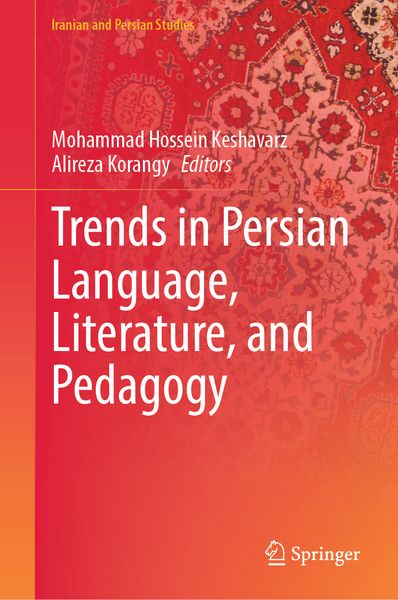
Produktbild: Trends in Persian Language, Literature, and Pedagogy

Trends in Persian Language, Literature, and Pedagogy

148,99 €

inkl. gesetzl. MwSt., Versandkostenfrei


Beschreibung

Produktdetails

Einband

Gebundene Ausgabe

Erscheinungsdatum

20.02.2026

Abbildungen

XXVIII, 181 illus., 14 illus. in color., schwarz-weiss Illustrationen, farbige Illustrationen

Herausgeber

Mohammad Hossein Keshavarz + weitere

Verlag

Springer Singapore

Seitenzahl

263

Maße (L/B/H)

24,1/16/2,2 cm

Gewicht

549 g

Auflage

1. Auflage

Sprache

Englisch

ISBN

978-981-9510-45-0

Beschreibung

Portrait

Mohammad Hossein Keshavarz  is Professor of Applied Linguistics at Girne American University in North Cyprus. He holds an MA in Applied Linguistics and TEFL from Ohio University, USA, and a PhD from the University of Wales, UK. He has published numerous articles in peer-reviewed international journals, including Language in Society, International Journal of Applied Linguistics, WORD, International Journal of Bilingualism, Educational Research, Contrastive Pragmatics, English for Academic Purposes, Journal of Psycholinguistic Research, Communication Disorders Quarterly, International Journal of Bilingualism and Bilingual Education, Journal of Research in Applied Linguistics, Reading in a Foreign Language, and TESOL Journal. He has also authored over twenty academic books in English. His recently published books include: The Handbook of Persian Carpets: Cultural and Semiotic Perspectives (Springer Nature, 2025), Contrastive Analysis, Error Analysis, and Interlanguage Hypothesis (6th Edition) (Rahnama Press, 2023), A New Analytical Model of Cultural Linguistics (Cambridge Scholars, 2023), and Parse Two-Volume Bilingual Dictionary (Rahnama Press, 2023). His research interests span First and Second Language Acquisition, Sociolinguistics, Pragmatics, Cultural Linguistics, Semiotics, and Phonology.

Alireza Korangy  received his PhD from the Department of Near Eastern Languages and Civilizations at Harvard University. His field of research is classical Persian and Arabic philology with a special emphasis on poetics, rhetoric, folklore, and linguistics.

Produktdetails

Einband

Gebundene Ausgabe

Erscheinungsdatum

20.02.2026

Abbildungen

XXVIII, 181 illus., 14 illus. in color., schwarz-weiss Illustrationen, farbige Illustrationen

Herausgeber

Verlag

Springer Singapore

Seitenzahl

263

Maße (L/B/H)

24,1/16/2,2 cm

Gewicht

549 g

Auflage

1. Auflage

Sprache

Englisch

ISBN

978-981-9510-45-0

Herstelleradresse

Springer-Verlag KG
Sachsenplatz 4-6
1201 Wien
AT

Email: GPSR Kontakt

Noch keine Bewertungen vorhanden

Verfassen Sie die erste Bewertung zu diesem Artikel

Helfen Sie anderen Kundinnen und Kunden durch Ihre Meinung.

Kundinnen und Kunden meinen

Bewertungen (0)

  • Produktbild: Trends in Persian Language, Literature, and Pedagogy
  • Part 1. Persian Language and Literature.- Chapter 1. Evolution of Persian prose fiction written by Iranian writers in the twentieth.- Chapter 2. Ke-clauses are Complementizer Phrases (CPs) in Persian.- Chapter 3. Indo-Persian after Colonialism: The Case of “Qawwali”.- Chapter 4. The Woman Question: Marriage and sensuality in poems by Parvin Etesami (1907-1941) and Forugh Farrokhzad (1934-1967).- Chapter 5. Poetic Discourse and its Perception: with Special Reference to HAFEZ.- Chapter 6. Color philosophy and the written word in Persian literature.- Chapter 7. Nativization of Persian Loanwords in Turkish: A Phonological Analysis.- Chapter 8. Daghughi and His Miracles Exploring Sufi Philosophy and Imagery in Classical Persian Literature A Lesson-Article.- Part 2. Teaching Persian as a Second Language.- Chapter 10. Persian Learners' Reflections about ChatGPT as a Tool in the L2 Writing Classroom.- Chapter 11. The Use of Online Fan Practices to Promote Langua-technocultural Competence: The Case of Persian as a Second Language Learners.- Chapter 12. Teaching Persian Politeness to Non-Persian Speakers.- Chapter 13. Digital Materials Development for TPSOL, Persian Language Structure, and Technological Compatibility: The Challenges.- Chapter 14. The Effect of Blended-learning on Reflective and Impulsive Persian Learners' Speaking Complexity, Accuracy, and Fluency: A Psycholinguistic Perspective.- Chapter 15. Pragmatic Competence Development in Learners of Persian as a Heritage Language: The Contribution of Task-Based Instruction.- Chapter 16. Exploring Ontology-Based Approaches to Teaching Persian Motion Verbs.- Chapter 17. Transition to the Persian Alphabet: A Sequential Approach.