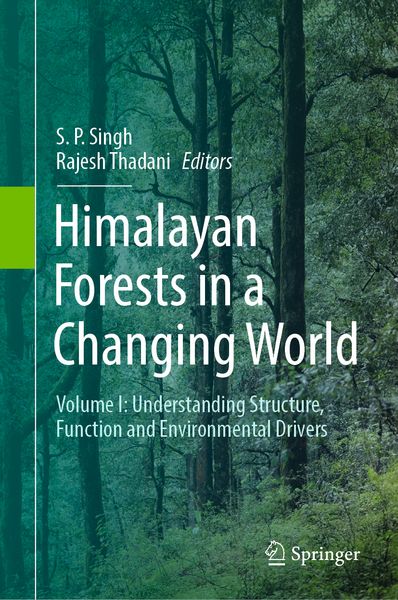

Himalayan Forests in a Changing World Volume I: Understanding Structure, Function and Environmental Drivers
-
Sprache:Englisch
-
Auflage:1. Auflage
- 1. Auflage 192,99 € ausgewählt
- 1. Auflage 192,99 €
192,99 €
UVP
219,99 €
inkl. gesetzl. MwSt.,
Beschreibung
Produktdetails
Einband
Gebundene Ausgabe
Erscheinungsdatum
04.11.2025
Abbildungen
XVI, 494 p. 120 illus., 99 illus. in color.
Herausgeber
S.P. Singh + weitereVerlag
Springer SingaporeSeitenzahl
494
Maße (L/B/H)
24,1/16/3,2 cm
Gewicht
1019 g
Auflage
1. Auflage
Sprache
Englisch
ISBN
978-981-9509-77-5
This first volume on Himalayan forests discusses the synthesis of Himalayan forest ecosystems. It begins with contextual foundations that establish the environmental background and climate patterns crucial for understanding these mountains. The chapters provide context through detailed examination of Himalayan climate dynamics and a novel leaf-based classification system, setting the framework for understanding major forest types and associations across elevational gradients. This book places particular emphasis on forest hydrological processes through critical review of water-forest interactions. This then further reveals topographic and climatic factors that govern forest distribution and crucial water regulation services these ecosystems provide to downstream communities. This book covers forest phenology, nutrient cycling, carbon dynamics and productivity and thus demonstrates the intricate functioning of these high-altitude ecosystems.
By collating scattered research and enhancing understanding of ecological processes, hydrology and ecosystem functioning, this volume establishes a comprehensive knowledge foundation. The chapter on forest fire focuses on the nature of fire regime, and its ecological implications. The integration of traditional ecological approaches with cutting-edge methodologies provides both theoretical depth and practical applications. Essential for forest researchers, ecosystem ecologists, and graduate students, this volume serves as the definitive reference for understanding Himalayan forests in their unique environmental context.
Noch keine Bewertungen vorhanden
Verfassen Sie die erste Bewertung zu diesem Artikel
Helfen Sie anderen Kundinnen und Kunden durch Ihre Meinung.
Kurze Frage zu unserer Seite
Vielen Dank für Ihr Feedback
Wir nutzen Ihr Feedback, um unsere Produktseiten zu verbessern. Bitte haben Sie Verständnis, dass wir Ihnen keine Rückmeldung geben können. Falls Sie Kontakt mit uns aufnehmen möchten, können Sie sich aber gerne an unseren Kund*innenservice wenden.
zum Kundenservice