Gutscheinbedingungen

**Gültig bis 06.07.2026 auf fremdsprachige Bücher online auf thalia.at, in der Thalia App ab einem Mindestbestellwert von 30€ und in allen Thalia Buchhandlungen in Österreich. In den Buchhandlungen nur gültig auf lagernde Ware. Einzelne Artikel können ausgeschlossen sein. Ausgenommen sind preisgebundene Artikel & eBooks. Pro Einkauf einmal einlösbar. Nur gültig gegen Vorlage oder im Onlineshop hinterlegter Bonuscard. Infos zur Einlösung in der Buchhandlung sind auf der Bonuscard-Vorteilspreisseite zu finden. Click & Collect nur bei Onlinevorabzahlung möglich. Keine Einlösung bei Scan & Go-Bezahlung. Keine Barauszahlung. Nicht kombinierbar mit anderen Aktionen und Gutscheinen. Gutschein wird auf max. 500€ Bestellwert angerechnet. Nicht gültig für Versandkosten und Services.

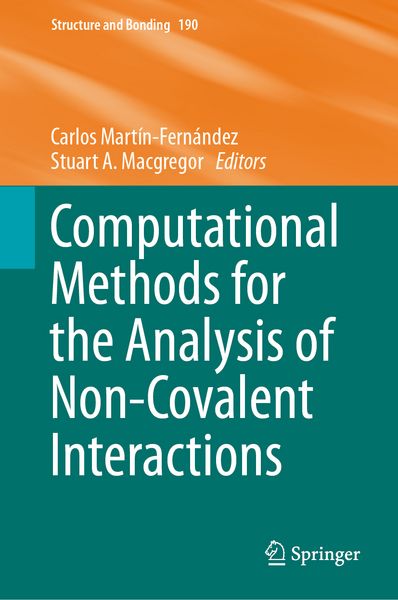
Produktbild: Computational Methods for the Analysis of Non-Covalent Interactions
Band 190 - 11%

Computational Methods for the Analysis of Non-Covalent Interactions

Aus der Reihe Structure and Bonding
11% sparen

164,99 € UVP 186,99 €

inkl. gesetzl. MwSt., Versandkostenfrei


Beschreibung

Produktdetails

Einband

Gebundene Ausgabe

Erscheinungsdatum

28.10.2025

Abbildungen

VII, 20 illus., schwarz-weiss Illustrationen

Herausgeber

Carlos Martín-Fernández + weitere

Verlag

Springer

Seitenzahl

314

Maße (L/B/H)

24,1/16/2,4 cm

Gewicht

596 g

Sprache

Englisch

ISBN

978-3-032-01542-6

Beschreibung

Portrait

Carlos Martín-Fernández obtained his PhD from KU Leuven (Belgium) under the supervision of Profs. Jeremy Harvey and Kristine Pierloot studying the electronic structure of transition metal complexes with DFT and ab initio methods. Before that, he studied the Erasmus Mundus Master's in Theoretical Chemistry and Computational Modelling (EMTCCM) in Universidad Autónoma de Madrid (Spain) and worked as a predoctoral researcher at CSIC with Prof. Ibon Alkorta. His research expertise includes the application of high-level computational methods (both ab initio and DFT) to the study of (bio)inorganic chemistry, with a focus on transition metal complexes, chemical bonding, and non-covalent interactions. 

Stuart Macgregor obtained his PhD degree from the University of Edinburgh working on the structural and electrochemical properties of metallaboranes. He was awarded a NATO Western European Fellowship to work with Odile Eisenstein in Orsay, where he first encountered DFT. After a post-doctoral position at ANU, Canberra, he took up a lectureship at Heriot-Watt University, Edinburgh, where he was promoted to full Professor in 2009. In 2024 he was appointed Chair of Computational Inorganic Chemistry at the University of St. Andrews. Stuart's research uses computational methods to model the structure and reactivity of transition metal systems in both solution and the solid state. He works in close collaboration with experimentalists and targets applications in catalysis. He received the 2019 RSC Ludwig Mond Award for work on the mechanisms of C–H and C–F activation and the organometallic chemistry of σ-alkane complexes in the solid state.

Produktdetails

Einband

Gebundene Ausgabe

Erscheinungsdatum

28.10.2025

Abbildungen

VII, 20 illus., schwarz-weiss Illustrationen

Herausgeber

Verlag

Springer

Seitenzahl

314

Maße (L/B/H)

24,1/16/2,4 cm

Gewicht

596 g

Sprache

Englisch

ISBN

978-3-032-01542-6

Herstelleradresse

Springer-Verlag KG
Sachsenplatz 4-6
1201 Wien
AT

Email: GPSR Kontakt

Noch keine Bewertungen vorhanden

Verfassen Sie die erste Bewertung zu diesem Artikel

Helfen Sie anderen Kundinnen und Kunden durch Ihre Meinung.

Kundinnen und Kunden meinen

Bewertungen (0)

  • Produktbild: Computational Methods for the Analysis of Non-Covalent Interactions
  • Interpreting Non Covalent Bonds with the Block Localized Wave Function (BLW) Method.- Local Energy Decomposition of Coupled Cluster Energies Principles and Applications.- Electron Density based Energy Decomposition Analysis from QM to QM/MM calculations.- GKS EDA method for intermolecular interactions in complex systems.- SAPT and many body dispersion: Intermolecular interactions at cubic scaling cost.- Survey of contemporary applications of Quantum Chemical Topology.- The Interpenetration Index and its applications in chemistry.- Exhibiting noncovalent interactions in dynamic environments using aIGM method.