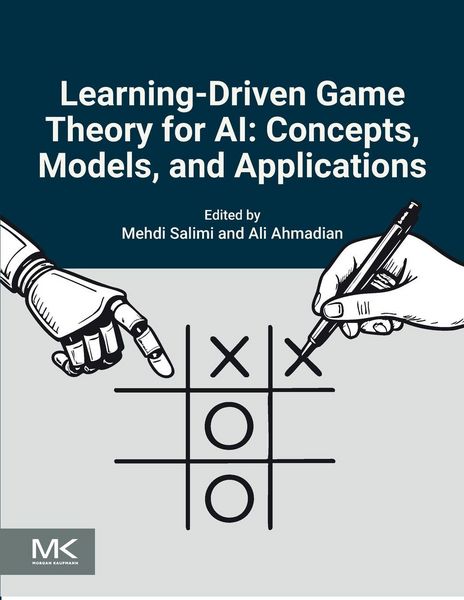
Learning-Driven Game Theory for AI Concepts, Models, and Applications
-
- Taschenbuch ausgewählt
- eBook
-
Sprache:Englisch
148,99 €
UVP
171,70 €
inkl. gesetzl. MwSt.,
Beschreibung
Produktdetails
Einband
Taschenbuch
Erscheinungsdatum
15.01.2026
Herausgeber
Mehdi Salimi + weitereVerlag
Elsevier Science & TechnologySeitenzahl
268
Maße (L/B/H)
27,4/21,4/1,6 cm
Gewicht
450 g
Sprache
Englisch
ISBN
978-0-443-43852-3
Learning-Driven Game Theory for AI: Concepts, Models, and Applications offers in-depth coverage of recent methodological and conceptual advancements in various disciplines of Dynamic Games, namely differential and discrete-time dynamic games, evolutionary games, repeated and stochastic games, and their applications in a variety of fields, such as computer science, biology, economics, and management science. In this book, the authors bridge the gap between traditional game theory and its modern applications in artificial intelligence (AI) and related technological fields. The dynamic nature of contemporary problems in robotics, cybersecurity, machine learning, and multi-agent systems requires game-theoretic solutions that go beyond classical methods. The book delves into the rapidly growing intersection of pursuit differential games and AI, focusing on how these advanced game-theoretic models can be applied to modern AI systems, making it an indispensable resource for both academics and professionals. The book also provides a variety of applications demonstrating the practical integration of AI and game theory across various disciplines, such as autonomous systems, federated learning, and distributed decision-making frameworks. The book also explores the use of game theory in reinforcement learning, swarm intelligence, multi-agent coordination, and cybersecurity. These are critical areas where AI and dynamic games converge. Each chapter covers a different facet of dynamic games, offering readers a comprehensive yet focused exploration of topics such as differential and discrete-time games, evolutionary dynamics, and repeated and stochastic games. The absence of static games ensures a concentrated focus on the dynamic, evolving problems that are most relevant today.
Noch keine Bewertungen vorhanden
Verfassen Sie die erste Bewertung zu diesem Artikel
Helfen Sie anderen Kundinnen und Kunden durch Ihre Meinung.
Kurze Frage zu unserer Seite
Vielen Dank für Ihr Feedback
Wir nutzen Ihr Feedback, um unsere Produktseiten zu verbessern. Bitte haben Sie Verständnis, dass wir Ihnen keine Rückmeldung geben können. Falls Sie Kontakt mit uns aufnehmen möchten, können Sie sich aber gerne an unseren Kund*innenservice wenden.
zum Kundenservice