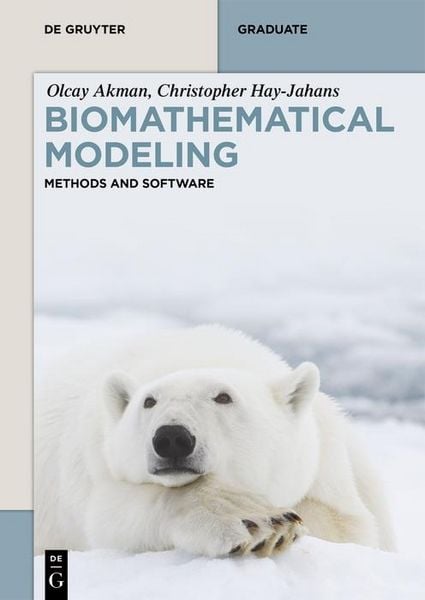
Biomathematical Modeling Methods and Software
-
- Taschenbuch
- eBook ausgewählt
-
Form:Einzelkauf Download
-
Sprache:Englisch
-
eBook Format:ePUB
- PDF 64,95 €
- ePUB 64,95 € ausgewählt
64,95 €
inkl. gesetzl. MwSt.Beschreibung
Produktdetails
Format
ePUB
Kopierschutz
Nein
Family Sharing
Nein
Text-to-Speech
Ja
Erscheinungsdatum
19.05.2025
Verlag
De Gruyter MoutonSeitenzahl
164 (Printausgabe)
Dateigröße
5840 KB
Auflage
1. Auflage
Sprache
Englisch
EAN
9783111609942
Welcome to the fascinating intersection of mathematics, biology, and ecology!
This book is intended primarily as a resource for teachers planning to teach their first introductory course on modeling in mathematical biology and/or ecology. This being said, it can also be used by students preparing to embark on an independent studies project in one of these fields; or, by researchers unfamiliar with the methods or software introduced who are seeking an accessible and quick introduction to one of the methods and/or software presented here; or, by curious biologists, ecologists, or mathematicians who may be unfamiliar with "the other side;" or, maybe, by the perpetual learner who is intrigued by the dynamics of living ecosystems. For each of the above, this book is designed to be an accessible introduction to the captivating landscape of biomathematics.
The approach used in this book takes advantage of technology in leading readers on a journey that bridges seemingly distinct fields through introductions to three methods and software platforms: Compartmental models with Berkeley Madonna; agent-based models with NetLogo; and cluster analysis through selforganizing maps using an R Shiny app.
This is not intended to be a textbook (though it may be used as one), nor is it a purely mathematics book or one purely about deeper aspects of biology or ecology. It focuses on three selected ways in which the intersection of mathematics and biology (and mathematics and ecology) can be explored with the help of software. Moreover, the manner in which the content is presented makes it possible to use this book to help prepare for an introductory course at a wide range of levels, depending on the discipline within which the course is taught and the mathematical prerequisites for the course.
There are four chapters, the first of which presents the reader with a bit of background information followed by suggestions on how to get the most out of this book. The three core chapters introduce the three previously mentioned methods and software in a manner envisioned to be accessible to most.
Noch keine Bewertungen vorhanden
Verfassen Sie die erste Bewertung zu diesem Artikel
Helfen Sie anderen Kundinnen und Kunden durch Ihre Meinung.
Kurze Frage zu unserer Seite
Vielen Dank für Ihr Feedback
Wir nutzen Ihr Feedback, um unsere Produktseiten zu verbessern. Bitte haben Sie Verständnis, dass wir Ihnen keine Rückmeldung geben können. Falls Sie Kontakt mit uns aufnehmen möchten, können Sie sich aber gerne an unseren Kund*innenservice wenden.
zum Kundenservice