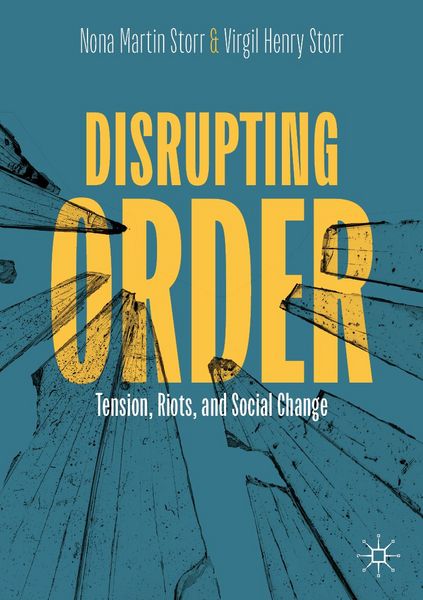
Disrupting Order Tension, Riots, and Social Change
-
- Englisch ausgewählt
38,99 €
inkl. gesetzl. MwSt.,
Beschreibung
Produktdetails
Einband
Taschenbuch
Erscheinungsdatum
14.11.2026
Abbildungen
XVII, 246 p. 2 illus.
Verlag
SpringerSeitenzahl
246
Maße (L/B)
21/14,8 cm
Sprache
Englisch
ISBN
978-3-032-01039-1
“In Disrupting Order , authors Nona and Virgil Storr provide a compelling reassessment of the significance of the Burma Road Riot.… Beyond a solid theoretical intervention, the authors are to be commended for the depth of archival and ethnographic research that makes this study an excellent contribution to Bahamian social-political history and larger studies on public disturbances.”— Christopher Curry , author of Freedom and Resistance
"This book provides a fascinating account of the 1942 riot that occurred in the Bahamas.”— Matthew Moran , author of The Republic and the Riots
“It does not glorify unrest but provides a thoughtful framework to understand why such moments arise and how they shape the trajectory of a people.”— J. Kwasi Thompson , Member of Parliament for East Grand Bahama and Former Minister of State for Grand Bahama and Finance
Are riots more than just breakdowns of order? Are rioters just violently and chaotically disrupting the status quo or are they individuals acting together in a surprisingly orderly manner? In Disrupting Order , Nona Martin Storr and Virgil Henry Storr argue that riots are rule-governed, self-generating, emergent phenomena. Viewing riots as what they call “tensive emergent orders” offers a grammar for discussing riots that foregrounds the motivations and actions of individual rioters, the tacit rules that rioters follow, and the socio-political causes and consequences of riots. Applying this grammar to the 1942 riot that occurred in the Bahamas, Storr and Storr demonstrate how the 1942 riot was not just a momentary outburst but a watershed event in the country’s history, ushering in far-reaching socio-political changes. As we move into an era of frequent extreme protests, Disrupting Order urges us to rethink why the threatened and marginalized sometimes speak through riots and gives us a framework to assess the impact of their speaking in this way.
Noch keine Bewertungen vorhanden
Verfassen Sie die erste Bewertung zu diesem Artikel
Helfen Sie anderen Kundinnen und Kunden durch Ihre Meinung.
Kurze Frage zu unserer Seite
Vielen Dank für Ihr Feedback
Wir nutzen Ihr Feedback, um unsere Produktseiten zu verbessern. Bitte haben Sie Verständnis, dass wir Ihnen keine Rückmeldung geben können. Falls Sie Kontakt mit uns aufnehmen möchten, können Sie sich aber gerne an unseren Kund*innenservice wenden.
zum Kundenservice