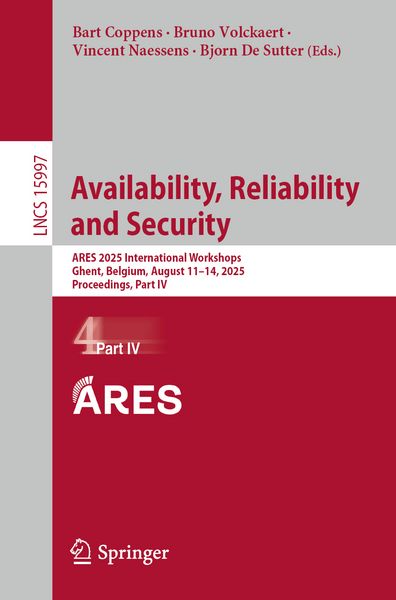
Availability, Reliability and Security ARES 2025 International Workshops, Ghent, Belgium, August 11–14, 2025, Proceedings, Part IV
-
- Taschenbuch ausgewählt
- eBook
-
Sprache:Englisch
-
Verlag:Springer
66,99 €
inkl. gesetzl. MwSt.,
Beschreibung
Produktdetails
Einband
Taschenbuch
Erscheinungsdatum
10.08.2025
Abbildungen
XXXIII, 352 p. 97 illus., 85 illus. in color.
Herausgeber
Bart Coppens + weitereVerlag
SpringerSeitenzahl
352
Maße (L/B/H)
23,5/15,5/2,1 cm
Gewicht
587 g
Sprache
Englisch
ISBN
978-3-032-00638-7
This four-volume set LNCS 15994-15997 constitutes the proceedings of the ARES 2025 International Workshops on Availability, Reliability and Security, held under the umbrella of the 20th International conference on Availability, Reliability and Security, ARES 2025, which took place in Ghent, Belgium, during August 11-14, 2025.
The 79 full papers presented in this book were carefully reviewed and selected from 173 submissions.
They contain papers of the following workshops:
Part I: First International Workshop on Artificial Intelligence, Cyber and Cyber-Physical Security (AI&CCPS 2025); 8th International Symposium for Industrial Control System and SCADA Cyber Security Research (ICS-CSR 2025); First Workshop on Sustainable Security and Awareness For nExt Generation InfRastructures (SAFER 2025); 4th Workshop on Cybersecurity in Industry 4.0 (SecIndustry 2025).
Part II: 6th Workshop on Recent Advances in Cyber Situational Awareness and Data-Centric Approaches (CSA 2025); First International Workshop on Responsible Data Governance, Privacy, and Digital Transformation (RDGPT 2025); 22nd International Workshop on Trust, Privacy and Security in the Digital Society (TrustBus 2025).
Part III: 18th International Workshop on Digital Forensics (WSDF 2025); 14th International Workshop on Cyber Crime (IWCC 2025); 9th International Workshop on Cyber Use of Information Hiding (CUING 2025).
Part IV: First International Workshop on Cybersecurity and Privacy Risk Assessments (CPRA 2025); Second International Workshop on Emerging Digital Identities (EDId 2025); Second International Workshop on Security and Privacy Enhancing Technologies for Multimodal Data (SPETViD 2025); 6th International Workshop on Graph-based Approaches for CyberSecurity (GRASEC 2025); 5th International Workshop on Behavioral Authentication for System Security (BASS 2025).
Noch keine Bewertungen vorhanden
Verfassen Sie die erste Bewertung zu diesem Artikel
Helfen Sie anderen Kundinnen und Kunden durch Ihre Meinung.
Kurze Frage zu unserer Seite
Vielen Dank für Ihr Feedback
Wir nutzen Ihr Feedback, um unsere Produktseiten zu verbessern. Bitte haben Sie Verständnis, dass wir Ihnen keine Rückmeldung geben können. Falls Sie Kontakt mit uns aufnehmen möchten, können Sie sich aber gerne an unseren Kund*innenservice wenden.
zum Kundenservice