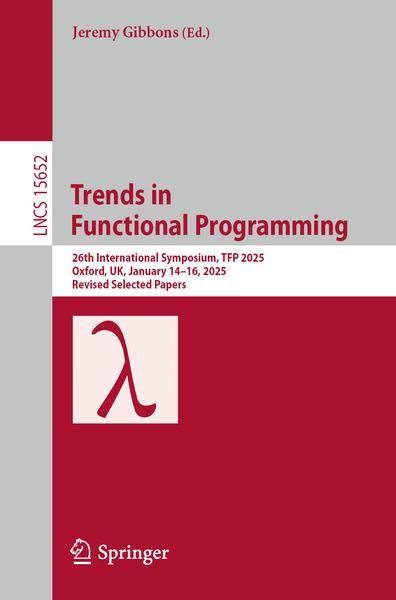
Trends in Functional Programming 26th International Symposium, TFP 2025, Oxford, UK, January 14–16, 2025, Revised Selected Papers
-
- Taschenbuch ausgewählt
- eBook
-
Sprache:Englisch
117,99 €
UVP
131,99 €
inkl. gesetzl. MwSt.,
Beschreibung
Produktdetails
Einband
Taschenbuch
Erscheinungsdatum
02.10.2025
Abbildungen
XV, 534 p. 292 illus., 179 illus. in color.
Herausgeber
Jeremy GibbonsVerlag
SpringerSeitenzahl
534
Maße (L/B/H)
23,5/15,5/3 cm
Gewicht
826 g
Sprache
Englisch
ISBN
978-3-031-99750-1
This book constitutes revised selected papers from the 26th International Symposium on Trends in Functional Programming, TFP 2025, held in Oxford, UK, during January 13–16, 2025.
The 20 full papers and 2 invited papers presented in this volume were carefully reviewed and selected from 35 submissions. They were categorized under the topical sections as follows:
Invited papers; Language Design; Compilation; Semantics; Types; Program Synthesis; Teaching.
Noch keine Bewertungen vorhanden
Verfassen Sie die erste Bewertung zu diesem Artikel
Helfen Sie anderen Kundinnen und Kunden durch Ihre Meinung.
Kurze Frage zu unserer Seite
Vielen Dank für Ihr Feedback
Wir nutzen Ihr Feedback, um unsere Produktseiten zu verbessern. Bitte haben Sie Verständnis, dass wir Ihnen keine Rückmeldung geben können. Falls Sie Kontakt mit uns aufnehmen möchten, können Sie sich aber gerne an unseren Kund*innenservice wenden.
zum Kundenservice