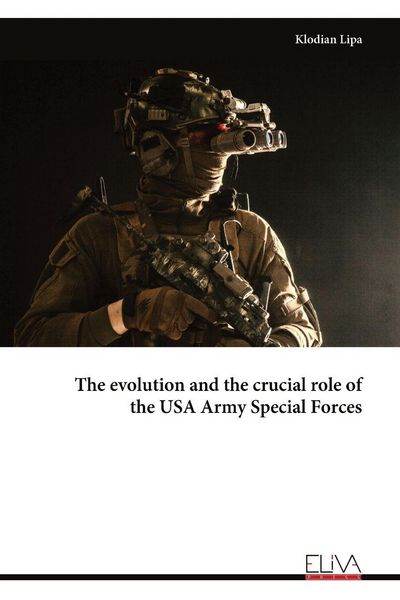
The evolution and the crucial role of the USA Army Special Forces
-
- Englisch ausgewählt
45,99 €
inkl. gesetzl. MwSt.,
Beschreibung
Produktdetails
Einband
Taschenbuch
Erscheinungsdatum
27.05.2024
Verlag
Eliva PressSeitenzahl
48
Maße (L/B/H)
22,9/15,2/0,3 cm
Gewicht
86 g
Sprache
Englisch
ISBN
978-1-63648-664-2
In 1997, members of the Special Forces community began the process of identifying SF's core ideology. Although the process has led to much thought, discussion and debate, after four years, the task remains unfinished. According to James C. Collins and Jerry I. Porras, an organization's core ideology is its enduring character - what the organization is and what it stands for. Core ideology transcends leaders. It is determined by the people who are inside the organization. We do not create a core ideology; we identify it. Often, the success or the failure of an organization can be traced to how well the organization identified its core ideology and how well it cultivated the energies and talents of its people. Core ideology has two components: core values and core purpose. By identifying those components, the organization defines who its members are. Core values are essential and enduring tenets. Core values are clear and powerful, and they provide substantial guidance with piercing simplicity. After three years of debate, the U.S. Army Special Forces Command reached a consensus on SF's core values, and the values were published in the Spring 2000 edition of Special Warfare. The SF core values are warrior ethos; professionalism; innovation; versatility; cohesion; character; and cultural awareness. What remains to be resolved is SF's core purpose. Of the two components of core ideology, core purpose is the more important. It is the organization's fundamental reason for being. Unlike goals or strategies, a core purpose does not change - it inspires change. An organization can evolve into new areas, but it will continue to be guided by its core purpose. SF's core purpose is to achieve our nation's objectives and to conduct our SF missions through, with or by surrogates, indigenous organizations or indigenous populations. That defining purpose sets SF apart from all other organizations. SF can conduct unilateral missions, and we can conduct them superbly, but we should conduct unilateral missions only as a last resort. They are inconsistent with our core purpose. SF was organized as a force multiplier that would conduct unconventional warfare.
Kundinnen und Kunden meinen
Verfassen Sie die erste Bewertung zu diesem Artikel
Helfen Sie anderen Kund*innen durch Ihre Meinung
Kurze Frage zu unserer Seite
Vielen Dank für Ihr Feedback
Wir nutzen Ihr Feedback, um unsere Produktseiten zu verbessern. Bitte haben Sie Verständnis, dass wir Ihnen keine Rückmeldung geben können. Falls Sie Kontakt mit uns aufnehmen möchten, können Sie sich aber gerne an unseren Kund*innenservice wenden.
zum Kundenservice