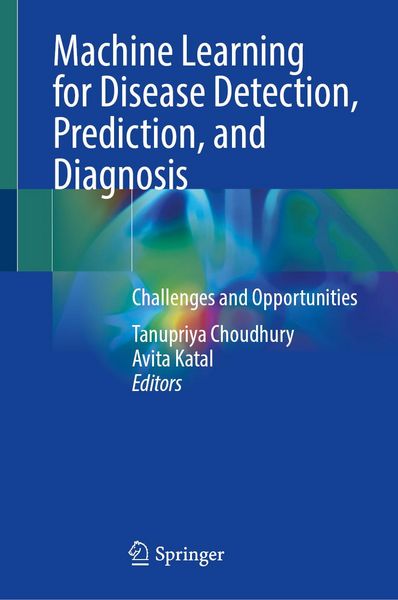
Machine Learning for Disease Detection, Prediction, and Diagnosis Challenges and Opportunities
-
- Hardcover
- Taschenbuch
- eBook ausgewählt
-
Form:Einzelkauf Download
-
Sprache:Englisch
142,99 €
inkl. gesetzl. MwSt.Beschreibung
Produktdetails
Format
Kopierschutz
Nein
Family Sharing
Nein
Text-to-Speech
Nein
Erscheinungsdatum
06.06.2025
Herausgeber
Tanupriya Choudhury + weitereVerlag
Springer Nature SingaporeSeitenzahl
383 (Printausgabe)
Dateigröße
16569 KB
Sprache
Englisch
EAN
9789819642410
The book "Machine Learning for Disease Detection, Prediction, and Diagnosis" can be a comprehensive guide to the novel concepts, techniques, and frameworks essential for improving the viability of existing machine-learning practices. It provides an in-depth analysis of how these new technologies are helpful to detect, predict and diagnose diseases more accurately. The book covers various topics such as image classification algorithms, supervised learning methods like support vector machines (SVM), deep neural networks (DNNs), convolutional neural networks (CNNs), etc. unsupervised approaches such as clustering algorithms as well as reinforcement learning strategies.
This book is an invaluable resource for anyone interested in machine-learning applications related to disease detection or diagnosis. It explains different concepts and provides practical examples of how they can it implements using real-world data sets from medical imaging datasets or public health records databases, among others. Furthermore, it offers insights into recent advances made by researchers which have enabled automated decision-making systems based on AI models with improved accuracy over traditional methods. This text also discusses ways through which current models could improve further by incorporating domain knowledge during the model training phase, thereby increasing their efficacy even further.
Overall, this book serves as a great source of information about the latest advancements made in the field of Machine Learning & Artificial Intelligence towards efficient building systems capable enough detecting & diagnosing diseases automatically while avoiding human errors resulting due manual intervention at any stage along process pipeline thus ensuring better outcomes overall. Moreover, it helps readers understand the underlying principles behind each technique discussed so that they may apply them according to their own application scenarios efficiently without worrying much about the implementation details required to get the job done the right way the first time around itself!
Noch keine Bewertungen vorhanden
Verfassen Sie die erste Bewertung zu diesem Artikel
Helfen Sie anderen Kundinnen und Kunden durch Ihre Meinung.
Kurze Frage zu unserer Seite
Vielen Dank für Ihr Feedback
Wir nutzen Ihr Feedback, um unsere Produktseiten zu verbessern. Bitte haben Sie Verständnis, dass wir Ihnen keine Rückmeldung geben können. Falls Sie Kontakt mit uns aufnehmen möchten, können Sie sich aber gerne an unseren Kund*innenservice wenden.
zum Kundenservice