Gutscheinbedingungen

**Gültig bis 22.07.2026 ab einem Mindestbestellwert von 40€ auf Spielzeug, Schreibwaren, Filme, Geschenke & Trends, Musik, tolino eReader & Zubehör, Hörbücher und Hörbuch-Downloads (außer Abo), nicht preisgebundene Bücher und Kalender online auf thalia.at und in der Thalia App. Einzelne Artikel können ausgeschlossen sein. Aufgrund der Buchpreisbindung sind deutschsprachige Bücher und eBooks ausgenommen. Zusätzlich ausgenommen sind preisgebundene Artikel, Abos & Flatrates, eBooks, Games, Geschenkkarten/-boxen, Shelfies, Software, Zeitschriften sowie einzelne Artikel von tonies®. Pro Einkauf einmal einlösbar. Click & Collect nur bei Onlinevorabzahlung möglich. Keine Barauszahlung. Nicht kombinierbar mit anderen Aktionen und Gutscheinen. Gutschein wird auf max. 500€ Bestellwert angerechnet. Nicht gültig für Versandkosten und Services. Preisgebundene Artikel sind vom Mindestbestellwert ausgeschlossen.

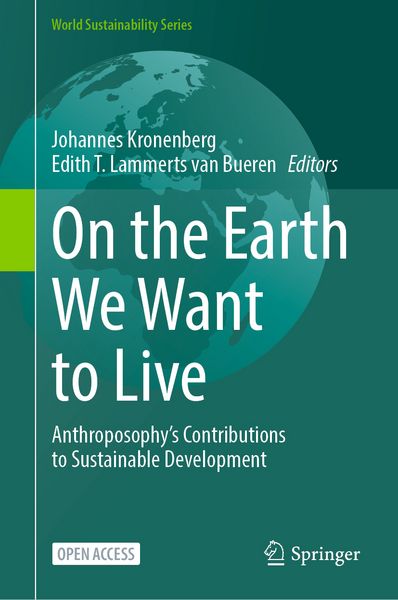
Produktbild: On the Earth We Want to Live

On the Earth We Want to Live Anthroposophy’s Contributions to Sustainable Development

49,99 €

inkl. gesetzl. MwSt., Versandkostenfrei


Beschreibung

Produktdetails

Einband

Gebundene Ausgabe

Erscheinungsdatum

20.11.2025

Abbildungen

XIX, 118 illus., 103 illus. in color., schwarz-weiss Illustrationen, farbige Illustrationen

Herausgeber

Johannes Kronenberg + weitere

Verlag

Springer

Seitenzahl

630

Maße (L/B/H)

24,1/16/4,1 cm

Gewicht

92 g

Sprache

Englisch

ISBN

978-3-031-98757-1

Beschreibung

Portrait

Johannes Kronenberg is a Research Associate at the Section for Agriculture at the Goetheanum – Freie Hochschule für Geisteswissenschaft in Dornach, Switzerland. His current work focuses on the intersection of sustainable development and the contributions of Anthroposophy to this field. Additionally, he is actively involved in several NGOs, including the Iona Stichting in Amsterdam, which supports societal and ecological transformation through project funding and capacity building for grassroots initiatives.

At the Goetheanum, the center of the General Anthroposophical Society and Freie Hochschule für Geisteswissenschaft , he is also involved in organisational and global development, supporting a membership body of 41,000 members across 78 countries and all continents. His current focus is on the cosmopolitan aspect of the Anthroposophical movement, working to support individuals and local initiatives while fostering their connection to its global nature.

Born in 1991 in the Netherlands, he obtained a Bachelor's degree in Fine Arts from ArtEZ University of the Arts. He later earned a Master of Science in Sustainable Development from the Blekinge Institute of Technology in Sweden and pursued further studies in Sustainable Development at the Center for Development and Environment at the University of Bern, Switzerland. 

Edith T. Lammerts van Bueren is currently an emeritus professor Organic Plant Breeding and chair of the BioAcademy, an online platform for education in organic agriculture in the Netherlands.

She was born in the Netherlands in 1952. She started her study at Wageningen University in plant breeding, and received her master’s degree in horticulture and ecology in 1978, and later obtained a PhD in organic plant breeding.

She worked for more than 40 years in research and teaching on organic and biodynamic agriculture and specialised in organic plant breeding. She started as a teacher at the biodynamic agricultural college Warmonderhof and worked at the Louis Bolk Institute (research institute for organic agriculture, nutrition and health) as a researcher since 1986, first exploring the effects of the biodynamic preparations and later focusing on research to support the development of an organic plant breeding and seed sector, while bridging the gap between farmers’ practice and science. She represented the organic sector in the Dutch Variety Board from 2001-2019. From 2005-2024, she was appointed as the first special professor in Organic Plant Breeding at Wageningen University. One of her main topics is plant integrity and the ethical discussions on genetically modified organisms (GMOs) and clarifying the arguments of the organic sector to refrain from GMOs. On behalf of that expertise she was a member of the Dutch National Committee on Genetic Modification (COGEM), Subcommittee Ethical & Societal Aspects from 2005-2012. Also at the political level she was active and co-founded the European Consortium for Organic Plant Breeding (ECO-PB) and was its first chair from 2001-2011. She also founded a Section Organic and Low-input Agriculture within the European breeders’ association EUCARPIA and was section chair from 2007-2018. She was guest-editor of many special issues of scientific peer-reviewed journals and co-edited the book Organic Crop Breeding for Wiley-Blackwell in 2012.

Her interest was also broader and for many years, she coordinated the Natural Science Section of the Anthroposophical Society in the Netherlands and was a member of the international Natural Science Section Collegium at the Goetheanum, Switzerland. She chaired the Dutch interdisciplinary, scientific Council for Integral Sustainable Agriculture and Nutrition (RIDLV) from 2010-2022.

Produktdetails

Einband

Gebundene Ausgabe

Erscheinungsdatum

20.11.2025

Abbildungen

XIX, 118 illus., 103 illus. in color., schwarz-weiss Illustrationen, farbige Illustrationen

Herausgeber

Verlag

Springer

Seitenzahl

630

Maße (L/B/H)

24,1/16/4,1 cm

Gewicht

92 g

Sprache

Englisch

ISBN

978-3-031-98757-1

Herstelleradresse

Springer-Verlag KG
Sachsenplatz 4-6
1201 Wien
AT

Email: GPSR Kontakt

Noch keine Bewertungen vorhanden

Verfassen Sie die erste Bewertung zu diesem Artikel

Helfen Sie anderen Kundinnen und Kunden durch Ihre Meinung.

Kundinnen und Kunden meinen

Bewertungen (0)

  • Produktbild: On the Earth We Want to Live
  • Introduction.- Anthroposophy in the context of Sustainable Development.- Sustainable Development – Definitions and an Expansion Towards an Integral Sustainable Development.- Worldview: Perspectives from Anthroposophy.- Sustainable Natives – Stories of Sustainable Development.- Concluding Remarks and Outlook.- Accountability and Research Approach.