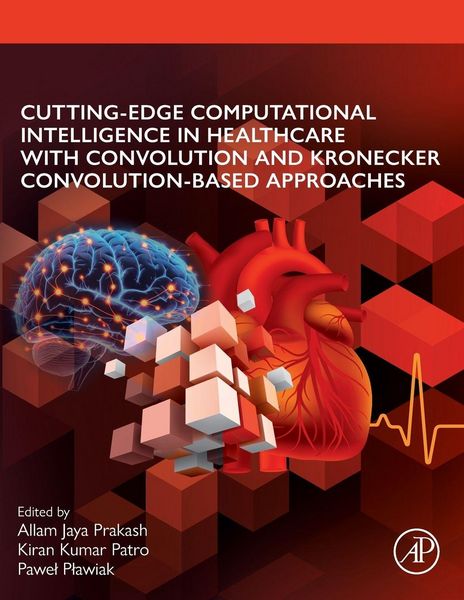
Produktbild: Cutting-edge Computational Intelligence in Healthcare with Convolution and Kronecker Convolution-based Approaches
- 13%

Cutting-edge Computational Intelligence in Healthcare with Convolution and Kronecker Convolution-based Approaches

13% sparen

139,99 € UVP 162,50 €

inkl. gesetzl. MwSt., Versandkostenfrei


Beschreibung

Produktdetails

Einband

Taschenbuch

Erscheinungsdatum

27.01.2026

Herausgeber

Allam Jaya Prakash + weitere

Verlag

Elsevier Science & Technology

Seitenzahl

320

Maße (L/B/H)

27,6/21,6/1,6 cm

Gewicht

450 g

Sprache

Englisch

ISBN

978-0-443-33082-7

Beschreibung

Portrait

Allam Jaya Prakash received the B.Tech. degree in Electronics and Communication Engineering from JNTU Kakinada, India, in 2009, the M.Tech. degree in Digital Electronics and Communication Systems from GMRIT, JNTU Kakinada, India, in 2012, and a PhD degree in Electronics and Communication Engineering from the National Institute of Technology, Rourkela, India, in 2024. He is currently a Postdoctoral Fellow in the Department of Electrical and Communication Engineering at United Arab Emirates University, Al Ain, UAE, and also serves as a Senior Assistant Professor (Grade I) in the School of Computer Science and Engineering at VIT Vellore, India. He has authored more than 30 journal and conference papers in reputable venues, including the IEEE Transactions on Artificial Intelligence, the IEEE Journal of Biomedical and Health Informatics, and Engineering Applications of Artificial Intelligence. His research interests include biomedical signal processing, deep learning, machine learning, edge AI, and remote sensing. He has also served as Guest Editor for a special issue of the IEEE Journal of Biomedical and Health Informatics. He is a regular reviewer for several international journals, including IEEE JBHI, IEEE TIM, IEEE Sensors Journal, IEEE Access, and Biomedical Signal Processing and Control. He was listed among Stanford's Top 2% Scientists in 2024.

Kiran Kumar Patro holds ME and PhD degrees from the Department of Electronics and Communication Engineering, Andhra University, Visakhapatnam, India. He first worked as a UGC junior research fellow (Govt. of India) for 2 years and then as a senior research fellow for 3 years at Andhra University. His research interests include biomedical signal processing, image processing, pattern recognition and machine learning. He currently works as an Assistant professor in the Department of Electronics and Communication Engineering, Aditya Institute of Technology and Management. He has published more than 24 papers in refereed international journals. He is an active peer reviewer for reputed journals of IEEE, Elsevier, Springer, Wiley, etc.
Pawel Plawiak was born in Ostrowiec, Poland, in 1984. He holds B.Eng. and M.Sc. degrees in Electronics and Telecommunications in 2012, a Ph.D. (with honors) in Biocybernetics and Biomedical Engineering in 2016 from the AGH University of Science and Technology, Krakow, Poland, and a D.Sc. degree in Technical Computer Science and Telecommunications in 2020 from the Silesian University of Technology, Gliwice, Poland. He is the Dean of the Faculty of Computer Science and Mathematics and an Associate Professor at the Cracow University of Technology, Krakow, Poland. He has also served as an Associate Professor at the Institute of Theoretical and Applied Informatics, Polish Academy of Sciences, Gliwice, Poland, and as the Deputy Director for Scientific Affairs at the National Institute of Telecommunications, Warsaw, Poland. He has published more than 100 papers in refereed international SCI-IF journals. His research interests include machine learning and computational intelligence (e.g., artificial neural networks, genetic algorithms, fuzzy systems, support vector machines, k-nearest neighbours, and hybrid systems), ensemble learning, deep learning, evolutionary computation, classification, pattern recognition, signal processing and analysis, data analysis and data mining, sensor technologies, medicine, biocybernetics, biomedical engineering, and telecommunications.

Produktdetails

Einband

Taschenbuch

Erscheinungsdatum

27.01.2026

Herausgeber

Verlag

Elsevier Science & Technology

Seitenzahl

320

Maße (L/B/H)

27,6/21,6/1,6 cm

Gewicht

450 g

Sprache

Englisch

ISBN

978-0-443-33082-7

EU-Ansprechpartner

Zeitfracht Medien GmbH
Ferdinand-Jühlke-Straße 7
99095 Erfurt
DE
produktsicherheit@zeitfracht.de

Herstelleradresse

Elsevier Science & Technology
London Wall 125
EC2Y 5AS London
GB
tradeorders@elsevier.com

Noch keine Bewertungen vorhanden

Verfassen Sie die erste Bewertung zu diesem Artikel

Helfen Sie anderen Kundinnen und Kunden durch Ihre Meinung.

Kundinnen und Kunden meinen

Bewertungen (0)

  • Produktbild: Cutting-edge Computational Intelligence in Healthcare with Convolution and Kronecker Convolution-based Approaches
  • Section 1: Foundational concepts

    1 Introduction to deep learning in medical imaging

    2 Fundamentals of convolutional neural networks

    Section 2: Advanced techniques in deep learning with kronecker convolutions

    3 Kronecker convolutions ensemble vision transformer and 3D kronecker U-net for volumetric segmentation of kidney stones, cysts and tumor from CT scans

    4 Image processing techniques in healthcare for early detection of heart diseases

    Section 3: Applications in medical imaging

    5 Automated atypical teratoid /rhabdoid tumor detection in magnetic resonance imaging using deep learning

    6 Ischemic stroke lesion segmentation using multiscale processing and knowledge distillation through intra-domain teacher

    7 Disease classification through advanced neural networks

    Section 4: Real-world implementation

    8 GAT-Net: ghost attention network for classification of gait-based neurodegenerative diseases

    9 Artificial intelligence-enhanced diagnostics: deep learning in medical imaging

    10 Precision medicine through imaging analytics: Kronecker convolutions in tumor detection

    11 Diagnosis of schizophrenia using convolutional neural networks based on multichannel electroencephalography signal

    12 Detection of anomalies in physiological signals using artificial neural network

    13 Advancements in electrocardiography-based detection of obstructive sleep apnea: a deep learning approach

    14 Machine learning-based life expectancy post chest surgery

    Section 5: Future directions and conclusion

    15 Challenges and future directions in medical image analysis