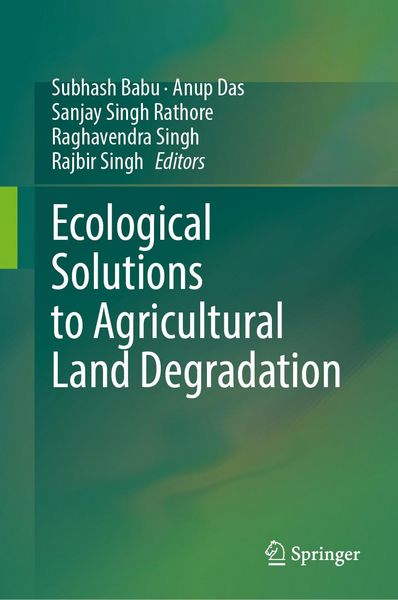
Ecological Solutions to Agricultural Land Degradation
-
- Hardcover
- Taschenbuch
- eBook ausgewählt
-
Form:Einzelkauf Download
-
Sprache:Englisch
240,90 €
inkl. gesetzl. MwSt.Beschreibung
Produktdetails
Format
Kopierschutz
Nein
Family Sharing
Nein
Text-to-Speech
Nein
Erscheinungsdatum
20.05.2025
Herausgeber
Subhash Babu + weitereVerlag
Springer Nature SingaporeSeitenzahl
429 (Printausgabe)
Dateigröße
26179 KB
Sprache
Englisch
EAN
9789819633920
This book provides an overview of the current status of land degradation globally and the different approaches used for its restoration. In addition to the technical aspects, it also delves into the social and economic implications of land restoration, such as in terms of policy planning. Land degradation is a serious threat to agriculture, affecting soil function and productivity. There are up to 6 billion hectares of degraded soil worldwide. It is estimated that 30% of forests, 20% of agricultural land and 10% of rangelands are severely affected by land degradation. The main causes of land degradation are soil erosion, acidification, compaction and salinization, intensive agriculture, overgrazing, poor management of arable land and deforestation. The consequences of such degradation include sand dune expansion and displacement, reduced rainfall, rangeland depletion, wind and rain erosion, and loss of biomass and biological integrity.
In 2015, the global goal of achieving land degradation neutrality (LDN) was included in the 2030 Agenda for Sustainable Development as sustainable development goal 15.3. Developing productive soil ecosystems by restoring degraded soils is therefore a future perspective for food security and environmental sustainability. This can be achieved through crop rotation, agroforestry, conservation agriculture, cover crops, terrace farming, ditching, geo-jute, and contour farming and zero tillage. Ecological restoration of farmlands offers an opportunity to reconcile agricultural production with improving ecosystem services. Restoring degraded land through environmentally friendly agroecological approaches has the potential to improve agricultural production and provide healthy ecosystems for organisms.
This book is an important resource for students, academics, researchers, national and international agricultural scientists, and soil experts.
Noch keine Bewertungen vorhanden
Verfassen Sie die erste Bewertung zu diesem Artikel
Helfen Sie anderen Kundinnen und Kunden durch Ihre Meinung.
Kurze Frage zu unserer Seite
Vielen Dank für Ihr Feedback
Wir nutzen Ihr Feedback, um unsere Produktseiten zu verbessern. Bitte haben Sie Verständnis, dass wir Ihnen keine Rückmeldung geben können. Falls Sie Kontakt mit uns aufnehmen möchten, können Sie sich aber gerne an unseren Kund*innenservice wenden.
zum Kundenservice