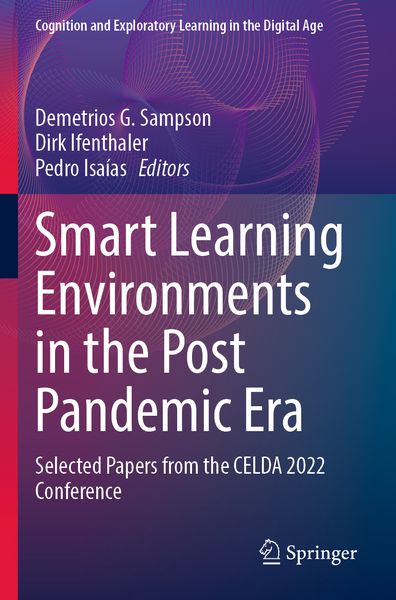
Produktbild: Smart Learning Environments in the Post Pandemic Era
- 10%

Smart Learning Environments in the Post Pandemic Era Selected Papers from the CELDA 2022 Conference

10% sparen

157,99 € UVP 175,99 €

inkl. gesetzl. MwSt., Versandkostenfrei


Beschreibung

Produktdetails

Einband

Taschenbuch

Erscheinungsdatum

26.03.2025

Herausgeber

Demetrios G. Sampson + weitere

Verlag

Springer

Seitenzahl

270

Maße (L/B/H)

23,5/15,5/1,6 cm

Gewicht

435 g

Sprache

Englisch

ISBN

978-3-031-54209-1

Beschreibung

Portrait

Demetrios Sampson is a Professor of Digital Systems for Learning and Education, Director of the MSc Program on Digital Learning, and Director of the Research Laboratory DiLearn at the Department of Digital Systems, University of Piraeus, Greece. He has been engaged in teaching and research in the field of educational technologies and digital learning since 1996.

Dirk Ifenthaler is a Professor of Learning, Design and Technology at the University of Mannheim, Germany and UNESCO Deputy Chair on Data Science in Higher Education Learning and Teaching at Curtin University, Australia. Dirk’s research focuses on the intersection of cognitive psychology, educational technology, data analytics, and organisational learning.

Pedro Isaías is an Associate Professor at Universidade Aberta (Portuguese Open University) in Lisbon, Portugal. Pedro is also an Adjunct Associate Professor at the School of Information Systems & Technology Management of The University of NewSouth Wales (UNSW – Sydney), Australia. He is co-founder and president of IADIS – International Association for Development of the Information Society.

Produktdetails

Einband

Taschenbuch

Erscheinungsdatum

26.03.2025

Herausgeber

Verlag

Springer

Seitenzahl

270

Maße (L/B/H)

23,5/15,5/1,6 cm

Gewicht

435 g

Sprache

Englisch

ISBN

978-3-031-54209-1

Herstelleradresse

Springer-Verlag GmbH
Tiergartenstr. 17
69121 Heidelberg
DE

Email: GPSR Kontakt

Kundinnen und Kunden meinen

0 Bewertungen

Informationen zu Bewertungen

Zur Abgabe einer Bewertung ist eine Anmeldung im Konto notwendig. Die Authentizität der Bewertungen wird von uns nicht überprüft. Wir behalten uns vor, Bewertungstexte, die unseren Richtlinien widersprechen, entsprechend zu kürzen oder zu löschen.

Die Bewertungen sind nach Format, Anzahl Sterne und Datum sortiert.

Verfassen Sie die erste Bewertung zu diesem Artikel

Helfen Sie anderen Kund*innen durch Ihre Meinung

Kundinnen und Kunden meinen

0 Bewertungen filtern

Weitere Artikel finden Sie in

  • Produktbild: Smart Learning Environments in the Post Pandemic Era
  • Part I – Smart Pedagogies in the Post-Pandemic Era: Chapter 1 – Learning Analytics in Supporting Teaching and Learning – Pedagogical Perspectives (Laura Hirsto, Sanna Väisänen, Erkko Tapio Sointu & Teemu Valtonen).- Chapter 2 – Learning Analytics Based Interventions: a Systematic Re-view of Experimental Studies (Mustafa Tepgeç, Dirk Ifenthal-er).- Chapter 3 – Experiencing Flow in Virtual Reality: an Investigation of Complex Interaction Structures of Learning-related Variables (Miriam Mulders).- Chapter 4 – Determining Learners’ Behavioral Patterns in a Technolo-gy and Analytics Enhanced Assessment Environment (Muhittin Şahin, Dirk Ifenthaler).- Chapter 5 – Clustering Techniques to Investigate Engagement and Performance in Online Mathematics Courses (Francesco Floris, Marina Marchisio, Fabio Roman, Matteo Sacchet, Sergio Rabellino).- Part II: Smart Learning Technologies in the Post-Pandemic Era: Chapter 6 – Automatic Speech Recognition System to Enhance the Use of Vocalization Strategy (Saki Hirata Masanori Yamada).- Chapter 7 – An Educational Unified Modelling Language Program-ming Environment and its two Case Studies (Maruyama, Shinpei Ogata, Mizue Kayama, Nobuyuki Tachi, Takashi Na-gai, Naomi Taguchi).- Chapter 8 – Physical Computing Systems: a Systematic Approach (Er-ic Schätz and Alke Martens).- Chapter 9 – a Digital Educational Game for Practicing OER (Lubna Ali, Quang Phung, Rene Roepke, Ulrik Schroeder).- Part III – Case Studies of Smart Learning Environments: Chapter 10 – Student Acceptance of Social Robots in Higher Education: Evidence from a Vignette Study (Josef Guggemos, Stefan Sonderegger and Sabine Seufert).- Chapter 11 – Evaluating Different Assessment Types in an Online Geoscience Course (Emre Dinç, April L. Millet).- Chapter 12 – Students Use of Learning Aids: Lessons from LearningAnalytics (Dirk Tempelaar).- Chapter 13 – Didactic Activities of Artificial Intelligence: the Perspec-tive of STEM Teachers (Cecilia Fissore, Francesco Floris, Ma-rina Marchisio and Matteo Sacchet).- Part IV – Looking To The Future: Chapter 14 – Is it time to consider Biomimetics for sustainable educa-tion? Lessons from the nature for “smarter” learning environ-ments (Boulus Shehata, Ahmed Tlili, Demetrios Sampson, Ronghuai Huang).