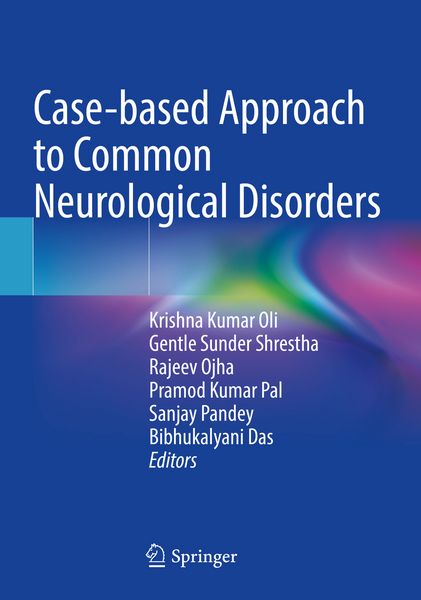
Produktbild: Case-based Approach to Common Neurological Disorders
- 11%

Case-based Approach to Common Neurological Disorders

11% sparen

77,99 € UVP 87,99 €

inkl. gesetzl. MwSt., Versandkostenfrei


Beschreibung

Produktdetails

Einband

Taschenbuch

Erscheinungsdatum

15.03.2025

Abbildungen

IX, 334 p.

Herausgeber

Krishna Kumar Oli + weitere

Verlag

Springer Singapore

Seitenzahl

334

Maße (L/B/H)

25,4/17,8/1,8 cm

Gewicht

726 g

Auflage

1. Auflage

Sprache

Englisch

ISBN

978-981-9986-78-1

Beschreibung

Portrait


Prof. Krishna Kumar Oli is the head of Department of Neurology at Tribhuvan University Teaching Hospital, one of the leading tertiary level teaching hospital of Nepal. The department is running the post MD, DM course in Neurology for a couple of years and has been leading in academics and training the doctors in the field of neurosciences. Prof Oli is the current president of Nepalese Academy of Neurology.


Dr. Gentle Sunder Shrestha is a leading neurointensivist and neuroanesthesiologists at Department of Anaesthesiology at Tribhuvan University Teaching Hospital, Kathmandu, Nepal. He has lead neurosciences educational endeavors in Nepal and abroad. He has over 75 peer-reviewed publications in national and international journals and is leading book projects on “A manual of neuroanesthesia and Neurocritical care” “Practical approach to point-of-care ultrasound”. He has attended multiple international neuroscience meetings as invited guest speaker and faculty. He was awarded the “Educational day medal” by the ministry of education on the occasion of National Education Day on 2010 for his appreciable work in the education sector.


Dr. Rajeev Ojha is a dynamic young neurologist at Department of Neurology at Tribhuvan University Teaching Hospital, Kathmandu, Nepal. He is one of the few certified neurologists in Nepal with DM in Neurology. He has a strong interest in education, training, and publications.


Prof. Dr. Pramod Kumar Pal is the head of Department of Neurology at NIMHANS (National Institute of Mental Health and Neuro Sciences), Bangalore, India. He has multiple publications and has special interest and expertise in movement disorders.


Prof. Sanjay Pandey is the head of the Department of Neurology and Stroke Medicine at Amrit Institute of Medical Sciences, Faridabad India, one of the leading tertiary-level teaching hospitals of India. The department is running many teaching and fellowship courses. Dr. Pandey is currently an executive committee member of the MDS-AOS section of the International Parkinson and Movement Disorders Society.


Prof. Dr. Bibhukalyani Das is the educational director and director of Neuroanaesthesia, Neurocritical Care and Pain Clinic at Institute of Neurosciences, Kolkata, India. She has multiple publications. She is the past president of Indian Society of Neuroanaesthesiology and Critical Care (ISNACC).

Produktdetails

Einband

Taschenbuch

Erscheinungsdatum

15.03.2025

Abbildungen

IX, 334 p.

Herausgeber

Verlag

Springer Singapore

Seitenzahl

334

Maße (L/B/H)

25,4/17,8/1,8 cm

Gewicht

726 g

Auflage

1. Auflage

Sprache

Englisch

ISBN

978-981-9986-78-1

Herstelleradresse

Springer-Verlag GmbH
Tiergartenstr. 17
69121 Heidelberg
DE

Email: GPSR Kontakt

Noch keine Bewertungen vorhanden

Verfassen Sie die erste Bewertung zu diesem Artikel

Helfen Sie anderen Kundinnen und Kunden durch Ihre Meinung.

Kundinnen und Kunden meinen

Bewertungen (0)

  • Produktbild: Case-based Approach to Common Neurological Disorders
  • Case-Based Approach to Japanese Encephalitis.- Case-Based Approach to Herpes Encephalitis.- Case-Based Approach to Bacterial Meningitis.- Case-Based Approach to Cryptococcal Meningitis.- Case-Based Approach to Neurocysticercosis.- Case-Based Approach to Parkinson Disease.- Case-Based Approach to Acute Ischemic Stroke.- Case-Based Approach to Subarachnoid Hemorrhage.- Case-Based Approach to Intracerebral Hemorrhage.- Case-Based Approach to Alzheimer’s Disease.- Case-Based Approach to Cerebral Venous Thrombosis.- Case-Based Approach to Mesial Temporal lobe epilepsy.- Case-Based Approach to Intracranial Hypertension.- Case-Based Approach to Hypoxic Ischemic Encephalopathy.- Case-Based Approach to Myasthenia Gravis.- Case-Based Approach to Freidrich’s Ataxia.- Case-Based Approach to Optic Neuritis.- Case-Based Approach to Thyroid Myopathy.-Case-Based Approach to Multiple Sclerosis.- Case-Based Approach toAmyotrophic Lateral Sclerosis.- Case-Based Approach to Trigeminal Neuralgia.-Case-Based Approach to Myotonic Dystrophy.-Case-Based Approach to  Migraine.- Case-Based Approach to Guillain Barre Syndrome.- Case-Based Approach to Polymyositis.- Case-Based Approach to Wilson's Disease.- Case-Based Approach to Metabolic  Syndromes in Neurology.- Case-Based Approach to Traumatic Brain Injury.- Case-Based Approach to Traumatic Spine Injury.- Case-Based Approach to Tetanus.- Case-Based Approach to Absence Epilepsy.- Case-Based Approach to Progressive Supranuclear Palsy.- Case-Based Approach to Multiple System Atrophy.- Case-Based Approach to Lower Body Parkinsonism.- Case-Based Approach to Childhood Dystonias.- Case-Based Approach to Neurodegeneration with Brain Iron Accumulation.- Case-Based Approach to Autoimmune Encephalitis.- Case-Based Approach to Frontotemporal Dementias.-Case-Based Approach to  Persistent Vegetative Stage and Coma.- Case-Based Approach to Subacute Sclerosing Panencephalitis.- Case-Based Approach to Tubercular Meningitis.- Case-Based Approach to Brain Abscess.- Case-Based Approach to Status Epilepticus.