Gutscheinbedingungen

**Gültig von 22.06.2026 ab 19 Uhr bis 23.06.2026 24 Uhr auf Spielzeug, Schreibwaren, Filme, Geschenke & Trends, Musik, tolino eReader & Zubehör, Hörbücher und Hörbuch-Downloads (außer Abo), nicht preisgebundene Bücher und Kalender online auf thalia.at und in der Thalia App. Einzelne Artikel können ausgeschlossen sein. Aufgrund der Buchpreisbindung sind deutschsprachige Bücher und eBooks ausgenommen. Zusätzlich ausgenommen sind preisgebundene Artikel, Abos & Flatrates, eBooks, Games, Geschenkkarten/-boxen, Shelfies, Software, Zeitschriften sowie einzelne Artikel von tonies®. Pro Einkauf einmal einlösbar. Click & Collect nur bei Onlinevorabzahlung möglich. Keine Barauszahlung. Nicht kombinierbar mit anderen Aktionen und Gutscheinen. Gutschein wird auf max. 500€ Bestellwert angerechnet. Nicht gültig für Versandkosten und Services.

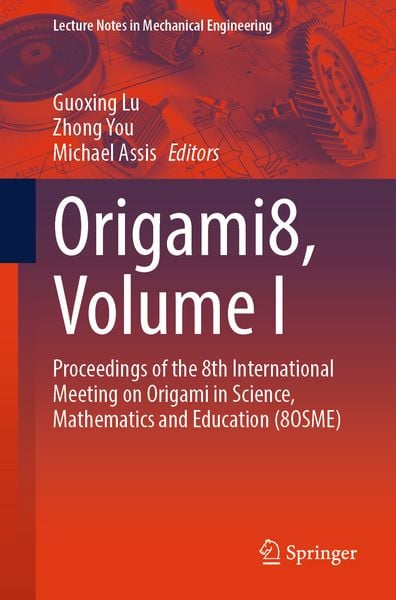
Produktbild: Origami8, Volume I

Origami8, Volume I Proceedings of the 8th International Meeting on Origami in Science, Mathematics and Education (8OSME)

377,99 €

inkl. gesetzl. MwSt., Versandkostenfrei


Beschreibung

Produktdetails

Einband

Taschenbuch

Erscheinungsdatum

03.01.2026

Abbildungen

XI, 304 illus., 238 illus. in color., farbige Illustrationen, schwarz-weiss Illustrationen

Herausgeber

Guoxing Lu + weitere

Verlag

Springer Singapore

Seitenzahl

431

Maße (L/B/H)

23,5/15,5/2,3 cm

Gewicht

749 g

Auflage

1. Auflage

Sprache

Englisch

ISBN

978-981-9686-63-6

Beschreibung

Portrait

Michael Assis is a mathematical physicist and origami artist. He received his PhD from Stony Brook University in the area of statistical mechanics, with applications in combinatorics and computational mathematics. He has exhibited his original origami models in conferences in several countries, and actively contributes to research in origami mathematics. He is currently based at the University of Melbourne, working in medical research in the area of paediatric oncofertility.

Guoxing Lu is a Qiushi Chair Professor in the Department of Engineering Mechanics, Zhejiang University, China. Prior to that, he was a University Distinguished Professor and Founding Director of the Impact Engineering Laboratory, Swinburne University of Technology, Australia. He held academic positions at Nanyang Technological University, Singapore. In 1989, he obtained his PhD in Structural Mechanics from the University of Cambridge. 

Zhong You is a professor of Engineering Science at the University of Oxford. His research encompasses the fields of folding and origami structures, with a particular focus on the development of a systematic approach to the creation of large deployable assemblies. He served as the chairperson for 7OSME, which was held in Oxford in 2018. He obtained his PhD in structural engineering from the University of Cambridge.

Produktdetails

Einband

Taschenbuch

Erscheinungsdatum

03.01.2026

Abbildungen

XI, 304 illus., 238 illus. in color., farbige Illustrationen, schwarz-weiss Illustrationen

Herausgeber

Verlag

Springer Singapore

Seitenzahl

431

Maße (L/B/H)

23,5/15,5/2,3 cm

Gewicht

749 g

Auflage

1. Auflage

Sprache

Englisch

ISBN

978-981-9686-63-6

Herstelleradresse

Springer-Verlag GmbH
Tiergartenstr. 17
69121 Heidelberg
DE

Email: ProductSafety@springernature.com

Kundinnen und Kunden meinen

0 Bewertungen

Informationen zu Bewertungen

Zur Abgabe einer Bewertung ist eine Anmeldung im Konto notwendig. Die Authentizität der Bewertungen wird von uns nicht überprüft. Wir behalten uns vor, Bewertungstexte, die unseren Richtlinien widersprechen, entsprechend zu kürzen oder zu löschen.

Die Bewertungen sind nach Format, Anzahl Sterne und Datum sortiert.

Verfassen Sie die erste Bewertung zu diesem Artikel

Helfen Sie anderen Kund*innen durch Ihre Meinung

Kundinnen und Kunden meinen

0 Bewertungen filtern

  • Produktbild: Origami8, Volume I
  • Chapter 1 :Adding more bite to the origami chomper.- Chapter 2:Quaternion-Based Loop Closure Method for Precise Kinematic Simulation of Rigid Origami.-Chapter 3 :Shape Optimization of Rigid Origami for Approximate Self-foldability under Gravity.- Chapter 4 :When will the existence of a non-trivial state guarantee a continuous motion for a quad-mesh rigid origami?.- Chapter 5 :Nonlinear Kinematics of Recursive Origami Inspired by Spidron.- Chapter 6 :Programmable multistability and rigid flattenability in origami cubes by adding a minimal cut.- Chapter 7 :Isometries of trapezoid-based origami.- Chapter 8 :Higher-order infinitesimal mechanism of rigid origami and polynomial approximation of its folding path.-Chapter 9 :Modular Origami Approach for Rigid Foldable Steel Load-Bearing Plate Lattices in Arbitrary Sizes.- Chapter 10 :Woven Rigidly Foldable T-hedral Tubes Along Translational Surfaces.- Chapter 11:Amplifying the kinematics of origami mechanisms with spring joints.- Chapter 12 :Rigid-Foldable Hexagon-Twist Origami Patterns.- Chapter 13 :Framework for the fabrication of flat foldable, thick origami structures via non-rigid origami methods..- Chapter 14 :Not So Thick Origami.- Chapter 15 :Regular and Semi-Regular Tessellations of Origami Flashers.-Chapter 16 :Constant-Thickness Accommodation by Pattern Modification for Origami Flashers.- Chapter 17 :Cyclic Testing of Membrane Hinges for use in Origami-inspired Engineering Design.- Chapter 18 :A lightweight building construction system using curved-crease origami blocks.- Chapter 19 :Designing Curved Folded Structures through Topology Optimisation.-Chapter 20 :Actuating tubes in multilayer curved folding.- Chapter 21 :Slit folding – openings to close along curved foldlines.- Chapter 22 :Rigid-ruling Curved Folding Origami Implemented with Straight Inflated Air Pouches.- Chapter 23 :Kirigami-inspired rectangular iso-area twist tessellations in architecture.- Chapter 24 :Growing kirigami with self-healing and reprogrammable mechanical properties.-Chapter 25:Fabrication of DCRA using Kiri-origami Structure.- Chapter 26:Auxetic Kirigami Pattern inspired by Indusium in a Dictyophora Indusiate.- Chapter 27:A kirigami-inspired folding configuration for Muira thick panel.- Chapter 28:Rotational Erection System (RES) variations: fractals, tessellation, and interlinkage.- Chapter 29 :Folding Condition of Kirigami and Rigid-foldable Kiri-origami Structure with Periodic Incision on Concentric Circles.- Chapter 30 :Design of morphing and multifunctional shape profiles through cutting tessellations.