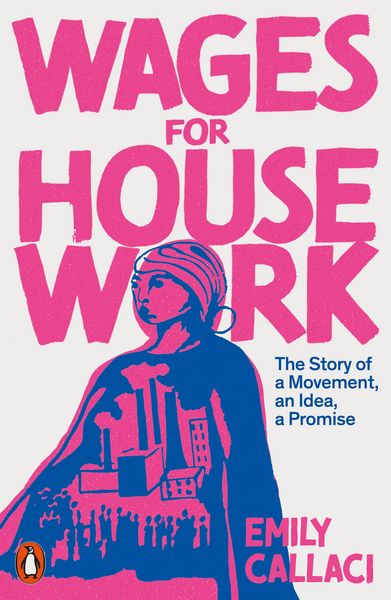
Wages for Housework The Story of a Movement, an Idea, a Promise
-
- Hardcover
- Taschenbuch ausgewählt
- eBook
-
Sprache:Englisch
12,99 €
inkl. gesetzl. MwSt.,
- Kostenlose Lieferung ab 30 € Einkaufswert
- Versandkostenfrei für Bonuscard-Kund*innen
Beschreibung
Produktdetails
Einband
Taschenbuch
Erscheinungsdatum
05.03.2026
Verlag
Penguin Books LtdSeitenzahl
288
Maße (L/B/H)
19,6/12,9/1,9 cm
Gewicht
220 g
Farbe
Aubergine / Lichtgrau
Sprache
Englisch
ISBN
978-0-14-199574-8
'The women of the world are serving notice. We want wages for every dirty toilet, every indecent assault, every painful childbirth, every cup of coffee and every smile. And if we don't get what we want, we will simply refuse to work any longer!'
Across the globe in the 1970s, a network of feminists distilled their struggles into a single demand: Wages for Housework! Today, it remains a provocative idea, and an unfulfilled promise.
Here historian Emily Callaci tells the story of this campaign by exploring the lives and ideas of its key creators, tracing their wildly creative political vision over the past five decades: from the early 1970s, when Selma James, a working-class political organizer, and Mariarosa Dalla Costa, a scholar-activist, started laying the foundations of Wages for Housework in London and Italy; through philosopher Silvia Federici reframing the campaign in the context of New York City's fiscal crisis; to Wilmette Brown, lesbian poet and anti-war activist, and Margaret Prescod, community organizer, who brought the insights of Black feminism to the movement.
Drawing on new archival research and extensive interviews, Callaci takes us deep inside the heart of the movement as it reached across Europe, America, Africa and the Caribbean. For these women, the wage was more than a demand for money: it was a starting point for remaking the world as we know it, imagining potential futures under capitalism - and beyond. Then as now, Wages for Housework poses profound questions. What would it be like to live in a society that prioritizes care rather than production? How would this change our relationship with the natural world? And what would women do with their lives if they had more time?
Noch keine Bewertungen vorhanden
Verfassen Sie die erste Bewertung zu diesem Artikel
Helfen Sie anderen Kundinnen und Kunden durch Ihre Meinung.
Kurze Frage zu unserer Seite
Vielen Dank für Ihr Feedback
Wir nutzen Ihr Feedback, um unsere Produktseiten zu verbessern. Bitte haben Sie Verständnis, dass wir Ihnen keine Rückmeldung geben können. Falls Sie Kontakt mit uns aufnehmen möchten, können Sie sich aber gerne an unseren Kund*innenservice wenden.
zum Kundenservice